


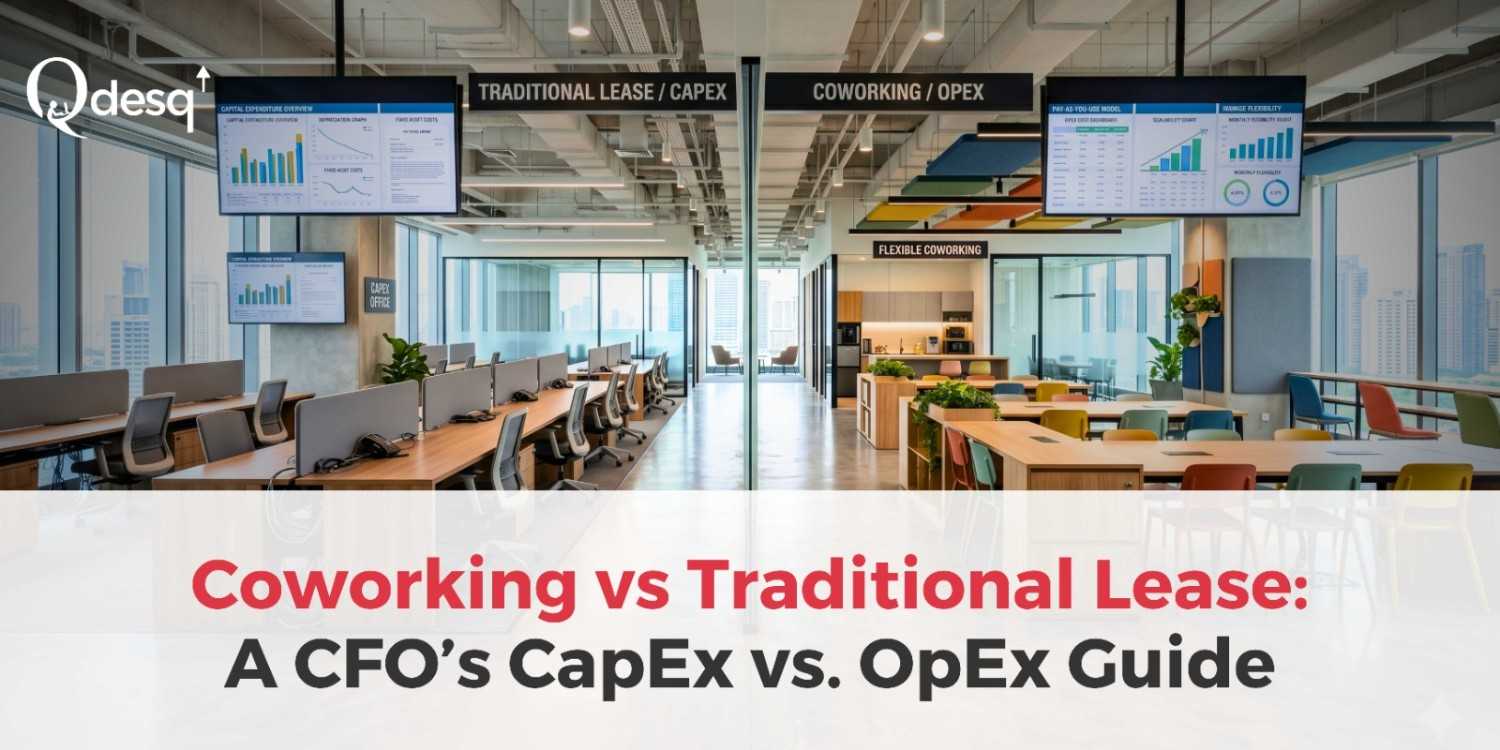
There was a time, not too long ago, when signing a 10-year traditional office lease was considered a badge of corporate stability. But walk into any boardroom today, and the conversation has shifted. The CFO is no longer just looking at the prestige of a physical address; they are looking at the velocity of capital.
If you’re weighing the merits of a traditional lease against a coworking setup, you aren’t just choosing between cubicles and hot desks. You are making a fundamental decision about your balance sheet. It’s a classic battle between CapEx and OpEx.
Let’s strip away the marketing fluff and look at the hard numbers and strategic realities that often go unmentioned in the standard “office vs. coworking” debate.
The CapEx Heavyweight: The Traditional Lease
When you sign a traditional lease, you are essentially entering the construction and hospitality business, whether you want to or not.
1. The “Iceberg” Costs of Fit-outs
Most decision-makers focus on the monthly rent per square foot. However, from a CFO’s perspective, that is only the visible portion of the total cost. The more significant financial burden lies in the upfront CapEx.
Designing the workspace, undertaking demolition, modifying HVAC systems, installing electrical and data wiring, and investing in quality furniture require substantial capital, often incurred well before operations even begin.
2. The Rigidity Tax
Traditional leases are inherently inflexible. If your company grows by 30% within two years, you quickly run out of space. If you downsize, you continue paying for “ghost overhead”, unused desks and underutilised areas that still incur costs for heating, lighting, and maintenance. This inefficiency quietly erodes overall ROI.
3. Depreciation and Maintenance
Own the fit-out, own the headache. When the AC breaks or the carpet frays, it’s on your ledger. You also have to manage the long-term depreciation of those assets, adding layers of complexity to your tax planning.
The OpEx Advantage: Coworking and Managed Spaces
Coworking flips the script by moving almost everything into a predictable, monthly OpEx line item. You are no longer paying for space; you are paying for a service.
1. Zero Upfront Friction
The most immediate benefit is the preservation of capital. Instead of sinking 5 or 6 figures into a security deposit and interior design, that capital remains liquid. It can be diverted into R&D, talent acquisition, or market expansion, areas that actually drive revenue, unlike a reception desk.
2. All-Inclusive Predictability
In a traditional setup, your monthly costs fluctuate. One month, it’s a plumbing emergency; the next, it’s a hike in electricity rates. Coworking space provides a single invoice. Internet, utilities, cleaning, security, and even the coffee are bundled. This makes budgeting incredibly precise.
3. Scaling at the Speed of Business
The Option Value: In a coworking environment, you can add five desks or a private suite next month. That agility has a financial value that is hard to quantify on a standard P&L but is invaluable during volatile market cycles.
Beyond the Numbers: The “Hidden” CFO Perspectives
1. The IFRS 16 / ASC 842 Impact
Since the implementation of new lease accounting standards, almost all leases, traditional or otherwise, must be recognised on the balance sheet as a “Right-of-Use” (ROU) asset and a corresponding lease liability. This can impact your debt-to-equity ratios.
However, many short-term coworking agreements (typically under 12 months) can still qualify for an exemption, allowing them to remain off the balance sheet. For a company looking to keep its debt profile lean ahead of an IPO or funding round, this distinction is significant.
2. Talent Retention as a Financial Metric
We often categorise “office culture” as an HR concern. But turnover is a massive financial drain. A traditional office that feels “stagnant” or is poorly maintained can contribute to attrition. Coworking spaces often provide amenities (gyms, networking events, modern lounges) that would be prohibitively expensive for a single company to build and maintain on its own. You are effectively “subsidising” a premium employee experience through the provider’s scale.
Comparison at a Glance: The Financial Breakdown
| Feature | Traditional Lease (CapEx Focus) | Coworking/Flexible (OpEx Focus) |
| Upfront Cost | High (Security deposit + Fit-out) | Low (Typically 1-2 months deposit) |
| Balance Sheet | Asset/Liability (IFRS 16/ASC 842) | Usually treated as a Service Expense |
| Maintenance | Direct responsibility & cost | Handled by provider (included) |
| Flexibility | Low (3–10 year commitments) | High (Month-to-month or yearly) |
| Ancillary Costs | Hidden (IT, cleaning, reception) | Transparent (All-in-one fee) |
The Strategic Middle Ground: The Hybrid Model
It doesn’t have to be all or nothing. We are seeing a surge in CFOs adopting a “Core and Spoke” strategy.
- The Core: A smaller traditional lease for the headquarters (stable CapEx).
- The Spoke: Flexible coworking memberships for satellite teams or remote workers (variable OpEx).
This limits your long-term liability while ensuring your team has the space they need to be productive.
Final Words
In 2026, the role of the CFO has shifted from merely managing costs to curating corporate agility. Choosing between a traditional lease and a coworking model is about deciding where your capital works hardest. While a traditional setup offers a sense of permanence, it often carries a “rigidity tax” and heavy upfront CapEx that can trap a growing firm. On the other hand, an OpEx-driven model preserves your liquidity and provides the “option value” needed to pivot when the market moves.
Finding that sweet spot between financial discipline and a great employee experience is where the real value lies. Qdesq helps you navigate this transition by opening doors to India’s top coworking spaces that align with a leaner, asset-light approach. Whether you are experimenting with a “Core and Spoke” model or supporting a distributed team, we provide the clarity and verified options to help you choose with confidence.
The right workspace should feel like a strategic advantage, not a fixed burden. Explore your options with Qdesq and find a space where your financial goals and your team’s productivity finally work in perfect sync.



