


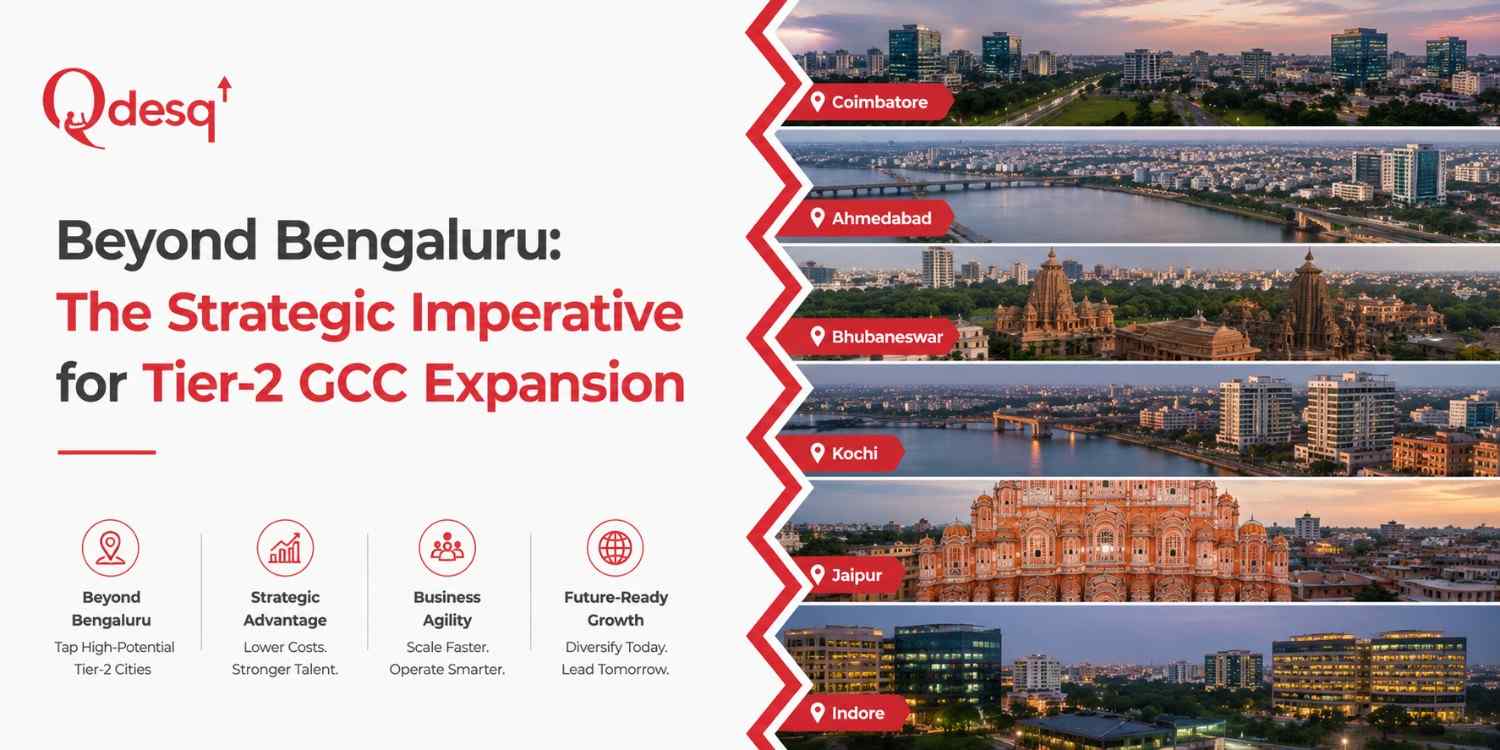
India currently hosts approximately 1,800 Global Capability Centres (GCCs), generating $65 billion in annual revenue [Inductus GCC]. By 2030, this is projected to scale to 2,400 GCCs, contributing over $100 billion. Yet, beneath these staggering figures lies a fundamental contradiction: the very cities that built this success, Bengaluru, Hyderabad, and Pune, are now becoming their own greatest bottlenecks.
As of early 2026, tech metros are grappling with acute capacity overload, soaring real estate costs, and an intensifying war for talent, which is driving voluntary attrition rates in tech roles to 20–25% [CXOdigitalpulse].
For CXOs and GCC leaders, the “Zone 1” dominance is no longer a sustainable growth engine. The paradox is clear: to remain global leaders in innovation, firms must decentralise. The shift to Tier-2 is no longer an experiment in cost-saving; it is a defensive and strategic necessity to de-risk operations.
The Tier-2 Pivot: Why Now Is the Operational Inflexion Point
The shift to secondary markets has been discussed for years, but 2026 marks an operational inflexion point. The share of GCCs in Tier-2 cities has grown from 5% in 2019 to 7% in 2025 [Policycircle].
Why now? The answer lies in the “Hub and Spoke” model. Organisations are keeping high-level strategic R&D and core leadership in the established metros while shifting execution, analytics, and shared services to Tier-2 hubs. These locations offer 20–30% lower operating costs and 20–30% lower attrition rates than metros.
This is not merely about arbitrage; it is about accessing stable, long-term talent that views a GCC as a career destination rather than a short-term stepping stone.
The Strategic Six: Deconstructing the Value Propositions
To understand these cities, we must stop viewing them as “cheaper versions of Bengaluru.” Each has a distinct “Product-Market Fit.”
- Coimbatore
- Ahmedabad
- Bhubaneswar
- Kochi
- Jaipur
- Indore
1. Coimbatore: The Engineering & ER&D Powerhouse
Coimbatore is emerging as a major GCC hub for core engineering and product‑focused R&D, backed by strong industrial roots and lower costs than Tier‑1 metros.
- New GCC setups grew at ~21% CAGR over five years, now over 50 centres (Zinnov).
- Around 60% of centres focus on Engineering R&D, especially embedded systems (Zinnov).
- Costs run roughly one‑third of Bengaluru, with a dense STEM‑graduate pool.
2. Ahmedabad (GIFT City): The BFSI & Fintech Sentinel
GIFT City is positioning itself as India’s primary FinTech‑focused GCC hub, combining IFSCA‑backed regulations with tax incentives and connectivity to Mumbai.
- The government targets 150,000 jobs in GIFT City, mostly in FinTech and tech roles (PwC).
- BFSI GCCs in India are projected to grow from ~$40–41B to ~$125B by 2032 (BFSI Economic Times)
- Nearly half of BFSI leaders see GIFT City as “high‑potential” for GCCs (BFSI Economic Times).
3. Bhubaneswar: The “Brain Gain” Analytics Hub
Bhubaneswar is evolving into an analytics and services hub for East India, supported by Odisha’s GCC‑focused policy and improving infrastructure.propnewstime+1
- Odisha GCC Policy 2025 targets ₹1,000 Cr investment and 50,000 jobs (The Hindu)
- Five GCC‑grade hubs planned across Bhubaneswar–Cuttack–Puri and Bargarh‑Jharsuguda corridors (The Hindu)
- The state aims to attract GCCs in IT, analytics, finance, and shared services.
4. Kochi: Niche Stability & Digital Continuity
Kochi is becoming a stable GCC base for cybersecurity and cloud‑heavy workloads, with lower attrition and strong state‑backed digital‑work policies.plugscale+1
- Tier‑2 cities, including Kochi, hold 10–12% of India’s GCC hiring share (Quesscorp)
- India GCC attrition averages ~18–22%; Kochi‑style hubs often run below that (Quatalent AI)
- State‑backed “Work Near Home”‑style models help retain senior technical talent.
5. Jaipur: The North-India Scalability Engine
Jaipur’s Mahindra World City is drawing GCCs and global enterprises as a cost‑efficient North‑India hub near DMIC and NH‑8.
- Major GCC‑style tenants include Deutsche Bank, Genpact, and MetLife.
- Costs run ~25–30% below Gurugram for similar‑quality English‑speaking talent.
- Mahindra World City spans ~3,000 acres with multi‑sector SEZ and DTA zones (Mahindra Life Spaces).
6. Indore: The High‑Output Productivity Zone
Indore is emerging as a central‑India GCC node for operations and product support, capturing talent before migration to Mumbai‑centric hubs.
- India’s GCC hiring grew 12–14% QoQ in Q4 FY26, led by Tier‑2 cities (Economic Times).
- Indore‑style hubs offer 15–20% lower hiring costs vs Tier‑1 metros.
- Central location supports logistics‑heavy and cross‑time‑zone operations.
The Metric Reality: A Side-by-Side Performance Analysis
| Metric | Tier-1 Metros (Avg) | Tier-2 Hubs (Avg) | Strategic Impact |
| Voluntary Attrition | 20–25% | 12–15% | Higher stability, lower hiring costs |
| Hiring Growth | 11% YoY | 21% YoY | Faster capacity building |
| Senior Talent Cost | ₹32 LPA | ₹28 LPA | Closing gap, high purchasing power |
Source: CXOdigitalpulse
What Decision-Makers Are Getting Wrong
A common pitfall is the “City-Hopping” fallacy, treating Tier-2 expansion as a quick fix to lower costs.
- The Infrastructure Oversight: Leaders often expect Tier-2 cities to provide “metro-ready” plug-and-play environments without engaging local ecosystems. Infrastructure is more than just office space; it requires integrated residential and recreational amenities to retain top talent.
- Local Hiring vs. Relocating Leadership: A frequent mistake is assuming you can simply hire local leadership. Successful Tier-2 GCCs relocate a “seed team” of 5–10% of existing senior staff from metros to establish the company culture and operational rigour during the first 18 months.
- The One-Size-Fits-All Approach: Not every city is for every GCC. If your operation requires high-density AI/ML researchers, choose a location with specialised university ties (like Nagpur or Pune-peripheral). If you need scale for BFSI operations, the infrastructure in GIFT City (Ahmedabad) is superior to most.
The Real Estate Paradigm: Designing for Flexibility
Real estate is shifting from a CAPEX-heavy requirement to a flexible OPEX model. In Tier-2 cities, the power dynamic has shifted toward the enterprise. As the “anchor tenant” in a developing commercial corridor, GCCs have unprecedented leverage to negotiate lease terms that include expansion rights and facility management service-level agreements (SLAs).
Instead of traditional long-term leases, GCC leaders should prioritise “agile footprinting.” This involves securing a core office that can scale up or down based on operational requirements.
By designing for “purposeful abundance”, creating hospitality-style environments rather than purely functional offices, firms can differentiate themselves in the local market, making the office a competitive advantage in talent acquisition.
Key GCC Trends to Watch in Tier‑2 India (2026–2030)
- GCCs will grow from ~1,800 today to ~2,400 by 2030, reaching ~$100–110 billion as ~2% of India’s GDP (Yourstory).
- Hiring in Tier‑1 cities will remain dominant, accounting for ~88–90% of GCC roles, while Tier‑2 cities will see their share rise to 10–12% (Business Standard).
- Tier‑2 GCC demand is projected to jump 30–40% over the next few years, driven by lower costs and better talent retention (LinkedIn).
- 40–50% of India’s top‑city Grade‑A office demand in 2026 will be driven by GCCs, reshaping commercial real estate planning (v3staffing).
Final Thoughts
The 2026 GCC landscape proves that scaling operations no longer requires metro-centric dominance. By pivoting to Tier-2 hubs, you shift from a volatile environment of high attrition and costs to one of long-term operational stability. As you decentralise, you gain the agility to build specialised, loyal teams in cities that view your presence as a community anchor.
The transition to secondary markets is no longer a cost-saving experiment; it is the definitive strategy for de-risking your global portfolio and securing your firm’s future competitiveness in the Indian ecosystem.
Ready to execute your decentralisation strategy? Qdesq provides the operational leverage you need to enter Tier-2 hubs like Coimbatore, Ahmedabad, or Jaipur with speed and precision. We offer 100% transparent access to specialised workspaces and flexible managed offices that align with your unique talent and infrastructure requirements. Let Qdesq help you secure the right “Spoke” location to build a resilient, future-ready GCC footprint today.


