


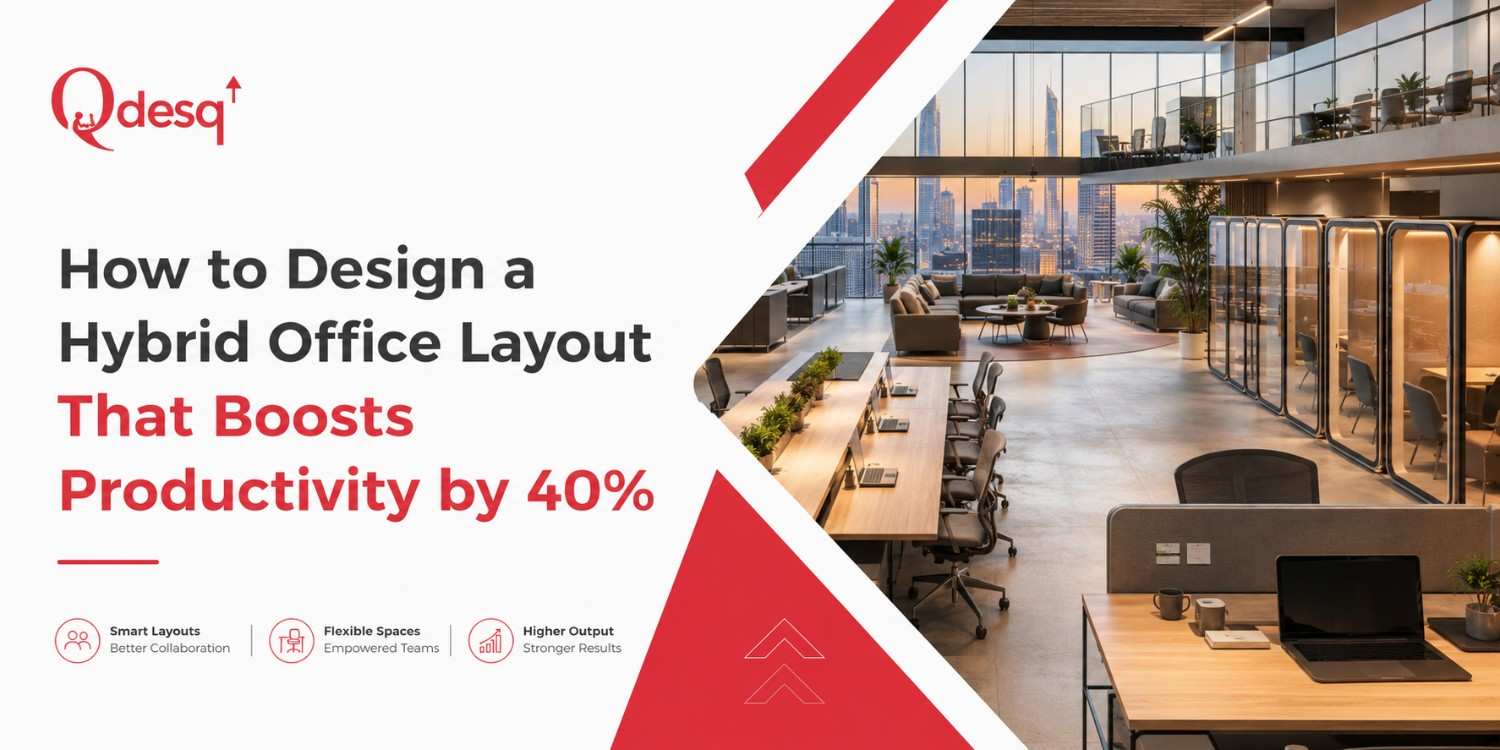
Think back to the last time you walked into your office. Did it feel like a “destination” where ideas actually spark, or just a place where you sat on the same laptop you used at your dining table that morning?
If it’s the latter, you’re not alone. But the hard truth for 2026 is that the traditional office layout is a productivity tax you can no longer afford to pay. Research now shows that a meticulously designed hybrid layout can boost team productivity by up to 40%.
This is a fundamental psychological shift. We are moving away from “Where do I sit?” to “What do I need to achieve today?”
Whether you’re a startup founder or a corporate strategist, here is your guide to designing a hybrid workspace that actually works as hard as your team does.
Beyond the 1:1 Desk Model: Scaling Through Targeted Work Zones
Under traditional leasing frameworks, we used a 1:1 desk-to-employee ratio. Today, however, that math creates inefficient ‘dead zones’ that fail to justify the high overhead of Grade-A real estate. Leading firms are now moving toward a “Sharing Ratio” of 1:1.5 or even 1:2.0, where 10 employees share 5 to 7 high-quality workstations.
But don’t just throw people into a giant pool of hot-desks, that’s the fastest way to kill morale. Instead, design “Team Neighbourhoods”.
- The Logic: Groups that work together (like Marketing or Engineering) have a designated “home base.”
- The Benefit: It creates the physical proximity that leads to spontaneous, unplanned conversations that solve problems in 30 seconds rather than a 30-minute Zoom call.
Micro-Zoning: Solving the “Acoustic War”
The #1 complaint in open-plan offices has always been noise. In a hybrid world, this is amplified because half your team is in the office while the other half is shouting through a speakerphone.
To boost productivity by 40%, you must implement Micro-Zoning. Think of your office as a library, a cafe, and a workshop all under one roof:
- The Focus Node: A “no-talking” zone with library-level quiet, deep-work pods, and ergonomic sit-stand desks.
- The Collaboration Hub: High-energy zones with mobile whiteboards and reconfigurable furniture.
- The Soundproof Sanctuary: In 2026, Phone Booths are no longer a luxury; they are a mechanical necessity. One booth for every 6-8 employees is the new gold standard to keep “The Hybrid Gap” from distracting everyone on the floor.
Biophilia: The 15% “Secret” Productivity Hack
We’ve all heard of putting plants in the office, but the University of Exeter’s research is staggering: employees in “green” offices are 15% more productive than those in “lean” environments.
But for a 40% boost, you need to go beyond a few succulents. The 2026 design is about biological optimisation:
- Circadian Lighting: Systems that mimic natural daylight: bright and blue-toned in the morning for focus, and warmer in the late afternoon to prevent burnout.
- Fractal Patterns: Using carpets or wall textures that mimic natural patterns (such as leaves or waves) has been shown to lower heart rate and cortisol levels.
- Air Quality Tracking: Smart HVAC systems that monitor CO2 levels. High CO2 is the silent killer of afternoon brainpower; keeping it low can improve cognitive function by over 20%.
Designing for “Weak Ties”
Most people design for their “Strong Ties” (the people they talk to every day). But innovation actually lives in your “Weak Ties”, the colleague from finance you bump into while waiting for your latte.
Your layout should intentionally create “Collision Points.”
- Centralise the Amenities: Don’t put a small coffee station in every corner. Create one “Social Magnet” (The Lounge) in the centre of the floor.
- The Flow: Force people to walk through different neighbourhoods to get to the printer or the pantry. These “engineered collisions” are where the real cross-departmental magic happens.
The “Smart Calm” Tech Layer
Nothing kills productivity like “Tech Friction”, spending 10 minutes trying to figure out how to connect a laptop to a TV.
A 40% productivity boost requires an Invisible Tech Layer.
- Predictive Booking: AI that suggests a desk near your frequent collaborators.
- Seamless Video-First Rooms: Every meeting room should be a “Zoom Room” by default, with 360-degree cameras that make remote participants feel like they are sitting at the table, not just watching a movie of it.
- IoT Occupancy Sensors: Real-time data that tells you which parts of your office are “overloaded” and which are “dead zones,” allowing you to reconfigure your layout every quarter based on actual human behaviour.
Final Thoughts
If your team can do their job just as well from a sofa, your office layout has failed. The goal of a 2026 hybrid design isn’t just to provide a desk; it’s to provide an Experience that people actually want to commute for.
By balancing the quiet of the “Focus Node” with the high-energy “Collision Points” and backing it all with biophilic science, you aren’t just rearranging furniture. You are building a high-performance engine.
If you’re ready to stop guessing and start designing a workspace that resonates with your team’s actual needs, Qdesq is here to help. We specialise in finding and tailoring flexible workspaces across India that are already optimised for the 2026 hybrid reality. From biophilic hubs in Bangalore to tech-first managed offices in Gurgaon, let Qdesq help you find the environment where your team’s productivity can finally hit its peak.


