


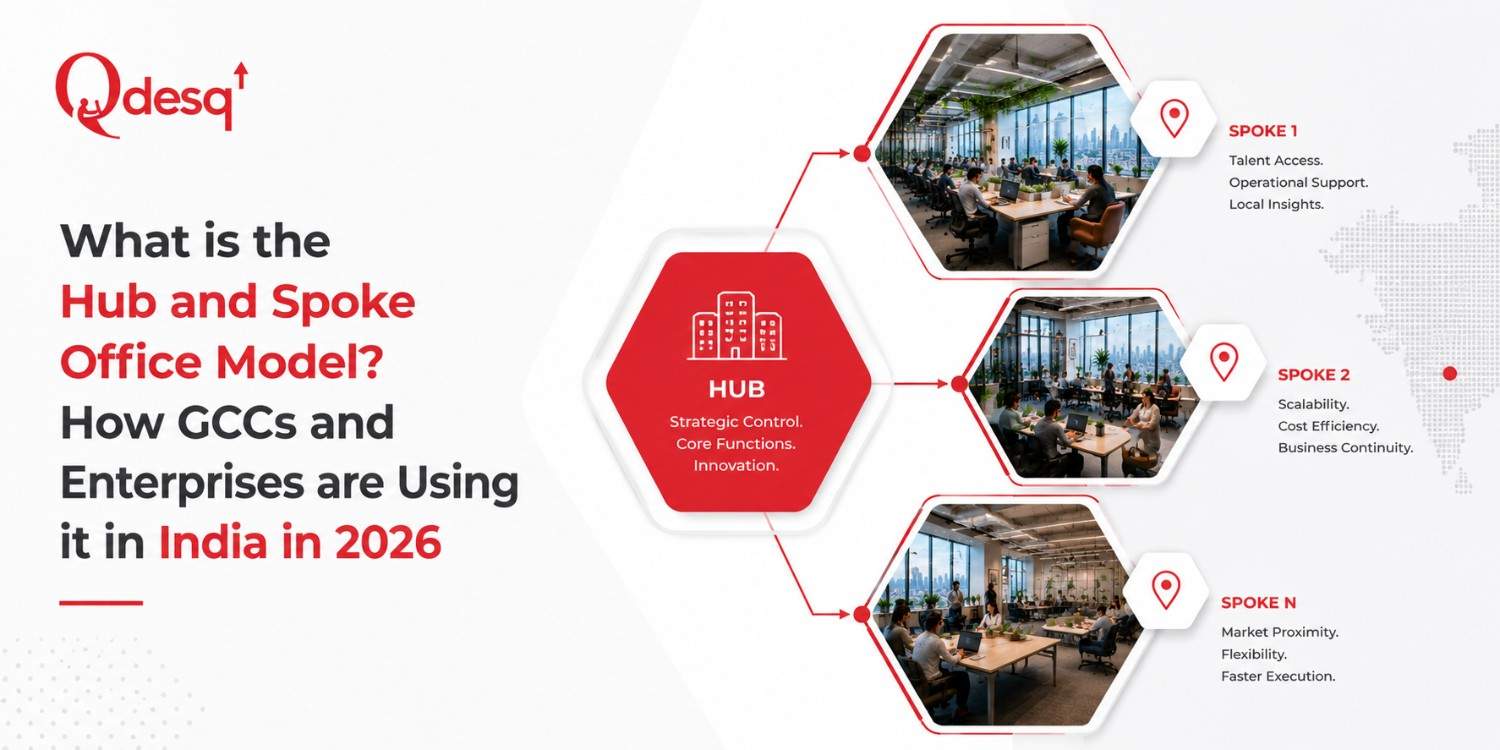
The hub-and-spoke office model is a multi-location workplace strategy in which a primary headquarters serves as the central operational and cultural anchor, supported by smaller satellite offices distributed across multiple cities or neighbourhoods. In practice, the hub operates as a managed office, while spokes function as flex or coworking centres.
This model has evolved from an experimental concept into the dominant office strategy for Global Capability Centres operating in India. The shift is quantifiable. India’s flexible office inventory crossed 100 million square feet in 2025, growing at a 23-25% CAGR over five years to reach 110-114 million square feet.
Bengaluru leads as the largest flexible workspace market with 30-32 million square feet, followed by Delhi NCR at 21-23 million square feet and Pune at 13.6-14.6 million square feet. These numbers represent structural change, not a temporary trend.
For GCC Heads, CRE Directors, CHROs, and COOs evaluating office portfolio strategies in 2026, understanding the hub-and-spoke model is no longer optional. The question has shifted from whether to adopt this model to how to implement it efficiently across multiple cities.
How Does Hub and Spoke Work in Practice in 2026?
The hub-and-spoke model creates intentional structure within distributed operations. Rather than forcing a binary choice between a single headquarters and complete decentralisation, the model establishes clear roles for each location type.
The hub functions as the primary operations centre. It houses leadership teams, manages compliance obligations, conducts board-level meetings, and anchors company culture. Hubs are almost always managed offices, private and branded spaces operated under a single provider agreement.
They typically occupy Grade A buildings in primary GCC cities such as Bengaluru, Hyderabad, and Pune. Seat counts range from 100 to 2,000, with lease commitments spanning 12 to 36 months.
The spokes serve as extension points. They provide access to regional talent, enable secondary function delivery, and reduce commute times for employees living outside primary cities.
Spokes can be managed offices in secondary cities or coworking centres in Tier 2 locations. Seat counts range from 5 to 200, with commitments varying from month to month for flex spaces up to 18 months for managed spokes.
Surge capacity nodes represent the third layer. These are on-demand flex spaces activated for peak project teams, business continuity plan execution, or VIP client visits. Hot desks and day passes operate on monthly rolling or same-day terms with variable seat counts.
Hub and Spoke Model Structure and Office Types at Each Node
| Node | Office Type | Typical Seat Count | Commitment | Primary Purpose |
| Hub (primary city) | Managed office, Grade A, private, branded | 100-2,000 seats | 12-36 months | Primary operations, leadership, compliance, culture, board-ready facilities |
| Spoke 1 (secondary city) | Managed office (private) or large coworking | 20-200 seats | 6-18 months | Regional talent pool access, secondary function delivery |
| Spoke 2 (Tier 2 city) | Coworking centre or flex office | 5-50 seats | Monthly rolling | Cost arbitrage, niche talent access, proximity to residential zones |
| Surge capacity (any city) | Hot desks, day passes, on-demand flex | 1-100 seats (variable) | On demand, same day | Peak project team overflow, BCP activation, VIP client visits |
The coordination logic makes this work: every spoke connects back to the hub for strategy, culture, and cross-team work, while day-to-day productivity happens where it makes the most sense for each employee and function.
Hub and Spoke Vs Alternative Models
Hub and Spoke Versus Single Campus Vs Fully Distributed Model Comparison
| Factor | Hub and Spoke (Recommended) | Single Campus | Fully Distributed (No Offices) |
| Talent access | Multi-city, the broadest talent pool across India | One city only, limited by local supply | Anywhere, but no office anchor or culture |
| Cost structure | Medium, optimised per city type and size | Highest, all costs concentrated in Tier 1 | Lowest real estate spend |
| Culture and collaboration | Strong at the hub, actively managed at the spokes | Strongest, physical proximity daily | Weakest, no shared physical environment |
| Compliance | Manageable, hub handles primary compliance | Easiest, single jurisdiction | Most complex, distributed obligations |
| BCP resilience | Strong, multiple independent nodes | Weakest, single point of failure | Strong but no dedicated DR office |
| GCC suitability 2026 | Recommended model, CBRE FICCI endorsed | Declining, single-city talent risk | Emerging but not mainstream for GCCs |
The evidence supporting the adoption of hub-and-spoke continues to accumulate. GCCs already account for over a third of India’s rental office space, with this share expected to rise further through 2026. In some office markets, nearly half of annual absorption is driven by GCC investors, underscoring the sector’s growing influence on leasing momentum.
The fully distributed model, while attractive for cost reduction, introduces significant compliance complexity and weakens organisational culture. The single campus model concentrates talent risk and limits access to India’s distributed workforce. The hub-and-spoke model occupies the strategic middle ground, balancing talent access, cost efficiency, and operational resilience.
Why Hub and Spoke Dominates GCC Office Strategy in India 2026
- The FICCI CBRE report Flex plosion, released on 24 March 2026 at the 3rd India Flexible Workspace Summit in Mumbai, identifies hub-and-spoke as one of the defining behaviours of enterprise flex adoption in India.
- The report highlights three major structural shifts driving the dominance of the hub-and-spoke model.
1. Flex Has Shifted From Supplementary to Structural
Companies are integrating flexible workspaces into long-term office strategies rather than treating them solely as add-ons to traditional leasing.
Flex spaces are now used for:
- Scalability
- Standardisation
- Operational outsourcing
In 2025:
- IT, technology, and software development companies accounted for 27-32% of total flex space demand.
- Global companies contributed 55-60% of overall flex demand.
2. GCCs Are Driving the Next Wave of Flex Adoption
GCCs in India are increasingly adopting flexible workspaces as they expand operations.
The share of GCCs maintaining more than 10% of their office portfolio as flex workspace is projected to rise:
- From 22% currently
- To 48% within two years
GCCs prefer flex spaces because the asset-light model helps them:
- Scale quickly
- Reduce upfront capital expenditure.
- Test new markets with greater flexibility.
3. Multi-city Operating Models Are Becoming Standard
Organisations are moving from a city-led strategy to a corridor-driven strategy.
Location decisions are increasingly based on:
- Talent depth
- Infrastructure readiness
- Long-term scalability
Southern India continues to dominate GCC leasing activity:
- Bengaluru accounts for 48%
- Hyderabad accounts for 19%
- Chennai accounts for 7%
The mature GCC landscape has prompted real estate developers, including Embassy Group, Sattva Group, and Bhartiya Urban, as well as global property consultants such as Cushman & Wakefield and CBRE, to launch integrated GCC platforms and dedicated teams that bundle strategy, execution, and operations under one umbrella.
VS Sridhar, executive managing director and head of GCC advisory at Cushman and Wakefield, notes that today’s boards want answers on talent readiness, total cost of ownership, regulatory sequencing and execution certainty well before signing a lease.
Implementation Guide by GCC Growth Stage
Hub and Spoke Implementation Guide by GCC Growth Stage
| GCC Stage | Typical Headcount | Hub Recommendation | Spoke Strategy |
| Launch and incubation | 10-50 seats | 1 managed office in primary city (Bengaluru, Hyderabad, or Pune) | No spokes yet, consolidate first |
| Early growth | 50-200 seats | Managed office HQ, expanded floor plate | 1-2 coworking spokes in secondary cities (Chennai, NCR) |
| Scale phase | 200-500 seats | Managed office HQ plus possible lease for primary city expansion | 3-5 flex centres in Tier 2 cities |
| Mature enterprise | 500-2,000+ seats | Managed office or long-term lease HQ, campus-grade | Full hub spoke network across 6-10 Indian cities |
- Launch-stage GCCs should consolidate operations into a single managed office to effectively establish culture, processes, and compliance foundations.
- Early-growth GCCs strategically add coworking or managed-office spokes in secondary cities to access specialised regional talent pools.
- Scale phase GCCs operate multiple flex centres across Tier 2 cities, requiring coordinated portfolio management and operational oversight.
- Mature enterprise GCCs manage integrated hub-and-spoke networks across multiple Indian cities, with dedicated operational and surge facilities.
- Companies adopting hub-and-spoke strategies have achieved significant real estate savings through optimised office allocation and space utilisation.
Tier 2 Cities and the Expanding Spoke Network
Tier 2 markets, including Coimbatore, Kochi, Trivandrum, Mysore, and Ahmedabad, are emerging as strategic spoke locations rather than direct substitutes for Tier 1 hubs. These cities offer distinct advantages for specific use cases.
- Cost arbitrage represents the most obvious benefit. Real estate and operating costs in Tier 2 cities are substantially lower than in Tier 1 markets. For functions that do not require daily leadership presence, Tier 2 spokes deliver significant savings.
- Niche talent access drives many Tier 2 location decisions. Specific engineering disciplines, language capabilities, and domain expertise are concentrated in certain Tier 2 cities, driven by local educational institutions and industry clusters.
- Proximity to residential zones reduces commute times for employees living outside primary cities. This proximity improves employee satisfaction and expands the accessible talent pool beyond those willing to relocate to major metros.
However, infrastructure readiness remains a defining factor. Companies must assess developer capability, connectivity, and long-term urban development trajectories before committing to Tier 2 investments.
The sentiment among industry leaders is cautiously optimistic, with speakers noting that infrastructure readiness, policy stability, and depth of skilled workforce will determine which Tier 2 cities emerge as sustainable growth hubs.
Zoho provides a relevant case study:
- The company plans to expand its hub-and-spoke model to smaller towns in Uttar Pradesh in 2026, marking a return to expansion in north India after a nearly 18-month pause.
- The expansion follows Zoho’s established approach of establishing regional hubs supported by smaller centres in nearby towns. The model was first implemented in Tenkasi, Tamil Nadu, in 2011 and later developed into one of the company’s major development centres outside Chennai.
- Zoho has indicated that a significant share of its workforce in regional centres is recruited locally and trained through internal programmes.
BCP Resilience and Geographic Diversification
Organisations are increasingly adopting multi-city operating models to mitigate risks arising from natural disasters, infrastructure disruptions, and geopolitical uncertainty. Historical events, including flooding in major Indian cities, have reinforced the importance of geographic diversification.
The hub-and-spoke model provides natural advantages for business continuity planning. Consolidating all operations into a single campus creates a single point of failure for the entire organisation. A hub-and-spoke network distributes operations across multiple independent nodes. If one city experiences a disruption, other locations continue to function.
This risk-management benefit has moved from a secondary consideration to a primary driver of hub-and-spoke adoption. GCC heads now evaluate location strategies through the lens of operational resilience, not just cost and talent access.
The shift is driven not only by risk management considerations but also by a broader strategic objective to balance scale and flexibility, leveraging established urban centres while accessing emerging talent pools in secondary markets to enhance long-term efficiency and operational resilience.
ESG and Workplace Quality in Hub and Spoke Decisions
- ESG as a Core GCC Priority: ESG considerations have become central to GCC workplace decisions, influencing sustainability goals, operational efficiency, and long-term brand positioning.
- Preference for Green Certified Buildings: Around 80% of GCC leasing activity occurs in green certified buildings with modern, energy-efficient infrastructure and facilities.
- Demand for Modern Workspaces: Nearly 78% of workspace demand is for buildings under 10 years old, reflecting a preference for premium-quality environments.
- Shift Towards Premium Grade A Offices: GCC occupiers increasingly prefer premium Grade A offices with modern amenities that enhance employee experience, workplace wellness, and corporate brand visibility.
- Sustainability and Talent Outcomes: Sustainability performance now directly impacts recruitment and retention, encouraging organisations to prioritise low-carbon and wellness-focused campuses.
Implementation Best Practices for GCC Leaders
Success with hub-and-spoke requires attention to several implementation factors.
- Unified portfolio management stands as the most critical success factor. The model fails without coordinated data across every location. GCC heads need visibility into utilisation rates, cost per seat, and employee satisfaction across the entire network, not just the hub.
- Provider selection determines execution quality. Working with a single provider across multiple cities simplifies contracting, invoicing, and relationship management. Multi-provider arrangements introduce coordination costs and service inconsistency.
- Culture management requires intentional effort at the spokes. The hub naturally develops culture through daily interaction and leadership presence. Spokes need deliberate programming, regular leadership visits, and strong communication channels to maintain cultural alignment.
- Compliance coordination becomes more complex with multiple locations. The hub should handle primary compliance obligations, but spokes operating in different jurisdictions require local attention to regulatory requirements.
The consensus among industry leaders is that GCC demand remains structurally strong, flexible workspace has matured into a mainstream asset class, and integrated commercial ecosystems are redefining competitive positioning.
For GCC heads, CRE directors, CHROs, and COOs planning 2026 office strategies, the hub-and-spoke model offers a proven path forward.
Take the Next Step With Qdesq
Qdesq’s multi-office enterprise portfolio spans 120 cities and includes 5,500 flex and managed office centres. The enterprise team manages full hub-and-spoke portfolios under a single agreement: one brief, one point of contact, one monthly consolidated invoice, and one digital portfolio dashboard.
Whether you are launching a new GCC with 50 seats or managing a mature enterprise network across 10 Indian cities, Qdesq provides the operational infrastructure to implement hub-and-spoke at scale. The Qdesq managed office product serves hub requirements from 100 to 2,000 seats. The Qdesq coworking network provides spoke locations from 5 to 200 seats. The HyperFlex on-demand solution delivers surge capacity for project teams and business continuity needs.
Contact the Qdesq enterprise team to discuss your hub-and-spoke requirements. Request a portfolio audit of your current locations, receive a multi-city implementation plan tailored to your GCC stage, and access consolidated pricing across India’s largest flex workspace network.
Frequently Asked Questions (FAQs)
What is the hub-and-spoke office model?
The hub-and-spoke model is a multi-location office strategy in which a primary, large office (the hub) serves as the main headquarters—the cultural and operational anchor—and multiple smaller offices (the spokes) in other cities or neighbourhoods extend the company’s geographic presence. The hub is typically a managed office; the spokes are coworking centres or smaller flex offices.
Why are GCCs using the hub-and-spoke model in India in 2026?
The CBRE-FICCI Flex-plosion report (March 2026) identifies hub-and-spoke as ‘one of the defining behaviours of enterprise flex adoption in India.’ GCCs use it to access talent across multiple cities, distribute BCP risk across multiple nodes, manage costs by matching office types to each location’s needs, and accommodate hybrid work preferences.
How many offices does a typical hub-and-spoke GCC have in India?
Most GCCs operate a single hub in their primary city (Bengaluru, Hyderabad, or Pune) and 2–5 spokes in secondary cities. Mature GCCs with 500+ seats often operate 6–10 locations across India under a unified portfolio managed by a single provider, such as Qdesq.
What type of office is the hub in a hub-and-spoke GCC model?
The hub is almost always a managed office — private, branded, fully operated by one provider — serving as the primary base for compliance, culture, and leadership. It typically houses 100–2,000 seats in a Grade A building in the GCC’s primary city and operates on a 12–36-month agreement.
How does hub-and-spoke compare to fully distributed work?
Yes — Qdesq’s multi-office enterprise portfolio covers 120+ cities with 5,500+ flex and managed office centres. Qdesq’s enterprise team manages the full hub-and-spoke portfolio under one agreement: one brief, one point of contact, one monthly consolidated invoice, and one digital portfolio dashboard.


