


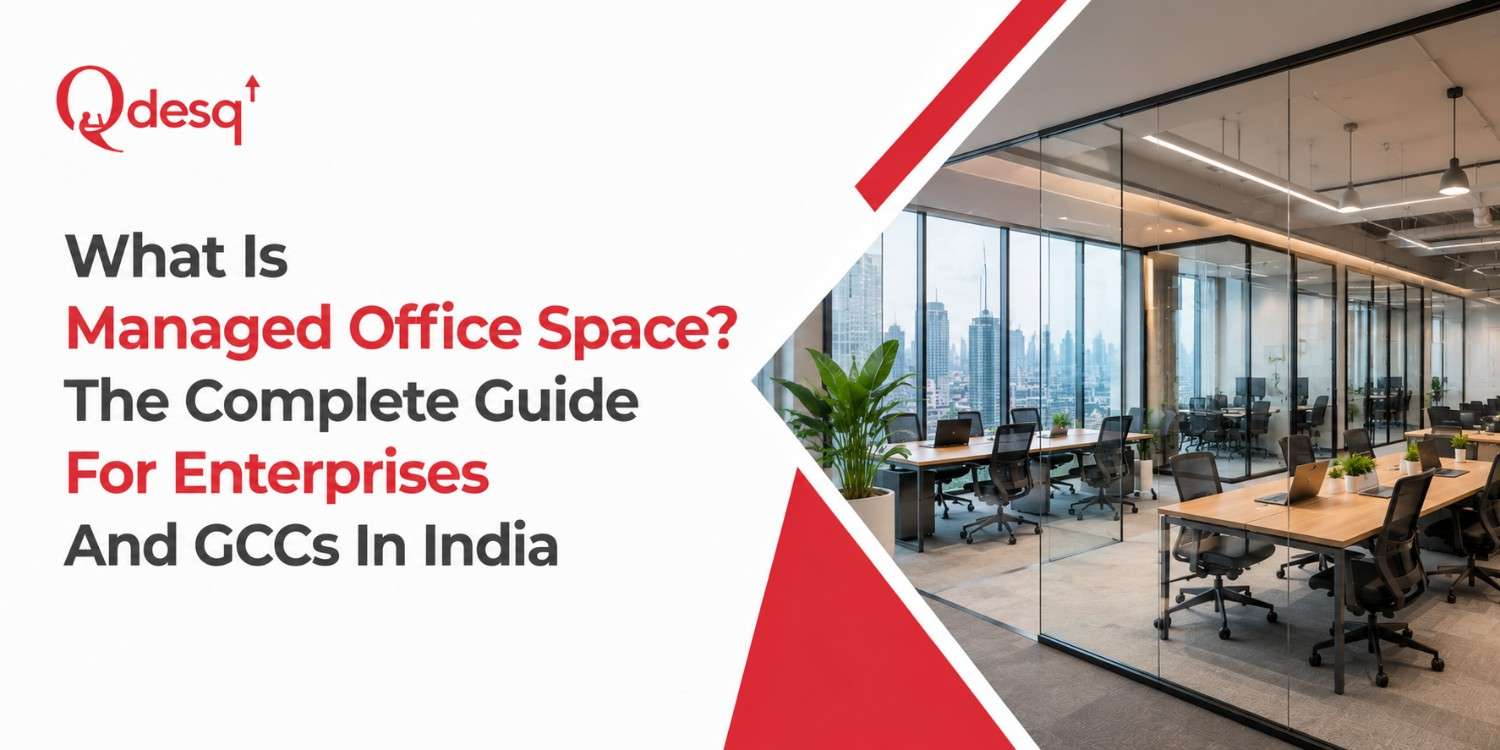
A managed office space is a fully equipped, private, and dedicated workspace that is designed, built, and operated by a third-party provider exclusively for a single enterprise occupant. It combines the long-term stability, privacy, and brand control of a traditional lease with the flexibility, speed, and cost-predictability of a service-based model.
Think of it less as renting four walls and more as procuring “Workspace-as-a-Service.” For a single, predictable monthly fee, an enterprise gains access to a Grade A environment where the provider manages everything: from interior design and IT infrastructure to reception staffing and regulatory compliance. For Global Capability Centres (GCCs) and large enterprises entering or scaling in India, this model has rapidly evolved from an alternative consideration to a primary strategic vehicle for growth.
The Indian office market is currently experiencing a structural upcycle unlike any before. In Q1 2026 alone, gross leasing hit a record 21.5 million square feet, a 10.2% year-on-year increase. Within this, the narrative is clear: GCCs and flexible workspace operators are the twin engines of demand. (CNBCTV 18)
Data from JLL indicates that GCCs accounted for a staggering 45.5% of total leasing activity in the first quarter of 2026, while flex operators (including managed office providers) accounted for 25.9%. For a CRE Director or CFO, this signals that managed offices are no longer a niche product but a mainstream asset class endorsed by the world’s largest corporations. (CNBCTV 18)
Managed Office vs. Traditional Lease vs. Coworking: The Strategic Matrix
To understand the value of a managed office, one must distinguish it from its alternatives. While coworking offers agility for small teams and traditional leases offer control for massive campuses, the managed office sits at the strategic intersection, purpose-built for enterprises of 50 to 2,000+ seats.
Managed Office vs Coworking Vs Traditional Lease at a Glance
| Feature | Managed Office | Traditional Lease | Coworking |
| Setup Time | 2–8 weeks | 6–18 months | 1–3 days |
| CapEx Required | Zero | ₹800–2,500/sq ft fit-out | Zero |
| Minimum Commitment | 6–12 months | 3–5 years | Monthly |
| Seats Available | 1 to 2,000+ | Unlimited (empty shell) | 1 to ~50 typical |
| IT & Infra | Provider-managed (Enterprise-grade) | Self-managed | Shared |
| Compliance | Enterprise-grade, dedicated | Self-arranged | Shared — compliance risk |
| Branding | Your brand, your design | Custom | Operator brand |
| IFRS 16 Treatment | Likely off-balance sheet (if <12 months) | On the balance sheet (ROU asset) | Off-balance sheet |
| Best for | GCCs 50–2,000 seats | Large enterprises, 5+ year view | Teams under 25, short horizon |
The key differentiator is exclusivity and control. In a coworking space, you are a tenant in a landlord’s ecosystem. In a managed office, the ecosystem is built solely for you. Unlike traditional leases, where a GCC Head must manage HVAC contractors and lighting electricians, and a separate vendor for internet, a managed office bundles these into a single service level agreement (SLA).
According to industry analysis, while leased offices have the lowest per-square-foot base rate, they have the highest total cost of occupancy once fit-out, CAM (Common Area Maintenance) charges, and operational expenses are factored in. Managed offices eliminate this volatility.
What Does a Managed Office Include? (Standard vs. Premium)
Managed office solutions can vary greatly from one provider to another. The market has bifurcated into “Standard” offerings, which are essentially upscale serviced offices, and “Premium” or Grade A offerings designed to compete with corporate headquarters.
What a Managed Office Includes – Standard vs Premium (Grade A)
| Included item | Standard managed office | Premium managed office (Grade A, average 70+ seats) |
| Dedicated internet leased line | Yes | Yes — redundant dual lines (99.999% uptime SLA) |
| Reception & concierge | Shared reception | Dedicated branded reception |
| Security & access control | Building-level biometric | Floor-level biometric + 24/7 CCTV monitoring + manned security |
| Furniture & fit-out | Standard spec (off-the-shelf desks) | Custom to brand guidelines (ergonomic, height-adjustable desks) |
| Housekeeping | Daily | On-demand 24/7 + deep cleaning |
| Meeting rooms | Shared pool (billed by the hour) | Dedicated rooms + enterprise video conferencing (Zoom/Teams integrated) |
| Pantry & F&B | Shared pantry | Branded pantry + barista + catering partnership |
| Green certification | Building LEED Certified | LEED Gold/Platinum + WELL Health-Safety Rating |
| IT infrastructure | Basic server room | Dedicated server room, SOC2 ready, private VLANs |
| Monthly cost per seat | ₹8,000–12,000 | ₹10,000–25,000 |
For a GCC operating in India, the “Premium” offering is often the baseline. These centres handle sensitive data and require high-end digital infrastructure. As Colliers notes, the flight to quality is accelerating, with leasing activity in green-certified and tech-integrated buildings set to account for nearly 80% of overall leasing in 2026 (Colliers). A managed office provider absorbs the risk of constructing these complex environments, delivering a “zero CapEx” ready-to-use asset.
How Much Does a Managed Office Cost in India? (2026 Benchmarks)
Pricing is the most searched sub-question for a reason. For a CFO, predictability is paramount. Managed office pricing in India is largely driven by micromarket dynamics and building Grade. While traditional leasing involves hidden costs like “fit-out depreciation,” managed offices offer an “all-in” operational expenditure (OPEX) model.
Managed Office Pricing by City – 2026 Benchmarks
| City | Cost per seat/month (all-in) | Key micromarkets | Building Grade |
| Bengaluru | ₹10,000 – 24,000 | Outer Ring Road, Whitefield, Sarjapur | Grade A |
| Hyderabad | ₹8,500 – 18,000 | HITEC City, Gachibowli, Financial District | Grade A |
| Pune | ₹8,000 – 16,000 | Baner, Hinjewadi, Magarpatta | Grade A |
| Delhi-NCR | ₹12,000 – 28,000 | Gurgaon Cyber City, Noida Expressway | Grade A |
| Chennai | ₹7,500 – 15,000 | OMR, Tidel Park corridor | Grade A |
| Mumbai | ₹18,000 – 35,000 | BKC, Navi Mumbai, Thane | Grade A |
Note: Prices are indicative for 2026 and vary based on customisation level, lease tenure, commitment, and retention period.
The variance in Mumbai reflects the scarcity of Grade A land, while Bengaluru’s wide range reflects the density of options along the ORR corridor. Recent data from JLL shows that vacancy levels in these core micromarkets are dropping to multi-year lows (pan-India vacancy is at a five-year low of 14.7%), suggesting that managed office rates may see upward pressure in late 2026 due to tightening supply. Locking in a managed office contract now hedges against this rental inflation.
The CFO’s Dilemma: IFRS 16 and Balance Sheet Treatment
For a CFO, the accounting treatment of a lease is as important as the physical space. IFRS 16, which became effective a few years ago but remains a critical point of analysis, requires most leases to be recognised on the balance sheet as Right-of-Use (ROU) assets and lease liabilities. This increases reported debt and EBITDA.
Why Managed Offices Win on Accounting:
- Traditional leases with 3–5 year tenures must typically be recorded on the balance sheet under IFRS 16, increasing lease liabilities and potentially impacting debt covenants.
- Managed office agreements with terms of 12 months or less may qualify for the “short-term lease exemption” under IFRS 16, particularly when structured with renewal options instead of automatic renewals.
- Short-term managed office agreements can often remain off-balance-sheet and be treated as straight-line rental expenses rather than capitalised lease liabilities.
- Since managed offices are procured as a service rather than a conventional asset lease, enterprises can maintain greater financial flexibility and cleaner balance sheets.
- This structure can help improve key financial metrics such as:
- Return on Capital Employed (ROCE)
- Leverage ratios
- Reported debt exposure
- The provider owns and manages the furniture, IT infrastructure, fit-outs, and operational assets, eliminating the need for enterprises to capitalise these expenditures.
- As a result, the entire workspace cost remains a predictable operational expense (OPEX), which is particularly valuable for publicly traded companies managing subsidiary-level financial reporting.
Who Should Choose a Managed Office? The Decision Framework
A managed office isn’t for everyone, but for the specific persona of a GCC Head or CRE Director in India, it is often the optimal solution.
You should choose a managed office if:
- You are a GCC scaling in India (50–2,000 seats): You need the security and privacy of a dedicated campus, but cannot wait 18 months for a traditional build. NASSCOM data indicates that India hosts over 1,700 GCCs, with Bengaluru alone accounting for ~35%. These centres need speed-to-market to capture talent before competitors.
- Compliance is a headache: a managed office provider handles fire safety, data privacy (SOC2/ISO), labour law compliance, and complex state-by-state business registrations. Shared coworking spaces often present shared liability risks that enterprise legal teams reject.
- Your growth is non-linear: Traditional leases punish expansion/contraction. Managed offices allow you to “right-size” within the same building or portfolio every 12 months.
- Talent expects Grade A amenities: In a tight talent market, offering a commute to a Green Platinum, WELL-certified office with a gym and premium pantry is a recruiting weapon. Colliers notes that “climate-ready assets are likely to dominate institutional portfolios” precisely because of this.
The speed of this model is validated by premium automotive giants. BMW Motorrad launched its India office in Bengaluru’s Electronic City through a managed workspace model, achieving a fully operational, Grade A environment with zero CapEx outlay, rather than waiting for a traditional build timeline. This allowed them to establish an immediate flagship anchor presence. (Sansovi GCC)
The 2026 Landscape: GCCs and the “Flex” Revolution
- Flexible workspaces are no longer just for startups. In 2026, they will have become a major workspace solution for enterprises and GCCs across India.
- In Q1 2026, flex operators accounted for 25.9% of total office leasing activity, underscoring the rapid growth of the managed office sector. (CNBC TV 18)
- Modern managed workspace providers now offer much more than office space. They support enterprises with:
- Location advisory
- Regulatory and compliance support
- Talent ecosystem assistance
- Enterprise-grade technology infrastructure
- This shift has positioned managed office operators as strategic business partners rather than traditional landlords.
- The growing demand is also reflected in large institutional deals. In Gurugram’s Sector 42, a managed workspace operator leased more than 1.4 lakh sq. ft. under a five-year agreement with monthly rentals exceeding ₹2.8 crore. (Urbanacres)
- The popularity of this “Capital Light” model stems from its ability to reduce real estate risk, eliminate heavy upfront investments, and enable enterprises to scale faster and operate with greater flexibility.
How to Find and Evaluate a Managed Office Provider in India
Choosing the wrong operator can lead to hidden fees and service failures. Use this 8-point checklist:
- Verify the “Landlord-Operator” relationship: Are they the actual leaseholder, or a sub-lessor with limited rights? You need the former.
- Audit the internet infrastructure: Request a “committed information rate.” Shared wifi is unacceptable for GCCs. You need dedicated leased lines with diverse fibre entry paths.
- Check the “Growth Clause”: Can you take an additional floor within the building with zero friction? If they don’t control the building inventory, they can’t guarantee your expansion.
- Assess the exit penalty: The best-managed offices have fair market “break clauses.” Bad ones lock you in like traditional leases, but without the asset control.
- Review the ESG credentials: Does the space have LEED/Platinum certification? By 2026, this is non-negotiable for corporate ESG reporting.
- Evaluate the Talent Density: Is the location within a 10-15 minute walk of a metro hub? Bangalore’s ORR and Hyderabad’s HITEC City work because of talent pools, not just cheap rent.
- Stress test the SLA: What is the response time for IT ticket resolution or HVAC repair? Get it in writing.
- Run the total cost of occupancy (TCO): Compare the “all-in” managed seat rate against the “hidden” cost of a traditional lease (Rent + CAM + Fit-out Amortisation + Security + IT Staff + Churn).
Bonus Tip
For the ideal flexible office space, connect with Qdesq workspace experts in your area. They’ll help you find the right managed office provider without brokerage fees and ensure transparency. This simplifies the process, allowing you to focus on your business while we secure your office space.
Conclusion
For the GCC Head facing pressure to launch in 10 weeks, for the CRE Director tasked with reducing real estate risk, and for the CFO seeking off-balance-sheet operating expenses, the managed office is not just an option. In 2026, India is the most sophisticated vehicle for growth.
The market has matured. With vacancy rates falling to 14.7% and GCC demand surging 43% year-on-year, the ability to secure high-quality, compliant, scalable space instantly is a competitive advantage that separates market leaders from followers .
Whether you’re launching a GCC in India, expanding into a new city, or scaling a team of 500+, Qdesq helps enterprises discover and deploy managed office spaces across Bengaluru, Hyderabad, Pune, Delhi-NCR, Chennai, and Mumbai.
From Grade A towers and enterprise-ready infrastructure to flexible lease structures and rapid deployment support, Qdesq enables companies to compare, customise, and secure managed office solutions aligned with their operational and compliance requirements.
Explore managed office spaces across India with Qdesq and accelerate your workplace strategy with built-in flexibility. Talk to a workspace expert today and build a workplace strategy designed for scale, agility, and long-term business growth.
Frequently Asked Questions (FAQs)
What is the minimum team size for a managed office?
Most providers accommodate 20 seats. Below 20 seats, coworking is usually more cost-effective due to lower absolute cost. However, the total cost of ownership (TCO) crossover point typically occurs between 40 and 75 seats over a 12-month horizon.
Is a managed office on or off the balance sheet under IFRS 16?
Short-term managed office agreements (under 12 months, cancellable) are generally off-balance sheet under IFRS 16. Agreements with terms of 12 months or more may trigger Right-of-Use asset treatment — verify with your auditor.
How long does it take to set up a managed office in India?
A standard plug-and-play configuration takes 2–8 weeks from signing to occupation. Custom builds that involve bespoke fit-outs in line with exact brand guidelines, server rooms, and specific security integrations typically take 60–90 days.
Can a GCC use a managed office for its primary India headquarters?
Yes. Managed offices are now the preferred launch model for GCC India HQs with fewer than 1,000 seats. BMW Techworks India scaled from 100 to 700 seats in Pune in 120 days using managed office infrastructure
What is the difference between a managed office and a serviced office?
A serviced office is a shared building or floor where an operator rents rooms to various companies, often with shared reception and pantries. A managed office is a private, dedicated floor or building built for exclusive use by a single occupier. The two terms are often confused, but they serve very different enterprise briefs.


