


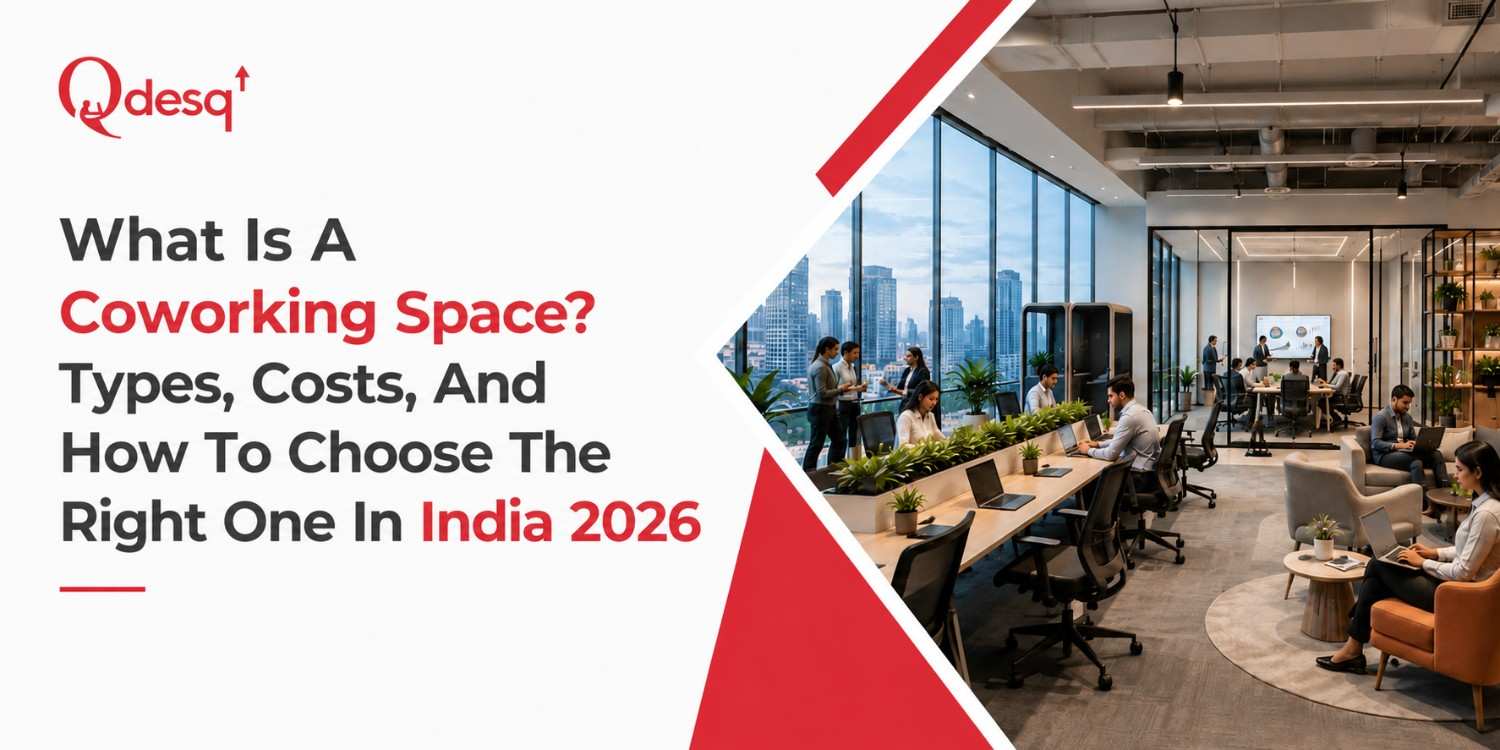
The Indian workspace landscape has reached a pivotal junction in 2026. Coworking has evolved from a startup-centric trend into a sophisticated, multi-tier ecosystem driving institutional real estate demand. With GCCs and large enterprises having become the dominant force in India’s CRE, the focus has shifted from mere “desk rental” to strategic infrastructure procurement.
Whether you are navigating the high-density hubs of Bengaluru or exploring the cost-efficiencies of Tier-2 markets like Kochi, selecting the right model, hot desks, private cabins, or managed office is critical. This guide provides the strategic depth required to align your 2026 workplace strategy with India’s rapid growth.
What is a Coworking Space?
A coworking space is a shared office environment designed to serve multiple independent professionals, teams, or companies under one roof. Members pay for access to workspace infrastructure without the burden of long-term leases, upfront CapEx, or facility management responsibilities.
What A Coworking Space Includes (Standard Membership):
- High-speed internet infrastructure
- Choice of desk type (hot desk, dedicated desk, or private cabin)
- Meeting room access (with monthly limits)
- Electricity, housekeeping, and security
- Pantry and common area access
- Reception services (premium spaces)
What A Coworking Space Is Not:
- A traditional lease office with exclusivity for one company
- An uncontrolled, chaotic environment (reputable spaces maintain professional standards)
- A solution requiring furniture purchases or infrastructure setup
A well-designed coworking space is also a community platform. It serves freelancers, remote workers, and entrepreneurial teams with flexible space rental options, meeting rooms, printing services, and digital tools for booking and management.
Types of Coworking Spaces in India (2026)
Choosing the right type of coworking space directly impacts your team’s productivity, costs, and growth trajectory. India currently offers 5 distinct workspace formats, each tailored to different team sizes, privacy requirements, and budget constraints.
Types of Coworking Space in India: Which is Right for Your Team?
| Type | Description | Team size | Cost (India, per seat/mo) | Best for |
| Hot desk | Shared open desk, no fixed seat, first-come-first-served | 1–5 | Rs.5,000–10,000 | Freelancers, solopreneurs, daily commuters, hybrid employees needing occasional workspace |
| Dedicated desk | Fixed desk assigned to you, lockable storage drawer, consistent setup | 1–10 | Rs.8,000–14,000 | Small remote teams, consultants, customer support teams needing permanent presence |
| Private cabin | Enclosed glass office within a coworking floor, soundproofing, AC control | 5–25 | Rs.12,000–20,000 | Small enterprises, consulting firms, legal practices, teams requiring client meeting privacy |
| Managed office | Fully private, branded, custom-built for one company | 50–2,000+ | Rs.10,000–28,000 | GCCs, MNCs, enterprises needing compliance (SOC2/ISO 27001) and dedicated infrastructure |
| Virtual office | Registered address + mail handling — no physical desk | Any | Rs.1,500–5,000/mo | Compliance, registered address requirement, entity setup without immediate physical presence |
Detailed Breakdown Of Each Type:
- Hot Desk: The entry point to coworking. You arrive and take any available seat. Ideal for freelancers needing a professional environment 3–4 days a week or hybrid workers who want to escape home distractions. Lower cost comes with lower predictability.
- Dedicated Desk: Your permanent workstation. You return to the same desk daily with personal storage, consistent ergonomics, and equipment setup. Best for small teams that need their team members to work together consistently.
- Private Cabin: A lockable glass-walled office within the coworking floor. Provides visual privacy, client meeting capability, and team collaboration space without the overhead of managing an entire floor. Many premium coworking operators now offer private office suites for 6-, 10-, 20-, and 40-person teams, available on flexible terms with no brokerage fees.
- Managed Office: A dedicated, branded workspace purpose-built for one company. Unlike coworking, managed offices provide exclusive infrastructure, custom layouts, your own branding, and enterprise-grade security. This is the standard choice for GCCs and large enterprises that have outgrown shared environments. The managed office and enterprise solutions model now dominates, accounting for up to 80% of post-pandemic demand in India.
- Virtual Office: No physical seating. Provides a registered business address for GST registration, mail handling, and compliance. Search volumes for virtual office queries have risen 99% over the past three years as startups and remote teams prioritise compliant entity setup (Fortune India).
Note: The average enterprise deal size has doubled from 25 seats to 53 seats between 2023 and 2025 (The New Indian Express). This reflects a structural shift toward larger, more committed flexible office deployments. Within the enterprise segment, global MNCs account for 81% of occupied seats, emphasising India’s role as a global service and innovation destination (IBEF).
How Much Does a Coworking Space Cost in India? City-by-City 2026
Pricing remains the most searched question in the coworking category. Costs vary significantly by city, micro-market, and space quality. The following table reflects Qdesq’s curated data inputs from 5,500+ verified centres across India.
Coworking Space Costs in India — City-by-City 2026
| City | Hot desk/month | Dedicated desk/month | Private cabin (10 seats)/month |
| Bengaluru | Rs.5,000–9,000 | Rs.8,000–14,000 | Rs.1,20,000–2,50,000 |
| Hyderabad | Rs.4,500–8,000 | Rs.7,000–12,000 | Rs.1,00,000–2,00,000 |
| Pune | Rs.4,000–7,500 | Rs.6,500–11,000 | Rs.90,000–1,80,000 |
| Delhi-NCR (Gurgaon) | Rs.6,000–12,000 | Rs.10,000–18,000 | Rs.1,50,000–3,20,000 |
| Chennai | Rs.3,500–7,000 | Rs.6,000–10,000 | Rs.80,000–1,60,000 |
| Mumbai | Rs.8,000–15,000 | Rs.12,000–22,000 | Rs.2,00,000–4,00,000 |
| Tier-2 (Kochi, Coimbatore, Indore, Lucknow, Visakhapatnam) | Rs.2,500–5,000 | Rs.4,000–8,000 | Rs.50,000–1,00,000 |
Pricing Insights and Benchmarks (2026):
- Coworking space in Bengaluru micro-markets such as Koramangala, HSR Layout, and Whitefield ranges from Rs. 8,000 to Rs. 15,000 per seat per month (My Branch).
- Tier-2 cities offer significant cost advantages. Coworking in Hubbli costs Rs. 3,000-6,000 per seat per month, representing 60–70% lower per-seat costs than in Bengaluru (My Branch).
- Mandatory GST: Coworking spaces are subject to 18% GST as a composite supply of renting non-residential immovable property. This applies to the complete invoice value, including rent and bundled services such as internet, meeting rooms, and power backup (Tax Buddy).
Why Tier-2 Cities Matter in 2026:
Industry reports indicate that the “Rest of India”, tier-2 and tier-3 markets, is set to grow at over 16% annually through 2030, outpacing metros as occupiers adopt distributed, hub-and-spoke workspace strategies (Realty+). Cities like Jaipur, Indore, Lucknow, Coimbatore, Visakhapatnam, Kochi, and Nagpur are rapidly transforming into vibrant business ecosystems, driven by improving infrastructure and abundant talent.
Coworking vs Managed Office — The Enterprise Decision Guide
For growing teams and GCCs, the decision between coworking and a managed office is critical. Many businesses start in coworking but quickly hit limitations around privacy, compliance, and operational control.
| Factor | Coworking | Managed office |
| Team size | Best under 25–40 seats | Optimal for 50+ seats |
| Privacy | Shared floors or entire building | Dedicated floor or dedicated building |
| Compliance (SOC2, ISO 27001, HIPAA) | Disqualified: shared network perimeter, shared physical access | Compliant: dedicated infrastructure, controlled access, custom network |
| Branding | Operator’s brand environment (minimal company branding allowed) | Your brand, your design, your culture, fully custom environment |
| IT infrastructure | Shared WiFi network, limited control | Dedicated server room, custom network, enterprise-grade security |
| Minimum commitment | Monthly or daily contracts | 6 months to 3 years (negotiable) |
| Cost crossover point | Cheaper under 40 seats | More cost-effective above 40–75 seats over 12+ months |
| GCC suitability | Incubation phase only (under 25 people), temporary setup | Primary and satellite offices at any stage, enterprise-ready |
When To Stay In Coworking:
- Team size under 25 people
- Testing a new city before committing
- Short-term project teams
- Hybrid employees needing occasional workspace
When To Upgrade To A Managed Office:
- Team size exceeds 40–50 people.
- Compliance obligations (SOC 2, ISO 27001, HIPAA, GDPR) require dedicated infrastructure.
- You need a consistent brand environment across all locations.
- Shared meeting rooms are fully booked, and double-booking is becoming routine.
- You are tired of managing shared WiFi issues, inconsistent power backup, or limited pantry access.
Expert perspective: A managed office sits between the flexibility of coworking and the rigidity of traditional leasing. It offers private, custom-designed space without the capital expenditure of fit-outs or the need to manage vendors.
Managed offices are permanent, strategic components of corporate real estate portfolios. Coworking optimises for flexibility and minimises risk, while managed offices balance flexibility with ownership and operational control.
The hybrid approach: Sophisticated occupiers now structure their India footprint with a hybrid model, a managed office anchoring the headquarters and coworking serving employees in secondary cities and shorter-tenure deployments.
How to Evaluate a Coworking Space in India: 8-Point Checklist
Before signing any membership agreement, work through this practical evaluation framework. Use it to systematically assess each candidate space.
1. Commute Reality Test
A beautiful coworking space loses its value if team members spend excessive time in traffic. Map the route from employee residences to the space, then test it during peak hours. Spaces near metro stations, bus depots, or major arterial roads consistently deliver higher utilisation rates.
2. Infrastructure Stress Test
- WiFi: Run a speed test. Upload a large file. Join a video call for 10 minutes. Request to see the provider’s uptime SLA.
- Power backup: Confirm that all workstations, meeting rooms, and the pantry are covered by generator backup.
- Ergonomics: Sit in the chair for 10 minutes. Check for desk wobbling, monitor placement options, and overall comfort.
3. Meeting Room Availability
Request access to the booking logs for the past week. If meeting rooms are consistently fully booked during business hours, your team will face constant scheduling conflicts. Premium spaces should offer at least 2–3 hours of meeting room access per seat per month.
4. Scalability Path
Can you increase from 5 seats to 15 seats without moving floors? Can you upgrade from dedicated desks to private cabins without terminating your membership? The right space provides a clear, documented expansion path.
5. Community Quality
Visit the space unannounced on a Tuesday or Wednesday mid-morning. Is the energy focused or chaotic? Does the community engage in professional interactions, or does it operate as a silent library with coffee? Talk to current members, ask what they wish they had known before signing.
6. Contract Clarity
- What is the notice period?
- Is there a lock-in period?
- Can you shift membership types easily?
- What happens if the operator closes the centre?
- Are there hidden charges for meeting room overuse, printing, or after-hours access?
7. Compliance and Legal Readiness
If you need GST registration, confirm that the workspace operator provides a valid sub-lease agreement with specific desk or cabin numbers. Tax authorities have recently increased scrutiny on coworking-based GST registrations, requiring clear demarcation of your space, a no-objection certificate, and layout plans showing your specific area. Businesses should select “shared premises” in GST forms and maintain strong documentation, including a no-objection certificate and recent utility bills.
8. Sustainability and Green Credentials
According to Fortune India, seven of the ten most-searched office parks in India are green-certified, contributing to 66.3% of total office park search volume. Environmental credentials are becoming a default consideration rather than a premium differentiator. Ask about LEED certification, energy efficiency ratings, and waste management practices.
Pro tip from Qdesq’s experience: A BSE/NSE-listed tech giant expanded across three cities (Noida, Pune, Bengaluru) with 250+ seats in just 50 days through careful workspace curation. The result: 18% improvement in space efficiency through optimised layouts and 50% higher employee satisfaction post-relocation. The same disciplined approach applies to any team’s coworking evaluation (Qdesq).
Key Takeaways to Take the Best Decision in 2026
| Your situation | Recommended action |
| Startup founder with 1–25 people | Start with dedicated desks or private cabins in a premium coworking space. Prioritise location, internet reliability, and scalability options. |
| HR Lead for a scaling company (25–75 people) | Evaluate both coworking and managed offices. If compliance or brand environment matters, move to a managed office. Use Qdesq’s platform to compare both options transparently. |
| GCC setup team (incubation phase) | Use coworking for the first 25 seats and the first 12 months. Plan the transition to a managed office at 40+ seats. |
| GCC setup team (established, 75–1,000 people) | Deploy a managed office as your primary workspace. Use satellite coworking centres for field teams or secondary city presence under a hub-and-spoke model. |
| Enterprise looking for multi-city expansion | Deploy managed offices in tier-1 headquarters cities. Use coworking in tier-2 and tier-3 centres for distributed teams and lower-cost operations. |
Ready to find your perfect workspace?
Qdesq is India’s largest and fastest-growing workspace platform, connecting corporates and occupiers with ready-to-move-in flexible workspaces across 120+ cities. With 5,500+ verified centres covering coworking, managed offices, private suites, meeting rooms, and virtual offices, Qdesq provides transparent pricing, zero brokerage, and expert curation for teams of all sizes.
Why Qdesq?
- 5,500+ verified centres across 120+ Indian cities
- 65,000+ desks booked annually for 10,000+ corporates
- Zero brokerage — completely free for occupiers
- Expert curation — from requirement deep dive to lease negotiation
- End-to-end support, including interior design, IT setup, and compliance documentation
Start your search: Visit qdesq.com today. Enter your city, team size, and requirements. Compare verified options. Book tours and move in within days, not months.
Your workspace is where your brand lives. Make it count.
Frequently Asked Questions (FAQs)
What is the difference between coworking and a managed office?
Coworking is a shared workspace where multiple companies share infrastructure and common areas. A managed office is a private, dedicated workspace designed for a single company. The critical difference is shared vs dedicated infrastructure, which determines compliance eligibility for enterprise teams.
Is coworking suitable for a GCC in India?
Coworking is suitable for a GCC’s incubation phase (under 25 people, under 12 months). Once a GCC exceeds 40–50 seats or has compliance obligations (SOC2, ISO 27001, GDPR), a managed office is the appropriate upgrade.
What is included in a coworking space membership in India?
Standard inclusions: high-speed internet, a hot or dedicated desk, meeting room access (limited hours), electricity, housekeeping, and kitchen access. Premium spaces add printing, reception services, and dedicated parking.
How do I find a coworking space near me in India?
Qdesq’s marketplace lists 5,500+ verified coworking and managed office centres across 120+ Indian cities. Search by city, seat count, and amenity requirements at qdesq.com — zero brokerage
Can I use a coworking space for a team of 100 people?
Some coworking providers offer private floors for 100+ person teams, but at that scale, a managed office (dedicated, branded, compliant) is almost always more cost-effective and operationally appropriate.


