


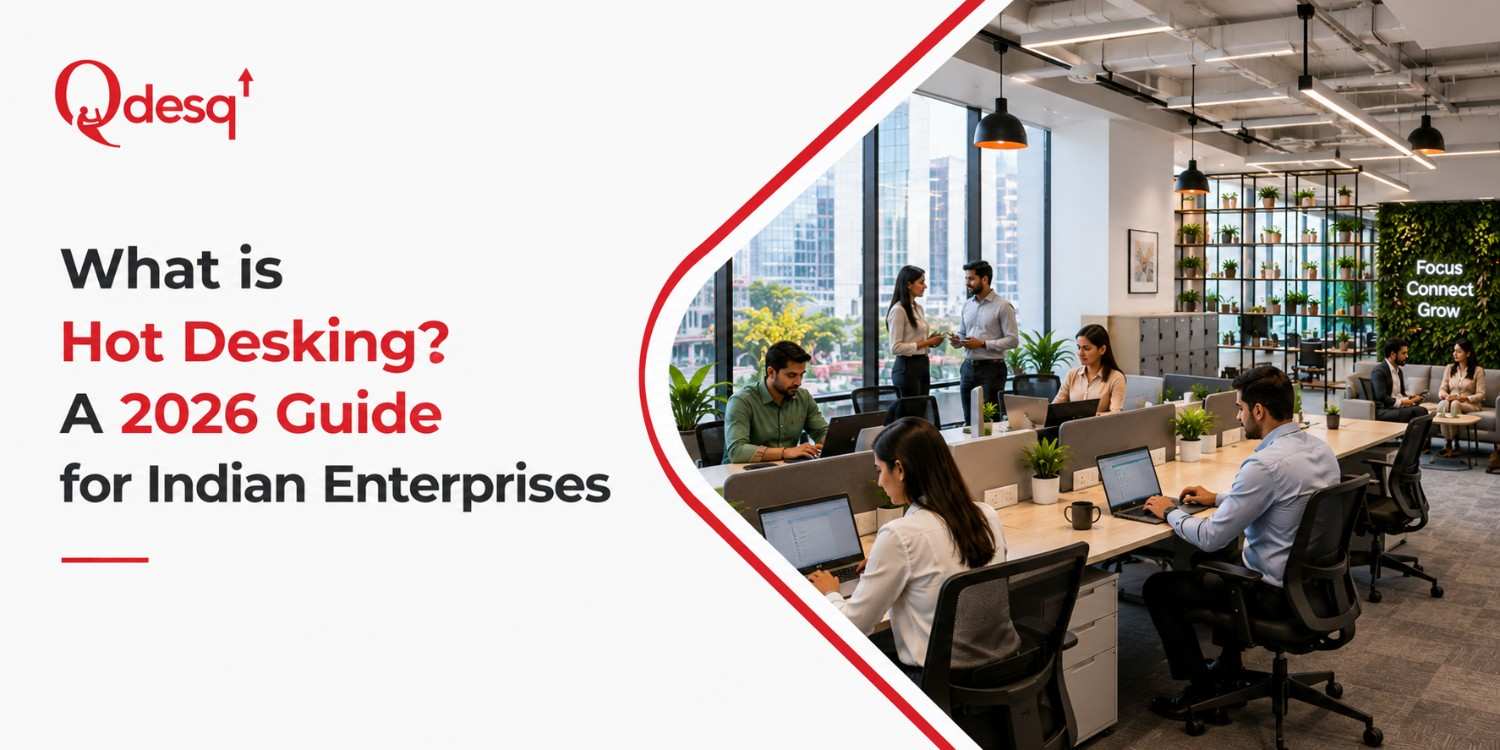
The way India Inc. utilises office space has undergone its most radical transformation since the turn of the decade. As we navigate through 2026, the rigid, sea-of-cubicles model is rapidly giving way to agility. At the heart of this shift lies a concept that every HR Lead and workplace manager is currently evaluating: Hot desking.
But what exactly is hot desking? Beyond the buzzword, it is a strategic operational model. For every GCC incubating a new team, for every Ops Head looking at P&L sheets dominated by real estate costs, and for every HR Lead trying to lure talent back to the office, hot desking represents both an opportunity and a logistical challenge.
This guide provides a deep dive into the mechanics of hot desking, the 2026 cost structures across Indian metros, a definitive comparison with dedicated desks, and the specific triggers that indicate when it is time to upgrade to a private, managed office.
What is Hot Desking? Definition & Mechanism
In the simplest terms, hot desking is a workspace organisation system where desks are not assigned to specific individuals. Instead, employees choose any available desk upon arrival.
Think of it like a library system for your corporate team. You reserve a spot (or simply walk in), plug your laptop into the dock, work for the day, and clear your belongings when you leave. The “hot” refers to the high turnover of occupants; the seat is always “hot” with a new user.
How It Works in a 2026 Indian Coworking Context
In practical terms, hot desking relies on three pillars:
- Digital Infrastructure: Modern hot desking isn’t just “find an empty chair.” It uses desk booking software (like Qdesq’s enterprise platform). Employees check availability on an app, book a slot, and locate their desk via a QR code or digital map.
- Clean Desk Policy: Personal items like family photos, specific ergonomic chairs, or stationery hoards are not allowed. Lockers are provided for daily storage, but the surface remains clear for the next occupant.
- Roster vs. Open Access:
- Rostered: Specific teams come in on specific days (e.g., the Finance team in the office on Mon/Wed).
- Open Access: “First come, first served” within a shared pool.
The global move back to the office in 2026 has not killed hot desking; it has refined it. With companies like Infosys capping work-from-home exemptions and mandating physical presence, the pressure to optimise every square foot of real estate has never been higher. Hot desking is the primary tool for that optimisation.
Hot Desk vs Dedicated Desk vs Managed Office
This is the most critical decision point for an Indian enterprise. While hot desking offers flexibility, it is not appropriate for every stage of growth. To visualise this, we look at the three-tier hierarchy of flexible workspace.
The 2026 Workspace Hierarchy in India
| Feature | Hot Desk | Dedicated Desk | Managed Office |
| Fixed Assigned Seat | No — any available desk daily | Yes — your desk, your territory | Yes — exclusive access for the team |
| Storage | Shared lockers only (daily use) | Locked personal pedestal/drawers | Full storage, server rooms, and filing cabinets |
| Cost in India (2026) | ₹5,000–10,000/seat/month | ₹8,000–14,000/seat/month | ₹10,000–28,000/seat/month |
| Minimum Commitment | Daily, Weekly, or Monthly | Monthly | 6 to 24 months |
| Privacy Level | Low — open, energetic, noisy | Medium — fixed neighbours | High — closed doors, meeting rooms inside |
| Compliance Suitability | Low (shared network, public access) | Medium (shared building, but fixed asset) | High (Dedicated infra, SOC2/ISO-ready) |
| Branding Possible? | No | No — only digital backgrounds | Yes — full reception and cabin branding |
| Best For | Freelancers, 1–5 person teams, Field Sales | Remote workers, Consultants, Small startups | Enterprises, GCCs, Legal/Financial firms |
The “In-Between” Zone
Many providers (like WeWork India or 91Springboard) offer dedicated desks as a middle ground. Here, you get the community benefits of a coworking space but the security of leaving your monitor and jacket overnight.
When Does Hot Desking Make Sense? (And When to Upgrade)
Not every team should have a hot desk. Using hot desking for a 50-person enterprise team under audit compliance is a recipe for chaos. Conversely, using a private office for a 3-person remote sales team is a waste of capital.
For Ops Heads and HR Leads, this decision matrix, based on 2026 Indian market realities, provides the clarity you need.
Decision Matrix for Indian Teams (2026)
| Team Situation | Hot Desking Appropriate? | Recommended Solution | Strategic Rationale |
| Team of 1–5 people (Freelancers/Startup) | Yes — Ideal | Hot Desk or Day Pass | Maximises cash flow; provides networking opportunities without asset liability. |
| Remote-first team (Occasional office use) | Yes — Best Fit | Hot Desk / Qdesq HyperFlex | Why pay for 10 empty desks when you only have 2 people in the office daily? |
| Team of 10–40 people (No compliance needs) | Partially | Dedicated Desks or Small Private Suite | The “noise” factor and lack of storage become frustrating at this size. |
| Team of 50+ people | No | Private Managed Office | Cultural identity and internal collaboration require a contiguous, branded zone. |
| GCC in Incubation Phase (< 25 people) | Yes (Temporarily) | Hot Desks (first 6 months) | Allows the GCC to enter the market fast without a 3-year lease. |
| Enterprise under SOC2 / ISO 27001 | No | Dedicated Managed Office | Shared WiFi and public access are compliance disqualifiers for data protection. |
| Hybrid workforce with variable daily attendance | Yes | Qdesq Flexi | Aligns cost directly with the actual headcount in the seat. |
The GCC Exception
For Global Capability Centres (GCCs) looking to set up in India, hot desking is often the “landing zone.” In 2026, many GCCs start in premium hot-desking environments (such as Bengaluru’s ORR or Gurugram’s Golf Course Road) to test the talent waters. However, as many HR leaders discover, once the team exceeds 25 people, the lack of data privacy and brand ownership forces an upgrade to a managed office.
Hot Desking Costs in India (2026 Data)
Pricing remains the largest driver for the hot desking model. In 2026, Indian enterprises can expect significant savings on prime real estate by shifting to this model.
While national averages sit between ₹5,000 and ₹10,000 per seat per month, the micro-markets tell a more specific story.
City-Wise Hot Desk Approx.Pricing (Monthly)
Bengaluru (ORR / MG Road): ₹6,500 – ₹10,000
- High demand from tech GCCs keeps prices elevated. Luxury spaces push towards the premium end.
Gurugram (Golf Course Road / Cyber City): ₹6,000 – ₹9,500
- A hub for consulting and legal firms using flex spaces for overflow staff.
Mumbai (BKC / Lower Parel): ₹7,000 – ₹10,000
- High real estate values make hot desking extremely cost-efficient for BFSI support teams.
Hyderabad (Hitech City / Gachibowli): ₹4,500 – ₹8,500
- The most competitive pricing among Tier-1 cities. Madhapur offers the lowest entry point.
Tier-2 Cities (Pune, Ahmedabad, Kochi): ₹3,000 – ₹6,000
- The rise of remote talent hubs has made hot desking affordable for satellite offices.
Note: These prices are approximate ranges based on current market data from 2026. They can vary by provider, exact location within the area, and add-ons.
Day Pass vs. Monthly
If your team only comes in for town halls or client meetings, Day Passes (₹300 – ₹800/day) are cheaper than a monthly commitment. However, for a regular roster, monthly subscriptions offer 40-50% savings over daily rates.
The ROI of Hot Desking: Beyond the Spreadsheet
While the per-seat cost looks attractive, HR Leads and Ops Heads must calculate the Total Cost of Occupancy (TCO) .
The Savings (Financial)
By moving to a hot desking model with a 0.7 desk-to-employee ratio (e.g., 7 desks for 10 people), companies typically reduce their real estate footprint by 30-40%. A 2021 analysis suggested that companies could save between ₹10 lakh and ₹1 crore per month by surrendering excess floors in favour of hot desking (Moneycontrol).
The Hidden Costs (Operational)
- Tech Investment: You need sensors or booking software. Without it, “hot desking” becomes “fighting for seats.”
- Employee Experience: For introverts or neurodiverse staff, the “lottery” of who your neighbour is each day can cause anxiety.
- The Utilisation Gap: If you mandate 10 days a month but don’t coordinate, you might still have 50% utilization on Monday and 10% on Friday.
How to Implement a Hot Desking Policy (5-Step Guide)
Transitioning from fixed seating requires change management. Here is the blueprint for Indian enterprises in 2026.
Step 1: Audit Actual Usage
Before you remove a single chair, analyse access logs for 4 weeks. You might find your 200-person office only has 110 people daily. That is your ratio baseline.
Step 2: Establish the Ratio
Most successful hybrid policies use a 0.65–0.75 ratio (6.5 desks for every 10 employees). If you drop below 0.6, employee satisfaction on “busy days” plummets as people scramble for power outlets.
Step 3: Invest in the Booking Stack
You cannot do analogue hot desking in 2026. Implement a platform (like Qdesq’s enterprise tools) that allows employees to see real-time availability, book amenities, and reserve meeting rooms.
Step 4: Define Zones (Neighbourhoods)
Don’t randomise everything. Create “Team Neighbourhoods.” While the specific desk may change, the Finance team always sits in the North wing. This preserves team cohesion without assigning specific assets.
Step 5: Pilot with a High-Agility Team
Don’t roll this out to Legal or Compliance first. Pilot with a sales or engineering team who are rarely at their desks anyway. Gather feedback, then expand.
The 2026 Verdict: Is It Right for Your Team?
Hot desking is not a moral statement about remote work; it is a financial and operational level. In the Indian market in 2026, it is the most intelligent way to manage the mandated return-to-office without bleeding cash on underutilised real estate.
Hot desking is right for you if:
- Your team is hybrid (not fully remote or fully in-office).
- You value collaboration over territory.
- You need a presence in a Grade A location (like BKC or Connaught Place) but can’t afford the rent for 100 fixed seats.
Hot desking is wrong if:
- You handle sensitive client data (Banking, Legal, Healthcare).
- Your team requires massive physical customisation (engineering labs, creative studios).
- You are a GCC trying to retain senior talent who value status symbols (like a window office).
The Expert Take:
“The future is not ‘all hot desks’ or ‘all private offices.’ The winning 2026 strategy is HyperFlex—enterprise-grade private infrastructure with hot-desk financial flexibility. You get the security of a managed office, but you only pay for the seats you actually scan into.” — Qdesq Industry Insights, 2026.
Ready to optimise your Office Real Estate?
If you’re an HR Lead, Ops Head, or GCC decision-maker rethinking office strategy in 2026, hot desking is no longer just a cost lever; it’s an operating model choice. The real question isn’t whether you should adopt flexibility, but how structured that flexibility needs to be.
This is where Qdesq helps you move from experimentation to execution. Whether you’re starting with hot desks, transitioning to dedicated seating, or upgrading to a fully managed private office, Qdesq enables transparent pricing, verified spaces, and enterprise-grade workplace planning across India’s top business districts.
Don’t let real estate inefficiency quietly drain your P&L. Build a workspace model aligned to actual attendance, compliance needs, and growth plans. Explore flexible office solutions with Qdesq and design a workplace that scales as fast as your business does without long leases, hidden costs, or operational guesswork.
Frequently Asked Questions (FAQs)
What is the difference between hot desking and a dedicated desk?
Hot desking means you sit at any available open desk each day — no fixed seat, no guaranteed position. A dedicated desk is permanently assigned to you, with your own locked storage. Dedicated desks cost 20–40% more but provide continuity, privacy, and the ability to personalise your workspace.
Is hot desking suitable for GCCs in India?
Hot desking suits GCC incubation phases (under 25 people, under 12 months). For established GCCs, a managed office with dedicated desks and private offices is the appropriate upgrade — providing compliance, branding, and the stability that hot desking cannot.
What is the recommended hot desk-to-employee ratio?
Most organisations using hot desking target a 0.6–0.8 desk-to-employee ratio (6–8 desks per 10 employees), based on expected daily attendance. GCCs with hybrid policies typically use ratios of 0.65–0.75. Below 0.6, employee satisfaction drops significantly.
How much does a hot desk cost in India?
Rs. 5,000–10,000/seat/month in major metros. Bengaluru and Delhi-NCR are at the higher end; Tier-2 cities like Coimbatore or Kochi can be Rs. 3,000–6,000/month. Day passes (single-day hot desk access) typically cost Rs. 300–800/day.
What is Qdesq’s HyperFlex model, and how is it different from standard hot desking?
HyperFlex is Qdesq’s usage-based enterprise model — companies pay only for the desks they actually use, not a fixed monthly fee. Unlike standard hot desking (shared, open infrastructure), HyperFlex provides enterprise-grade private infrastructure with the financial flexibility of pay-per-use. Ideal for GCCs with hybrid work and variable attendance.


