


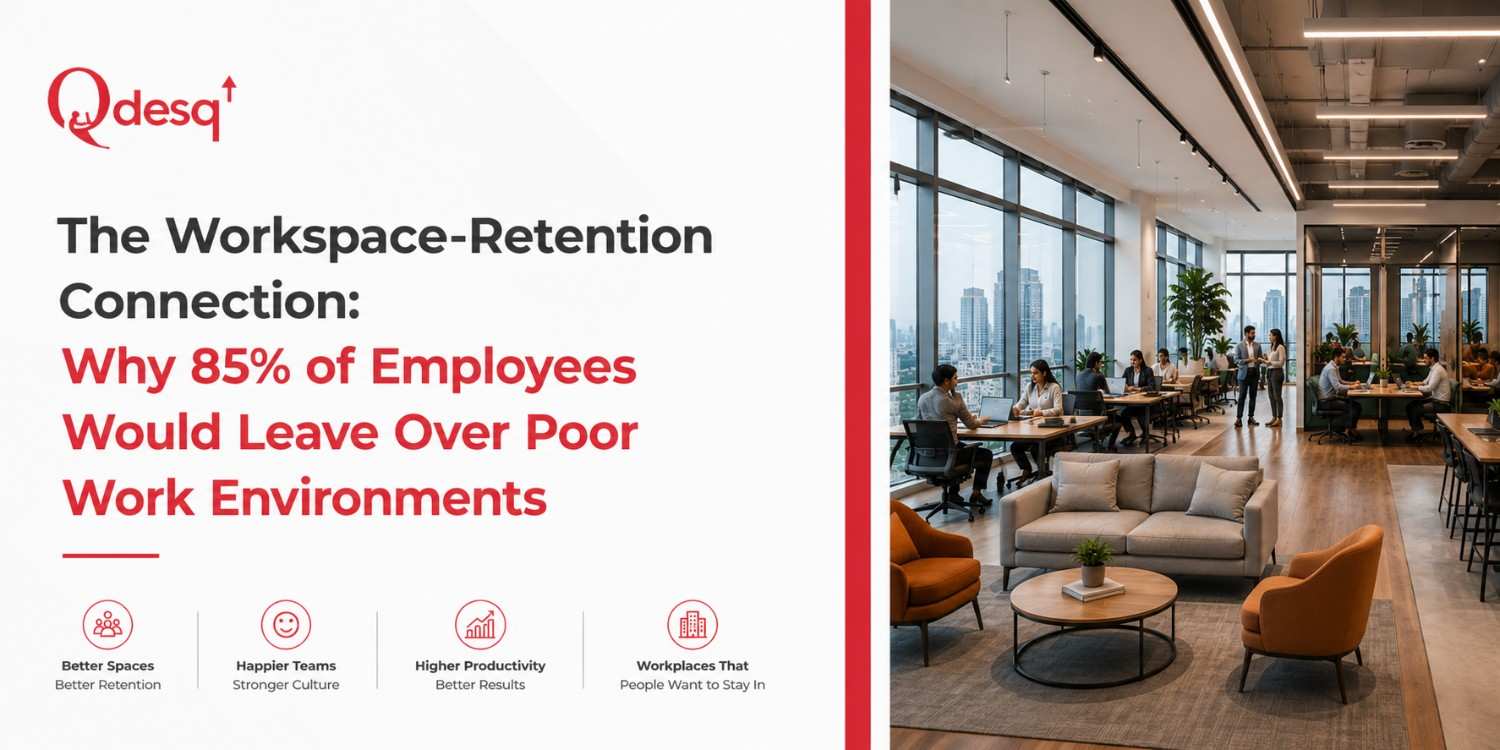
The traditional contract between employer and employee has undergone a fundamental structural shift. In 2026, the physical and cultural workspace is no longer a backdrop to productivity; it is the primary determinant of organisational stability.
According to the Wellhub State of Work-Life Wellness 2026 Report, a staggering 85% of employees would consider leaving a company that does not prioritise wellbeing (Wellhub). This suggests that retention is no longer solely a function of compensation.
As talent becomes more intentional about their health, the environment in which they work has become the ultimate competitive advantage. For leaders, particularly those managing Global Capability Centres (GCCs), the message is clear: the workspace is now a retention tool or a turnover trigger.
The New Calculus of Retention: Beyond the Paycheck
The era of “work-hard, play-hard” has been replaced by a wellness-first mindset. For years, HR strategies focused on salary benchmarks to curb attrition. However, the data for 2026 reveals a different reality. While compensation remains a baseline, it is no longer the differentiator.
| Metric | Impact on Job Evaluation | Source |
| Wellbeing Importance | 86% of employees rate it as important as salary | Wellhub |
| Flexibility Demand | 52% prioritize flexible schedules over other perks | Wellhub |
| Performance Link | 89% perform better when well-being is prioritised | Wellhub |
This shift is particularly visible in the rising expectation for “third places.” Employees are increasingly utilising gyms, yoga studios, and recreational spaces to manage work-related stress, with 91% stating these environments are essential for their mental resilience (Wellhub Executive Summary). If the primary workspace, whether digital or physical, cannot replicate this sense of support, employees will seek it elsewhere.
The GCC Landscape: A Specific Crisis of Disengagement
Global Capability Centres (GCCs) face unique challenges. While overall attrition in the GCC sector has dipped slightly to 17.4% in 2024, down from 19.4% in previous years, churn among high-impact talent remains high (Economic Times via V3 Staffing). In these high-pressure hubs, the environment is often the silent killer of productivity.
- The Engagement Deficit: Globally, employee engagement has plateaued at approximately 20-21%, a decline that costs the global economy an estimated $10 trillion in lost productivity (Gallup State of the Global Workplace 2026).
- The Managerial Gap: In the GCC context, the “bad manager” remains a primary driver of exit. 75% of Gen Z and 77% of Millennials would quit if they felt their manager did not support their growth or environment (Hirex).
Strategic leaders are now pivoting toward outcome-based measurement rather than attendance. In 2026, 72% of GCC leaders prioritise upskilling and environmental wellness as their top strategic pillars to combat the niche skills gap (NASSCOM via V3 Staffing).
Environmental Psychology and Spatial Autonomy
When employees feel they have a choice in where and how they work, they are 50% more likely to view the job market optimistically and stay with their current firm (Gallup). This isn’t just about remote work; it is about “activity-based working.” A workspace that forces a software engineer into an open-plan office for deep-focus coding is an environment that actively encourages them to browse LinkedIn.
Insight: The workspace must be viewed as a “wellbeing ecosystem.” According to Wellhub, 95% of workers believe physical, mental, and social well-being are interconnected. If your workspace ignores the social aspect, the need for “community-based wellness”, you lose 83% of the potential engagement from wellness initiatives (Wellhub).
Reversing the “Culture Decay” in Hybrid Models
The GCC model often suffers from “cultural thinning”, where remote-heavy or hybrid teams lose their connection to the mother-brand. 2026 data shows that job market optimism among fully remote workers has dropped by 5 points, while on-site workers saw a slight increase (Gallup).
This indicates that people are feeling isolated. To fix the workspace-retention connection, companies must implement Internal Talent Marketplaces. LinkedIn data shows that employees who move internally, often enabled by a culture of lateral growth, are 75% likely to stay, compared to only 56% for those in stagnant environments (Hirex).
“Retention is not a passive outcome of satisfaction; it is the active result of an environment that facilitates continuous evolution.”
Cognitive Load and the Frictionless Workspace
A critical yet overlooked aspect of the retention connection is cognitive friction. In many large-scale GCCs, employees spend significant time searching for information or navigating poorly designed internal systems. When the “digital workspace” is cluttered, it mirrors the stress of a physically cramped office.
Retention in 2026 is heavily influenced by how easily an employee can achieve a “flow state.” If the workspace, whether physical or digital, is constantly interrupted, the resulting mental fatigue can lead to burnout.
The people who feel they have the “tools and environment to succeed” are less likely to experience severe burnout. By reducing environmental friction, organisations effectively lower the cognitive tax on their talent, making the prospect of leaving for a chaotic competitor far less appealing.
Social Capital as a Retention Anchor
Strategy must also account for the erosion of social capital. It is found that employees with a “best friend” at work are seven times more likely to be engaged in their jobs (Gallup). However, engagement hinges on whether the workspace naturally facilitates these connections.
Modern GCCs are now redesigning their floors to move away from rows of desks toward “neighbourhood” models. These models increase social interactions, which directly correlate with increased retention over time. When the workspace acts as a social hub rather than a mere production factory, it creates “sticky” relationships that are difficult to replicate at another organisation, regardless of the salary offer.
The Economic Cost of Environmental Failure
Ignoring the workspace isn’t just an HR oversight; it is a fiscal liability. The deterioration of well-being is stark: in 2025, only 54% of workers rated their well-being as good, a sharp drop from 63% the previous year (Wellhub).
Critical ROI Indicators for 2026:
- Talent Retention: 73% of CEOs now admit that wellness-centric environments directly improve retention rates (Wellhub).
- Burnout Mitigation: 90% of employees reported burnout symptoms in the last year, with 39% experiencing them weekly (Wellhub). A “poor work environment” is the primary catalyst for this sustained strain.
- The Recognition Factor: Simple environmental changes, such as integrating frequent recognition into the digital workspace, can reduce the likelihood of quitting by 71% (Hirex).
Designing the “Resilient Workspace”
To bridge the gap between 85% of employees wanting to leave and the current reality, organisations must adopt a segmentation strategy. What works for a Gen Z new-hire in a Bangalore GCC (who may prioritise social connection and mentorship) will not work for a senior architect in London (who may prioritise deep focus and financial wellness).
- Identify Retention Risks: Use “Stay Interviews” to uncover what drivers are missing.
- Audit the “Toxic Patterns”: Address workloads and bad leadership before adding “perks.” A gym membership cannot fix a 70-hour work week.
- Deploy AI for Personalisation: GCCs are increasingly using AI to predict attrition with 85% accuracy (V3 Staffing). Use this data to intervene in teams where the work environment is deteriorating before the resignations start.
- Prioritise Sensory Inclusion: Workplaces that incorporate neuroinclusive design, such as low-sensory zones, quiet spaces, and adjustable lighting, have been shown to reduce stress and improve comfort for neurodivergent employees.
Final Words
The workspace is no longer a static background; it is a living entity that either nourishes your workforce or accelerates turnover. With 85% of talent prepared to leave environments that fail to support their holistic health, organisations must treat wellbeing as a core infrastructure requirement rather than a secondary perk.
The frontline of corporate survival in 2026 is built on “return on wellbeing”, designing spaces that eliminate friction, prioritise sensory inclusion, and foster genuine social capital. Those that build these human-centric needs into their physical infrastructure will secure the loyalty of the world’s most sought-after talent.
If you’re ready to evolve your workspace, Qdesq is here to make that transition feel like a natural step forward. We offer a transparent, advisor-led approach to finding managed offices that actually align with your team’s needs, removing the usual search friction.
We believe that when your environment is designed to support your people, the results speak for themselves. Let’s look at your requirements together and find a space where your team can truly do their best work.


