


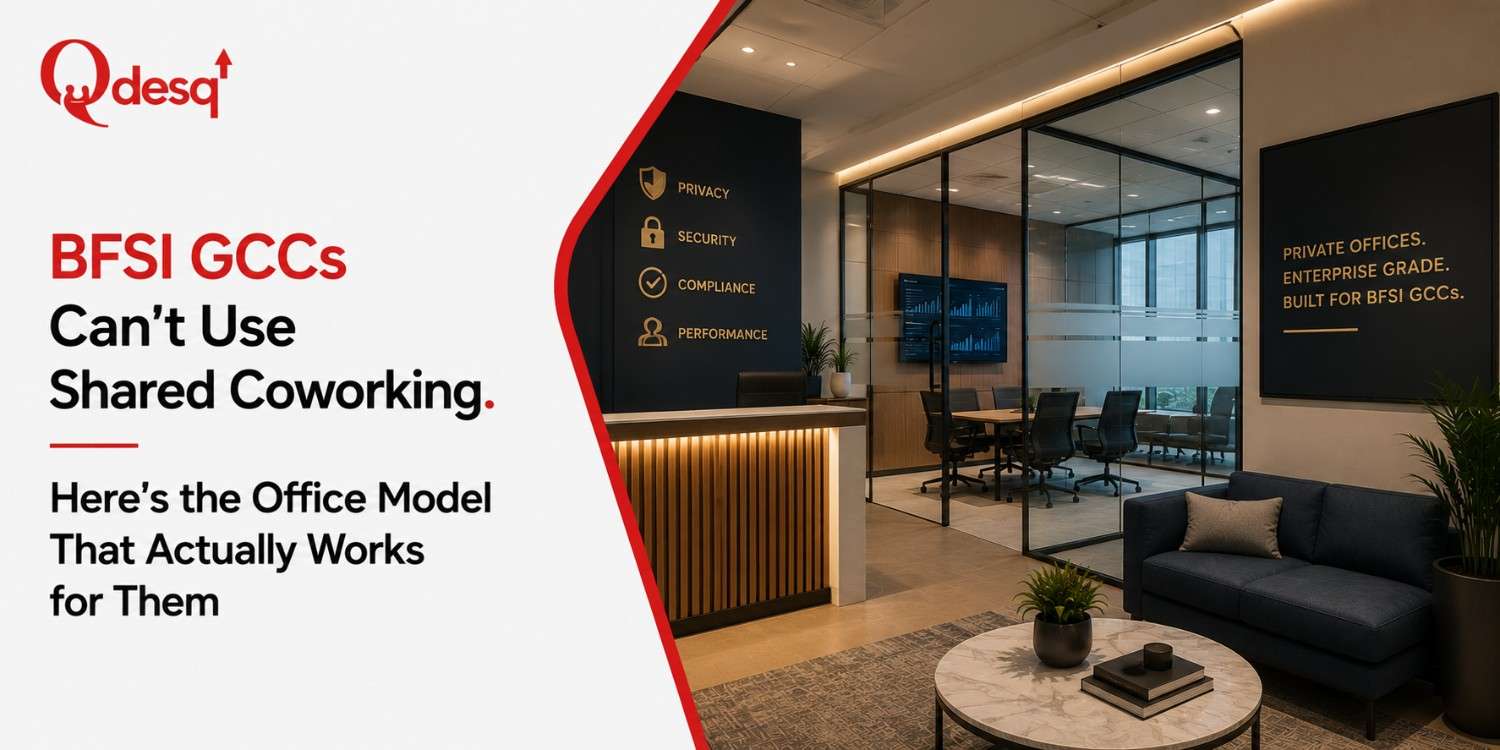
India hosts nearly 190 BFSI Global Capability Centres (GCCs) employing over 550,000 professionals. These centres form a critical pillar of the country’s GCC ecosystem, which continues to expand rapidly. According to Colliers India (February 2026), BFSI, alongside manufacturing, is expected to contribute 40–50% of GCC office space uptake in 2026, underscoring the sector’s growing real estate footprint amid broader GCC leasing projected at 35–40 million sq ft annually in the coming years.
For Heads of Real Estate and India Operations Directors at US, UK, or EU financial services firms — whether establishing a new GCC or scaling an existing one — workspace decisions carry outsized stakes.
Regulatory compliance, data security mandates from the RBI and SEBI, and stringent client confidentiality requirements render standard shared coworking spaces largely unusable. Yet, the vast majority of workspace industry content overlooks this reality, lumping all GCCs into a one-size-fits-all “flexible workspace” narrative.
This article is the first to explicitly name the problem and present the practical solution: managed office spaces tailored for regulated environments. It delivers the agility of modern flex models with the security, isolation, and compliance controls BFSI operations demand.
The Regulatory and Operational Realities BFSI GCCs Face
BFSI GCCs handle sensitive functions, including risk modelling, compliance analytics, customer data processing, algorithmic trading support, anti-money laundering (AML) and know-your-customer (KYC) operations, and fintech and digital banking innovation. These activities fall under intense scrutiny.
RBI guidelines on outsourcing and IT services (Master Directions) place ultimate responsibility for data confidentiality, integrity, and security on the bank/GCC. Key requirements include:
- ‘Need-to-know’ access controls.
- Isolation of customer data to prevent commingling in multi-tenant setups.
- Regular security audits, breach notification to the RBI, and robust business continuity plans.
- Due diligence on service providers, with banks retaining oversight even for subcontractors.
SEBI regulations for intermediaries and market participants emphasise the suitability of office infrastructure, compliance officer oversight, and controls over trading terminals, data handling, and the prevention of issues such as front-running. Physical workspace must support these without introducing external risks. See: BFSI GCCs Are Scaling Fast in India & Compliance-Ready Workspaces Are Becoming a Strategic Priority for more.
International standards (GDPR for EU parents, SOC 2, ISO 27001) add layers of contractual obligations. Parent companies often impose stricter internal policies on data flows, physical access, and vendor risk.
Standard shared coworking fails here because:
- Multi-tenant floors create inherent risks of shared networks, HVAC systems, visitor flows, and cleaning staff access.
- Generic providers rarely offer dedicated perimeters, customizable access logging, or the ability to guarantee audit isolation.
- Rapid tenant turnover and less stringent screening increase the number of insider threat vectors.
- Limited customisation hampers the creation of brand-aligned, secure collaboration zones or war rooms.
An analysis of workspace trends shows most flex operators optimise for tech/ITeS or startups, where these constraints are lighter. BFSI teams risk non-compliance findings, delayed audits, or reputational damage if they force-fit into such environments.
Why Changing Business Models Are Driving the Move Toward Managed Office Solutions
India’s GCC story is well-known: over 2,400 centres projected by 2030, employing millions, with BFSI contributing significantly to both employment and leasing. US-headquartered GCCs dominate, but UK/EU firms are gaining share, particularly in BFSI and specialised functions.
BFSI GCCs are evolving from back-office cost centres to strategic hubs for AI-driven analytics, regulatory tech, and global innovation. This shift demands workspaces that support hybrid models, talent attraction in competitive cities (Bengaluru, Mumbai, Hyderabad, Pune, Delhi-NCR), and rapid scaling without tying up capital.
Traditional owned/leased campuses offer control but take 6–18 months for fit-outs, require heavy CapEx (fit-outs alone can run crores), and lack elasticity in uncertain global markets. Shared coworking is too fast and cheap — but insecure.
Managed offices strike the balance.
What Are Managed Office Spaces for GCCs?
Managed offices (sometimes called enterprise flex, dedicated managed workspaces, or Workspace-as-a-Service) provide fully furnished, IT-ready, customizable private spaces within Grade A buildings. A single provider handles end-to-end operations: fit-out, facilities management, security enhancements, maintenance, and often compliance support. For more, see: Managed Office Space Guide 2026: Enterprise & GCC Strategy.
Unlike generic coworking (hot-desking in open plans), managed solutions for enterprises offer dedicated floors or segregated pods with:
- Private entrances/access controls.
- Branded interiors.
- Isolated IT infrastructure options (VLANs, dedicated bandwidth).
- Enhanced physical security (biometrics, CCTV with audit logs, visitor management).
The Core Strategic Advantages of Deploying Managed Offices in the Financial Sector
1. Superior Security and Compliance Alignment
Providers design for regulated sectors with features like:
- Documented access controls and separation of tenant data flows.
- Ability to support RBI/SEBI audit requirements through SLAs, right-to-audit clauses, and pre-configured isolation.
- Secure meeting rooms, data rooms, and collaboration zones that meet confidentiality needs without shared infrastructure risks.
Case in point: Global banks and financial GCCs have successfully used managed models for compliance-heavy teams by layering proprietary security (e.g., endpoint controls, DLP) on provider infrastructure.
2. Speed to Market and Scalability
- Traditional setup: 6–12+ months for lease negotiation, design, fit-out, and move-in.
- Managed Offices: Often 4–12 weeks from decision to occupancy. This is critical for GCC pilots, new city entries, or responding to M&A/integration needs.
3. Cost Efficiency and Predictable OpEx
- Zero or minimal CapEx: Fit-outs, furniture, cabling amortised into monthly fees.
- Predictable budgeting: All-inclusive (rent, utilities, facilities, often enhanced security).
- Lower total cost of ownership in early years compared to traditional leases when factoring in internal RE headcount, vendor management, and downtime risks. Reports indicate significant savings in fit-out/maintenance for managed vs. self-managed, plus balance sheet benefits under Ind AS 116.
4. Talent Experience and Productivity
Modern designs emphasise collaboration, wellness, hybrid work (focus pods, team zones), and amenities that help attract/retain scarce BFSI talent (quants, compliance experts, AI specialists). Branded spaces reinforce culture and employer brand, unlike anonymous coworking.
5. Operational Simplicity
One contract replaces the need to manage landlords, fit-out vendors, FM providers, IT integrators, and security firms. Internal teams focus on GCC delivery, not real estate headaches.
A Direct Comparison of Real Estate Strategies for Financial Institutions
- Shared Coworking: Fast, affordable, vibrant — but inadequate isolation and controls for BFSI. Best for non-sensitive sales/marketing teams.
- Traditional Lease/Campus: Maximum control and customisation for very large, mature operations (>1,000–2,000 seats long-term). High upfront cost, long timelines, reduced flexibility.
- Managed Office: Optimal for most BFSI GCC stages — setup, scaling, hub-and-spoke models across cities. Combines control with agility.
Quantitative Snapshot (illustrative for a 200–500 seat Bengaluru/Mumbai setup over 24–36 months):
- Traditional: High initial CapEx (fit-out ₹1.5–3+ Cr), 6–12 months delay, ongoing multi-vendor management.
- Managed: Lower entry, faster ROI through productivity/earlier launch, scalable terms (1–5 years).
Real-world outcomes: PwC, Microsoft, Shell, and financial players have scaled thousands of seats via managed models with documented time/cost savings and compliance adherence. Related reading: Coworking Space Vs Managed Office Space.
A Step-by-Step Workspace Implementation Strategy for Corporate Leadership
- Needs Assessment: Classify functions by sensitivity. Map against RBI/SEBI requirements and parent policies. Engage compliance/legal early.
- Provider Evaluation:
- Track record with BFSI/GCC clients.
- Security certifications, SLA rigour, audit support.
- Customisation capabilities and technology partnerships.
- Multi-city footprint for expansion.
- References and case studies.
- RFx and Due Diligence: Include data-isolation proofs, penetration-test results, exit clauses, and performance metrics.
- Hybrid Strategy: Start with managed core teams; layer traditional for ultra-large anchor sites. Use for incubation or overflow.
- Transition Planning: Build in knowledge transfer for eventual owned campuses if scaling demands it.
- Metrics for Success: Track time-to-occupancy, total occupancy cost/seat, employee NPS, audit pass rates, and scalability incidents.
Emerging Trends Shaping the Future
- ESG Integration: Providers with green-certified buildings and energy-efficient designs appeal to global parents.
- Tech-Enabled Workspaces: AI visitor management, smart access, hybrid collaboration tools.
- Tier-2 City Expansion: Managed models accelerate entry into cost-optimised locations with growing talent pools.
- Sustainability and Wellness: Features supporting well-being boost retention in high-pressure BFSI roles.
- AI-Driven GCCs: Workspaces evolving to support secure AI labs and cross-functional innovation without compromising controls. As GCCs mature into autonomous innovation hubs, workspace strategy becomes a competitive differentiator — not just a cost line.
Final Words
Standard shared coworking fails to account for the unique constraints of regulated financial services. Traditional leasing works for established enterprises but often slows expansion due to high capital requirements and long setup timelines. Managed office spaces offer the ideal middle ground—secure, compliant, scalable, and operationally efficient.
For Heads of Real Estate and India Operations Directors, the right workspace strategy can reduce risk, accelerate GCC launches, and support long-term business growth without compromising regulatory requirements.
If you’re planning to establish or expand a BFSI GCC in India, connect with Qdesq to explore customised managed office solutions across major business hubs. Our workspace experts can help you identify secure, enterprise-grade offices that meet your compliance, scalability, and operational needs—so your team can focus on driving business outcomes while we handle the workspace.


