


For the better part of a decade, the script for GCC location strategy in India was simple: Bengaluru for tech, Hyderabad for scale, and everything else was secondary. The 2025 office absorption data has rewritten that script, and the change most site selection consultants are still processing is the Delhi NCR surge.
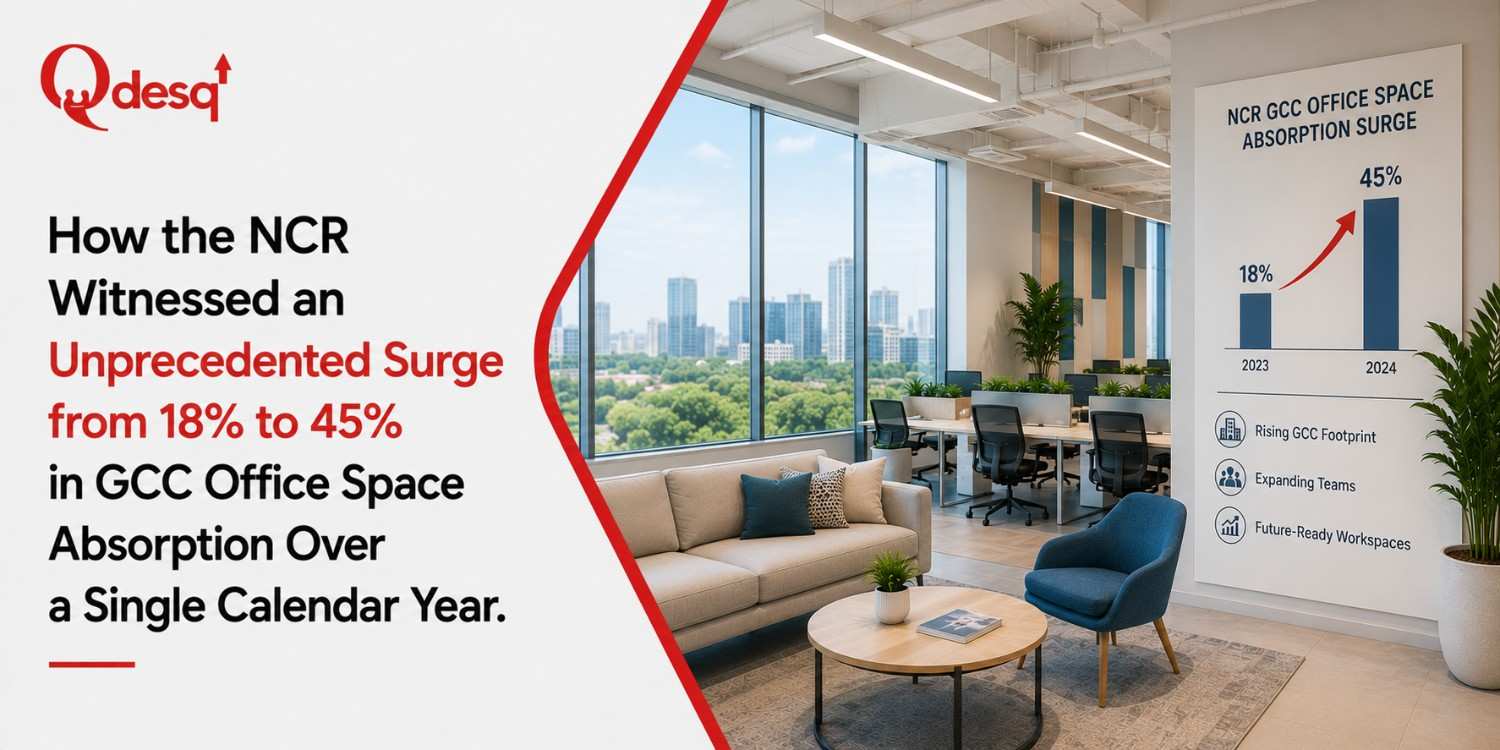
According to Vestian Research, NCR’s share of office space absorbed by GCCs jumped from 18% in 2024 to 45% in 2025. This is a structural shift. Delhi NCR posted 25% year-on-year growth in net absorption, the fastest of any Indian city, while overall NCR gross absorption reached 13.6 million sq ft, marking a 33% YoY increase.
For a Real Estate Head or site selection consultant evaluating North India vs South India for a 300–1,000 seat GCC in 2026, understanding what’s driving this surge and which micro-markets deliver what is no longer optional.
Understanding the Core CRE Statistics Redefining the Market
Let’s start with the headline statistic that should be on every site selection dashboard.
- Pan-India GCC-led leasing reached 34.9 million sq ft in 2025, a 20% year-on-year increase, accounting for 45% of total office absorption across the country.
- Total office absorption hit a record 78.2 million sq ft, with absorption significantly outpacing supply, driving the pan-India vacancy rate down by 310 basis points to 10.8%.
But the NCR story is where the real signal lives.
NCR’s share of office space absorbed by GCCs increased from 18% in 2024 to 45% in 2025 — a 27 percentage-point swing in a single calendar year. Delhi-NCR recorded an 82% year-on-year jump in net office leasing to 10.9 million sq ft in 2025, compared with 6 million sq ft in the previous year.
To put this in perspective: NCR’s GCC absorption share now rivals Bengaluru’s historical dominance. Bengaluru led GCC absorption with a 32% share in 2025, followed by Hyderabad at 19%. NCR has effectively leapfrogged into contention as a primary GCC destination, not a secondary option.
What Is Fueling NCR’s Rapid Rise as a GCC Destination
NCR’s rise isn’t accidental. Three factors are driving enterprises to choose the region for new GCCs.
1. Access to a Broader Talent Pool
As Bengaluru and Hyderabad face rising talent costs and increasing competition, companies are looking to diversify hiring. NCR offers a large pool of engineering, management, and business professionals, making it particularly attractive for consulting, BFSI, telecom, healthcare, enterprise technology, and shared services functions.
Unlike traditional tech hubs, NCR combines technology talent with business leadership and operations expertise, supporting the shift of GCCs from delivery centres to strategic business hubs.
2. Better Cost Economics
Compared to premium office locations in Bengaluru and central Gurugram, emerging NCR corridors such as Noida and Dwarka Expressway offer significantly lower real estate costs while maintaining Grade-A office infrastructure.
For enterprises setting up 300–1,000-seat GCCs, the lower occupancy costs create meaningful long-term savings without compromising talent access. See: Delhi NCR Emerges as India’s Fastest Growing GCC Hub as Leaders Rethink Their India Strategy 2026 for more.
3. Infrastructure and Flexible Workspace Growth
Major infrastructure projects, including the Noida International Airport and Dwarka Expressway, are improving regional connectivity and expanding the appeal of newer office corridors.
At the same time, the rapid growth of managed and flexible workspaces enables GCCs to enter the market more quickly, scale gradually, and avoid committing to long-term leases in an uncertain hiring environment.
Understanding the NCR Micro Markets Driving GCC Expansion
Gurugram Financial District Emerging as the Enterprise Command Centre
Gurugram captured approximately 70%70% of NCR leasing in Q2 2025, decisively leading the region’s absorption mix. In H1 2025, Gurugram accounted for ~65% of NCR’s 7.2 million sq ft leasing. The city accounted for 75% of NCR’s new office completions in Q2. Key corridors to watch:
- Golf Course Road: Mature Grade-A inventory with proximity to the Rapid Metro ↔ Delhi Metro interchange at Sikanderpur, binding Cyber City and Golf Course Road into the broader network.
- Southern Peripheral Road (SPR) and New Gurugram: Emerging locations with new office projects, modern infrastructure, and high-rise office towers.
- Dwarka Expressway: The August 2025 opening of the Delhi section of the Dwarka Expressway and UER-II (Delhi’s third ring) has eased airport and ring-road access, decongesting core approaches. This has materially improved executive travel and client cadence.
Gurugram’s sweet spot: Enterprise leadership, consulting-led GCCs, BFSI, and functions requiring frequent C-suite interaction. The city is fast becoming India’s HQ for global services and digital finance.
Noida Expressway Becoming the Preferred Corridor for Scale and Value
While Gurugram dominates absorption share, Noida has emerged as the destination of choice for GCCs seeking scale at competitive costs.
Noida and Greater Noida accounted for 33% of NCR’s total absorption in 2025. The Noida-Greater Noida Expressway corridor has emerged as an attractive destination for office occupiers, driven by improved connectivity, the upcoming Noida International Airport, and the expansion of technology-led businesses and GCCs.
Recent marquee transactions signal the trend:
- EY Global Delivery Services leased 1.72 lakh sq ft at Embassy Oxygen Business Park in Noida at approximately ₹57 per sq ft, with a five-year lease and a 15% rent escalation after three years.
- MetLife Global Operations Support Centre leased an additional 75,000 sq ft at the same park, paying approximately ₹56 per sq ft per month. MetLife has already occupied around 2.91 lakh sq ft in Tower 2 since 2020.
Embassy Oxygen Business Park, located close to the Noida-Greater Noida Expressway, is home to ARM Semiconductor, GlobalLogic, Air Liquide, and other global names.
Noida’s sweet spot: Large-scale operations, cost-conscious expansions, functions that benefit from modern Grade-A park infrastructure, and organisations willing to trade Gurugram’s prestige for Noida’s value. The upcoming Noida International Airport will further enhance connectivity and investment appeal. For more, see: Traditional vs. Managed Offices in Delhi NCR.
Dwarka Expressway Emerging as NCR’s Next Strategic Growth Corridor
The Dwarka Expressway corridor represents the infrastructure-driven frontier. The August 2025 opening of the Delhi section of the Dwarka Expressway and UER-II has tightened airport and ring-road access and de-risked peak-hour variability for professionals.
For site selection, the Dwarka Expressway corridor offers:
- Direct connectivity to the airport and Delhi’s ring roads
- Emerging Grade-A office inventory
- Access to talent pools from both Delhi and Gurugram
- The potential for significant value appreciation as the corridor matures Dwarka Expressway’s sweet spot: Organizations prioritizing executive travel convenience, client-facing functions, and those willing to pioneer in an emerging corridor with lower current costs.
How GCC Leaders Should Approach Site Selection in 2026
For a 300–1,000-seat GCC evaluating North India vs South India in 2026, here’s the decision framework:
When NCR Makes Strategic Sense for GCC Expansion
- Your GCC serves consulting, BFSI, telecom, or healthcare verticals where proximity to enterprise leadership and regulatory stakeholders matters.
- You need access to a diverse talent pool that includes business analysts, finance professionals, and operations leaders, as well as technology talent.
- You want cost advantages compared to Bengaluru without sacrificing Grade-A infrastructure.
- You’re exploring hybrid or flexible workspace strategies, NCR’s flex market is among India’s most mature
- You need to scale rapidly; NCR’s talent pipeline and office inventory can support growth timelines that South Indian markets may struggle with due to saturation.
When Bengaluru and Hyderabad Still Hold the Advantage
- Your GCC is product-engineering-heavy, requiring deep technology leadership and architects.
- You’re in ER&D, AI, cybersecurity, or semiconductor verticals where Bengaluru’s ecosystem is unmatched.
- You need to hire 10+ senior engineering leaders in the first six months — Bengaluru remains the only market where this is feasible without extraordinary recruiting effort.
How Hybrid GCC Models Are Redefining Location Strategy
The GCC map is no longer binary. Organisations are increasingly adopting hub-and-spoke or distributed GCC models, anchoring leadership and R&D in metros while distributing delivery, operations, and automation to emerging cities.
JLL projects that the total GCC footprint will cross 350 million sq ft over the next three to four years, with US-headquartered firms driving around 70% of demand. This scale demands diversification. NCR’s emergence as a complementary GCC hub, not a substitute for Bengaluru but a strategic alternative for specific functions, reflects this evolution.
The Infrastructure Multiplier
NCR’s infrastructure pipeline adds tailwinds to the GCC surge:
- Noida International Airport will enhance connectivity and investment appeal for the Noida-Greater Noida corridor.
- Dwarka Expressway and UER-II have materially improved Delhi-Gurugram connectivity, reducing friction in commutes.
- Metro extensions, though facing delays, continue to integrate micro-markets into the broader NCR network.
For site selection, infrastructure timelines matter. Leaders must plan footprints with realistic timelines, blend core HQ space with flexible options, rethink talent strategy to reflect commute realities, and stay infrastructure-and compliance-ready.
The Bottom Line
The 18% to 45% GCC share swing in 12 months is not a statistical anomaly; it’s a structural signal. NCR has emerged as India’s second GCC pole, not as a replacement for Bengaluru’s tech dominance, but as a distinct value proposition for enterprise functions, cost-conscious scaling, and strategic diversification. Related reading: Gurugram: India’s Fastest-Growing Tech Hub.
For site selection in 2026, the question is no longer “NCR or South India?” but “Which corridor in NCR, and what portfolio strategy?”
Gurugram delivers prestige, talent density, and enterprise leadership. Noida delivers scale, value, and modern Grade-A parks. Dwarka Expressway delivers connectivity and future upside.
The smart play: treat NCR as a portfolio of micro-markets, not a single destination. And treat flexible workspace as a permanent portfolio component because in a market where AI-driven workforce uncertainty is the new normal, locking into 10-year leases before you know your 2028 headcount is a risk no GCC can afford.
Ready to evaluate NCR’s micro-markets for your next GCC site? Qdesq helps enterprise occupiers and site selection consultants navigate India’s evolving office landscape with data-driven insights and flexible workspace solutions. Whether you’re exploring Gurugram’s Financial District, Noida Expressway, or Dwarka Expressway, Qdesq’s platform connects you to the right workspace without brokerage or long-term lock-in.
Visit Qdesq to start your site selection journey.


