


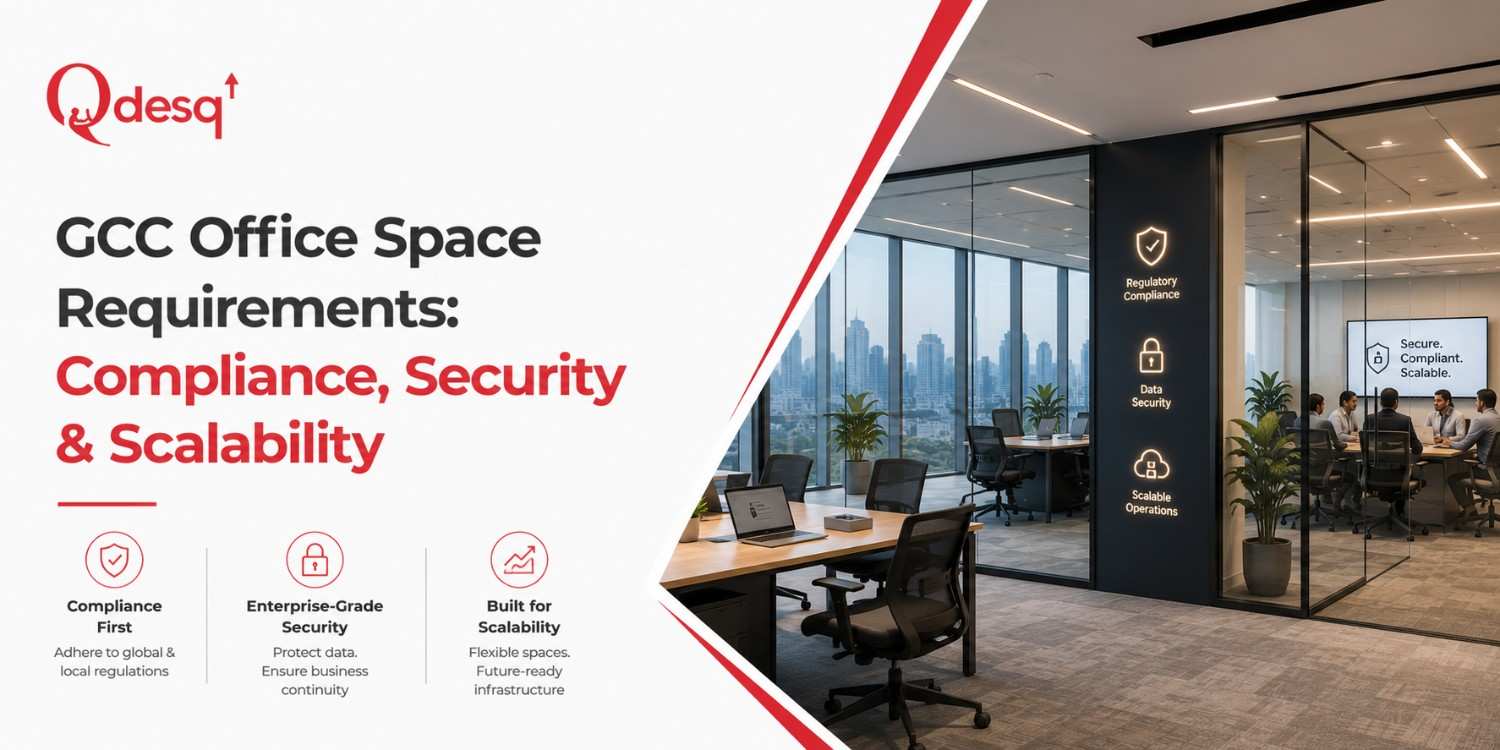
India’s GCC boom looks exciting on paper, with millions of jobs, massive campuses, and record leasing. But beneath that growth lies a harder truth: most office strategies are being built on outdated assumptions. Compliance is treated like paperwork, security like an add-on, and scalability like a future problem. That approach no longer works.
Today’s GCCs handle sensitive data, operate globally, and pursue rapid expansion, all under increasing regulatory scrutiny. One wrong real estate decision can create years of operational friction. This is not just about leasing space anymore. It is about building an environment that can withstand audits, scale quickly, and protect what matters most before those risks quietly become expensive mistakes.
So what does it actually take to get GCC office space right in this new reality? Let’s explore.
Compliance in GCC Offices Goes Beyond Documentation
Most global firms underestimate the regulatory surface area of a GCC. You are dealing with labour laws, data protection, IT regulations, environmental norms, fire safety, and sector-specific compliance. These are not static requirements.
India’s GCC ecosystem already spans more than 2,000 centres employing over 1.9 million professionals, with projections of 2,500 centres by 2030. As scale increases, regulatory scrutiny increases with it.
Large GCC leases above 1 lakh sq ft have grown 44 per cent year on year, indicating that enterprises are centralising operations rather than fragmenting them. Centralisation amplifies compliance risk.
What Enterprises Must Build Into Their Office Assets From Day One:
- Grade A compliance readiness is non-negotiable: Fire NOCs, seismic compliance, green certifications, and occupancy permits must be built into the asset, not retrofitted.
- Data compliance is now physical infrastructure: With stricter global data regimes, including evolving data protection frameworks in India, your building must support secure server rooms, restricted access zones, and audit-ready layouts.
- Vendor and facility compliance matters: Housekeeping, security staff, and facility operators are part of your compliance chain. Their certifications and processes will be audited.
Strategically, many enterprises are shifting toward managed or institutional-grade campuses because they reduce compliance fragmentation. The trade-off is a higher upfront cost in exchange for lower long-term regulatory risk.
Why Security Must Be Built Into GCC Office Design, Not Added Later
Security in GCCs has moved far beyond guards and CCTV. The nature of work has changed. GCCs now handle core engineering, AI development, financial operations, and regulated data. That fundamentally alters office design.
In cities like Bengaluru and Hyderabad, which together account for a dominant share of GCC demand, the tenant mix itself is driving higher security standards. Financial services, healthcare, and deep-tech firms bring global security protocols into local real estate decisions.
Your office space must support three layers of security:
Physical Security
- Multi-layer access control with zonal restrictions
- Visitor management integrated with enterprise systems.
- Secure parking and controlled entry points
Digital Infrastructure Security
- Dedicated server rooms with environmental controls
- Redundant power and network systems
- Shielded cabling and secure IT pathways
Operational Security
- Surveillance coverage aligned with global standards.
- Incident response integration with global SOC teams
- Compliance with international frameworks such as ISO 27001 or SOC 2 (often required by parent organisations)
The critical shift is this: security cannot be added after leasing. It must be embedded in the building design. Retrofitting security into a standard office floor creates inefficiencies, cost overruns, and audit gaps.
Why Scalability Is The Biggest GCC Real Estate Risk
Cost arbitrage built the GCC model. Scalability sustains it.
India is expected to see 180 million sq ft of GCC office absorption between 2025 and 2030, following 112 million sq ft leased between 2020 and 2024. This is not incremental growth. It is a structural expansion. At the same time, GCC leasing is projected to grow 15 to 20 per cent over the next two years.
This creates a supply-demand mismatch in high-quality assets, and from a strategic standpoint, scalability has three dimensions:
Spatial Scalability
You need the ability to expand within the same campus or micro-market. Fragmented portfolios across the city create operational friction. Large deals, up 44 per cent, indicate that companies are prioritising contiguous expansion capacity.
Talent-Linked Scalability
Office location must align with talent clusters. Bengaluru captured 47 per cent of GCC leasing demand in 2024, not because of cost but because of talent density. If your office cannot scale with hiring, your real estate strategy fails.
Operational Scalability
Infrastructure must support rapid team expansion:
- Higher seat density without compromising compliance
- Flexible layouts for hybrid teams
- Plug-and-play infrastructure for faster onboarding
This is why flex and managed office models are gaining traction within GCC portfolios. They provide short-term elasticity while core campuses anchor long-term scale.
The Emerging Model: Hybrid Real Estate Strategy
The data points to a clear direction. Enterprises are no longer choosing between traditional leases and flexible spaces. They are combining both.
- Core campuses for compliance-heavy, secure operations
- Managed offices for rapid team deployment
- Expansion buffers within the same micro-market
This hybrid model aligns with how GCCs are evolving. They are no longer back-office units. They are global command centres. That requires both stability and flexibility.
Three Non-Negotiables When Evaluating GCC Office Space Today
If you are evaluating GCC office space today, three filters should guide every decision:
- Can this asset pass a global audit today and three years from now
Compliance frameworks evolve. Your building should not become obsolete under new regulations.
- Does the infrastructure support enterprise-grade security without redesign
If you need to redesign the floor plate for security, you chose the wrong asset.
- Can you scale 2x within the same ecosystem
If expansion requires relocation, you will incur operational and talent costs that outweigh initial savings.
Closing Perspective
GCCs have become the primary driver of India’s office market, contributing up to 42 per cent of total leasing activity. This scale is forcing a reset in how office space is evaluated.
You are not optimising for rent. You are optimising for risk, resilience, and growth velocity. The companies that get this right treat real estate as infrastructure. The ones who do not rebuild their GCC strategy within three years.
At this level, even the search process needs to evolve. Access to verified options, complete cost transparency, and a frictionless evaluation journey are no longer conveniences; they are decision-critical. Qdesq enables exactly that, helping enterprises navigate complexity with clarity, speed, and zero brokerage, without adding noise to an already high-stakes decision.
Because in the end, the right workspace is not just about where you operate, it shapes how effectively you scale, secure, and sustain your GCC. Choosing it should feel as structured and future-ready as the strategy it supports.


