


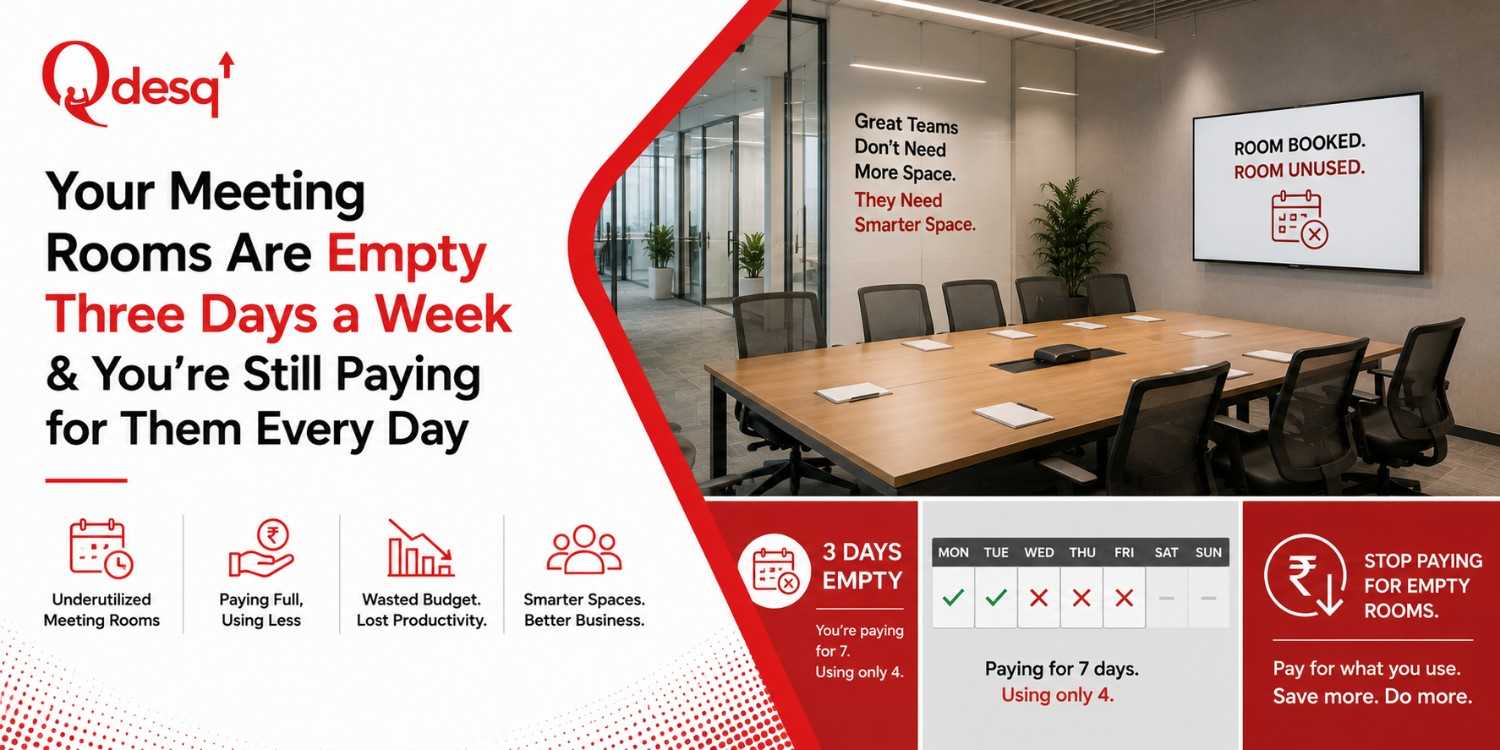
Before signing a lease, few businesses stop to calculate the true cost of unused space. You lock in a 3,000-square-foot office with four dedicated meeting rooms. Your CFO signs the 5-year lease. Then work patterns change. Hybrid work becomes the norm, and suddenly those meeting rooms sit empty for much of the week while the costs remain fixed.
According to the latest report from the Association of Chartered Certified Accountants (ACCA), 79% of Indian respondents said they prefer hybrid work, compared with 75% globally. For three days a week — Monday, Friday, and often Wednesday depending on the team — your ₹1.5 lakh per month in meeting room lease costs sits idle. The rooms echo. The booking screens show white space. And your P&L bleeds for space nobody uses.
This is not an operational oversight. It is a structural mismatch between fixed lease accounting and variable team attendance — and it costs Indian enterprises between ₹4.2 lakh and ₹7.2 lakh annually per underutilised meeting room cluster.
Related: How Meeting Rooms on Demand Save Enterprises Time & Money
How Hybrid Work Has Changed the Role of Meeting Rooms Forever
Here is the paradox that flips conventional office planning on its head. Pre-2020, offices existed for individual work. Desks dominated floor plans. Meeting rooms were secondary — one per 20-25 employees was the standard. People came to the office because that is where their computer lived.
Hybrid inverted this completely. Now, employees work from home to focus on deep work. They commute to the office for exactly one thing: collaboration. Team syncs. Client presentations. Design reviews. Onboarding sessions. Strategy offsites. The office has transformed from a work factory into a collaboration hub.
Gensler’s 2025 Workplace Survey captures this shift: time spent working with others in-person continues to increase while working alone continues to steadily decrease. As collaboration becomes a bigger part of the workweek, offices are evolving from desk-centric layouts toward spaces designed for meetings, teamwork, and meaningful in-person interactions.
But here is the trap: while demand intensity for conference room booking has spiked, utilisation days have collapsed. Your team might need 8 meeting rooms on Tuesday and Thursday, but only 2 on Monday and Friday. A fixed lease forces you to pay for peak capacity every single day of the week.
What Underutilised Meeting Rooms Are Really Costing Your Business
Let’s build a model for an Indian enterprise with 200 employees in Gurgaon or Bengaluru.
| Component | Monthly Cost (₹) | Annual Cost (₹) |
| 4 meeting rooms @ ₹30,000 per room | 1,20,000 | 14,40,000 |
| AV equipment amortisation | 15,000 | 1,80,000 |
| Utilities & maintenance allocation | 12,000 | 1,44,000 |
| Total fixed meeting room cost | 1,47,000 | 17,64,000 |
Industry data shows hybrid meeting rooms sit empty 40-60% of available time. Running the conservative scenario: operating days per week — 5; peak collaboration days (Tue, Wed, Thu) — 3 days at 75% utilisation; low attendance days (Mon, Fri) — 2 days at 25% utilisation; weighted average utilisation: (3×0.75 + 2×0.25) ÷ 5 = 55%.
That 55% utilisation means you are paying ₹80,850 monthly for space generating zero productive output. But the hidden cost is worse. When meeting rooms are undersupplied on peak days, teams leak costs into external bookings. Each hour booked at a coworking conference room costs ₹500-800 in Gurgaon. If you are short 2 rooms and teams book 40 external hours monthly, that is ₹20,000-32,000 in team expense reports — real cash out the door, just not in your real estate budget.
The true annual bleed: fixed lease waste ₹9.7 lakh; external conference room booking leakage ₹3.6 lakh; productivity loss from scheduling conflicts ₹1.7 lakh (20 meetings × 20 min delay × ₹500/hr); total annual waste approximately ₹15 lakh. That is a mid-level manager’s fully-loaded cost vanishing into underutilised real estate.
When Paying for Meeting Rooms on Demand Makes Better Financial Sense
Here is the question every CFO should ask their Workplace Manager: At what meeting volume does fixed leasing become cheaper than on-demand conference room booking?
On-Demand Meeting Room Pricing (India average, 2026)
- Standard meeting room (4-6 persons): ₹600-900 per hour
- Large meeting room (8-12 persons): ₹1,000-1,500 per hour
- Training room (15-20 persons): ₹1,800-2,500 per hour
| Team Size | Weekly Meeting Hours Required | Fixed Lease Cost (₹/month) | On-Demand Cost (₹/month) | Winner |
| 50 employees | 40 hours | 35,000 | 28,000 (₹700/hr avg) | On-Demand |
| 100 employees | 80 hours | 70,000 | 56,000 | On-Demand |
| 200 employees | 160 hours | 1,40,000 | 1,12,000 | On-Demand |
| 300 employees | 240 hours | 2,10,000 | 1,68,000 | On-Demand |
| 400 employees | 320 hours | 2,80,000 | 2,24,000 | On-Demand |
| 500 employees | 400 hours | 3,50,000 | 2,80,000 | On-Demand |
The threshold: For 400-450 employees, on-demand meeting rooms are cheaper than fixed-lease options in Tier 1 cities. Above that, fixed may pencil out — but only if your peak utilisation exceeds 75% across all rooms.
Here is the winning strategy most enterprises miss: you do not have to go all-or-nothing. Keep 1-2 fixed rooms for your executive team (high utilisation, confidential). Shift the remaining 3-4 rooms to on-demand conference room booking. This reduces fixed commitment by 60-75% while maintaining guaranteed access for critical meetings.
Why Flexible Training Spaces Are Becoming Essential for Modern Enterprises
Ask any L&D head about their biggest facilities headache. They will not mention content or facilitators. They will point to training room availability.
| Training Activity | Fixed Lease Cost | On-Demand Cost | Savings |
| Monthly new hire onboarding (2 weeks) | ₹35,000 | ₹12,000 | 66% |
| Quarterly leadership offsite (3 days) | ₹35,000 | ₹7,200 | 79% |
| Weekly team training (8 hours/week) | ₹35,000 | ₹22,400 | 36% |
The India Skills Report 2026 notes that project-based hiring has grown nearly 40%. More cohorts. More frequent training cycles. More need for a flexible training infrastructure. Fixed training rooms are a pre-hybrid relic.
A Smarter Way to Align Meeting Room Capacity With Actual Demand
Step 1: Calculate Your Current Room Utilisation
Track for 4 weeks: total available room-hours (rooms × operating hours × days); actual booked room-hours from your calendar system; utilisation rate = booked ÷ available. Industry benchmark: If you are below 60% utilisation, you are over-invested in fixed rooms.
Step 2: Model Your Break-Even Point
Map your average weekly meeting hours by room size; peak day concurrent demand (this is your minimum fixed room need); low day concurrent demand (this determines the on-demand opportunity). The rule of peak: size fixed inventory for your Tuesday/Thursday demand. Source everything else on demand.
Step 3: Compare Fixed vs On-Demand Across Your City Footprint
| City Tier | Fixed Lease Cost/Room | On-Demand Availability | Recommended Mix |
| Tier 1 (Mumbai, Delhi, Bangalore) | Very high (₹35k-45k/room) | Excellent (300+ venues) | 80% on-demand |
| Tier 2 (Pune, Ahmedabad, Kochi) | Moderate (₹20k-30k/room) | Growing (50+ venues) | 50% on-demand |
| Tier 3 (Coimbatore, Indore, Surat) | Low (₹10k-18k/room) | Limited (10-20 venues) | 20% on-demand |
Frequently Asked Questions
How much does a conference room booking cost per hour in Gurgaon or Bengaluru?
In Gurgaon and Bengaluru’s prime corridors, hourly conference room booking rates in 2026 run approximately ₹600-900 for a standard 4-6 person room, ₹1,000-1,500 for large rooms seating 8-12 people, and ₹1,800-2,500 for training rooms with 15-20 capacity. Rates vary by operator tier, AV equipment quality, and location within the city.
At what company size does on-demand conference room booking become cheaper than a fixed lease?
Based on 2026 Tier 1 city pricing, on-demand meeting rooms remain cheaper than fixed leases all the way up to teams of approximately 400-450 employees — assuming an all-in fixed room cost of ₹35,000-45,000/month per room and an average on-demand rate of ₹700/hour. Above 500 employees with sustained 75%+ utilisation, a fixed lease may begin to pencil out, but a hybrid model (1-2 fixed executive rooms + on-demand for the rest) almost always beats going fully fixed.
What is the average utilisation rate of meeting rooms in Indian offices in 2026?
Industry data consistently shows hybrid meeting rooms in India sit empty 40-60% of available time. A typical enterprise sees high utilisation on Tuesday, Wednesday, and Thursday (70-80%) but sharp drops on Monday and Friday (20-30%). This uneven demand pattern is the fundamental reason fixed leases are financially inefficient for most organisations with hybrid work policies.
Where can I book a training room by the hour in India?
Training rooms are bookable on-demand in all major Tier 1 cities through Qdesq’s network of 5,500+ centres across 120+ cities. Hourly training room rates for 15-20 person capacity typically run ₹1,800-2,500 in metros. Booking can be done same-day for most locations with standard AV setups included.


