


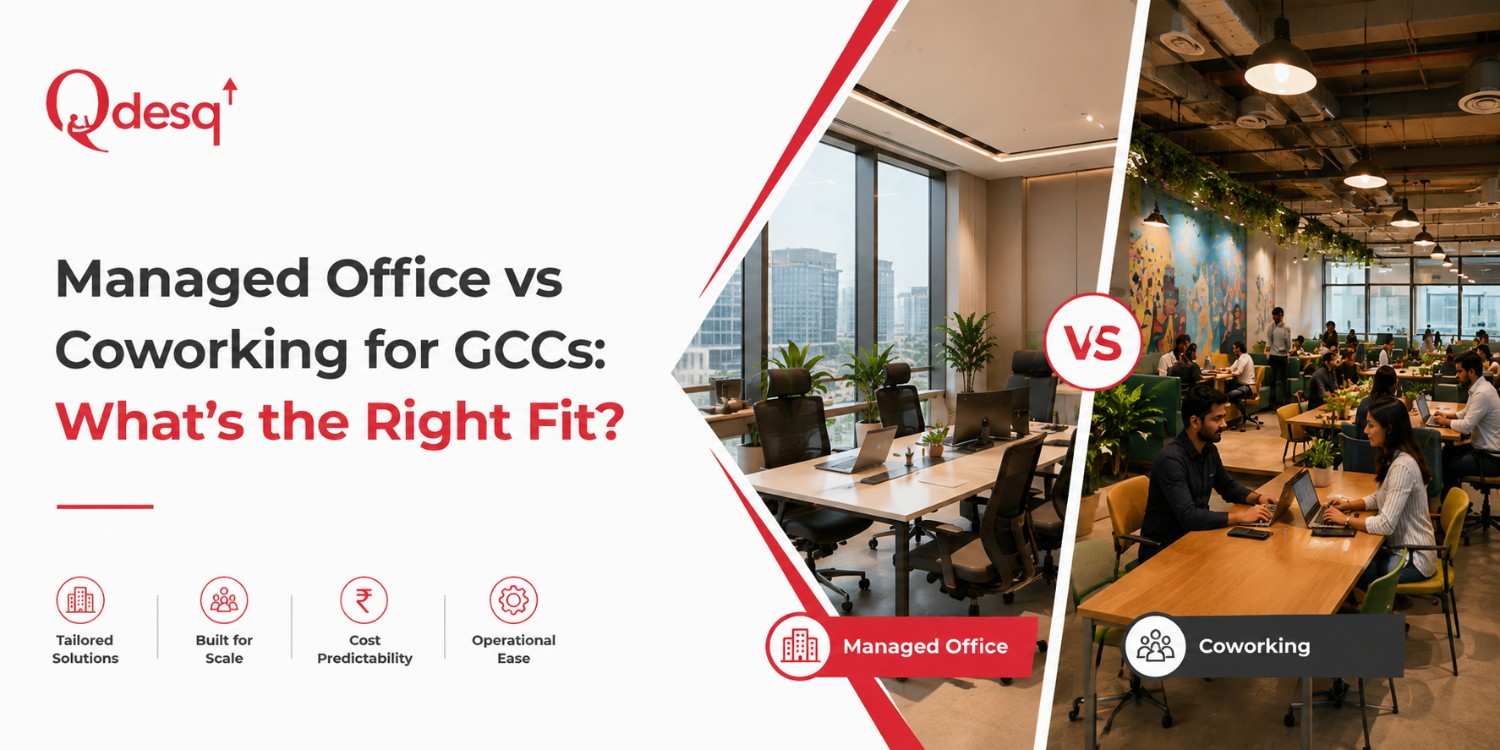
The decision between managed offices and coworking is no longer a real estate choice. For GCCs, it is a capital-allocation strategy, a talent-positioning lever, and an operating-model decision that directly shapes speed, control, and long-term value creation.
In 2026, GCCs sit at the centre of enterprise transformation. India alone hosts more than 1,900 GCCs, employing over 1.9 million professionals and contributing significantly to global product development, analytics, and innovation (Growth Hackers). At the same time, GCCs account for 37-45% of India’s total office leasing demand, showing how central workspace strategy has become to enterprise expansion (GRI Hub News).
- Managed Offices → Control + scalability + enterprise-grade infrastructure
- Coworking → Flexibility + speed + community-driven efficiency
The real question is not which model is better, but which aligns with the GCC’s stage, scale, and strategic intent. To simplify this decision, it helps to look at it through a structured lens:
The Strategic Context: From Cost Centres to Value Creation Engines
GCCs have undergone a structural transformation. Earlier, they were designed for cost arbitrage. Today, they own critical functions such as product engineering, AI development, and global delivery operations.
Leaders now look at:
- Time to operational readiness and impact on product cycles
- Cost per productive employee rather than cost per square foot
- Degree of control over security, compliance, and culture
- Ability to scale seamlessly across cities and functions
A report by Awfis and ANAROCK shows:
- 86% of enterprises prefer managed offices for expansion (ETHRWorld)
- 71% rank cost efficiency as the top decision driver (ETGCCWorld.com)
- 68% report improved employee productivity in managed setups (ETGCCWorld.com)
This signals a clear shift from traditional leasing and even from generic coworking toward more structured workspace models.
Structural Differences: Beyond Surface-Level Comparison
The distinction between managed offices and coworking spaces reflects two fundamentally different infrastructure philosophies.
| Dimension | Managed Office | Coworking |
| Ownership Experience | Enterprise-controlled environment | Shared ecosystem |
| Customization | Fully customizable (branding, security, layout) | Limited customization |
| Cost Model | Predictable OpEx with enterprise scope | Pay-per-seat flexibility |
| Security & Compliance | High, enterprise-grade | Moderate, shared infrastructure |
| Scalability | Structured scaling across cities | Flexible but fragmented |
| Culture | Dedicated company culture | Community-driven |
The key insight here is that managed offices replicate a captive environment without capital investment, while coworking optimises for flexibility and speed.
The Economics: A Deeper Financial Model
To understand the real impact, it is necessary to examine the full cost structure.
Scenario: A US-based fintech building a 300-seat GCC in Bengaluru
Traditional Model
- Fit-out cost: ₹4,000 to ₹6,000 per sq ft
- Total upfront investment: ₹12 to ₹15 crore
- Setup time: 6 to 9 months
This model locks capital and delays operational readiness.
Managed Office Model
- Zero upfront CapEx
- Fully operational in 4–8 weeks
- 57% savings in fit-out and maintenance costs (ETGCCWorld.com)
Coworking Model
- No upfront investment
- Immediate occupancy
- Higher recurring cost per seat beyond a certain scale
The Real Metric: Cost per Productive Employee
Cost per Employee = (Total Occupancy Cost + Operational Overheads + Downtime Cost) ÷ Productive Headcount
Now factor in hidden variables:
- Downtime cost from delayed setup in traditional offices
- Churn inefficiency due to poor workspace experience
- Underutilisation in fixed layouts
Coworking minimises entry cost but introduces inefficiencies as teams grow. Managed offices optimise utilisation, reduce downtime, and align cost with productivity.
Time-to-Market: The Compounding Effect of Speed
Speed is one of the most underestimated factors in GCC success.
A delay of 3–6 months in GCC setup can:
- Delay product roadmaps
- Increase hiring costs
- Impact global delivery timelines
Coworking Advantage
- Immediate plug-and-play
- Ideal for pilot teams (10–50 people)
Managed Office Advantage
- Fully operational in weeks, not months
- Supports rapid scaling once validated
This creates a two-phase strategy used by leading enterprises:
- Start in coworking for market validation.
- Transition to a managed office for scale.
Talent Strategy: Workspace as a Competitive Advantage
In cities like Bengaluru, Hyderabad, and Pune, competition for talent is intense. Workspace plays a direct role in attracting and retaining top talent.
Managed offices enable:
- Branded environments aligned with global identity
- Better collaboration through customised layouts
- Higher employee satisfaction and productivity
Data shows that nearly 68% of enterprises observe productivity improvements in managed setups. This is linked to factors such as reduced noise, better infrastructure, and stronger cultural alignment. (ETGCCWorld.com)
Coworking environments offer strong community benefits and are attractive for smaller teams. They provide networking opportunities and a dynamic work environment. However, they offer limited control over employee experience at scale.
For GCCs focused on long-term talent retention, workspace becomes a strategic differentiator rather than a support function.
Control, Compliance, and Risk Management
For GCCs operating in sectors such as BFSI, healthcare, and deep technology, compliance is a foundational requirement.
Managed offices provide:
- Dedicated network infrastructure
- Controlled access zones
- Compliance-ready layouts aligned with global standards
Coworking environments operate on shared infrastructure, which limits the ability to implement advanced security protocols.
As GCCs increasingly handle sensitive workloads such as AI models, financial systems, and proprietary data, the need for control becomes central to workspace decisions.
Multi-City Scalability and Operating Consistency
GCC expansion is no longer limited to a single city. Enterprises are building distributed models across Tier 1 and emerging Tier 2 cities.
Around 44% of enterprises are expanding into multiple cities using flexible workspace strategies. (ETGCCWorld.com)
Managed offices support this through:
- Standardised infrastructure across locations
- Centralised vendor management
- Consistent employee experience
Coworking
- Easier entry into new cities
- Less operational consistency
For enterprises building large, distributed GCCs, consistency becomes critical for operational efficiency and brand integrity.
Where Coworking Delivers Strategic Value
Coworking continues to play a critical role in the GCC lifecycle.
It is particularly effective for:
- Initial market entry
- Innovation labs and experimental teams
- Temporary project-based teams
- Satellite offices with small headcounts
Its strength lies in flexibility and speed. It allows enterprises to test markets, build initial teams, and validate strategies without long-term commitment.
The GCC Workspace Maturity Curve
Leading enterprises rarely rely on a single workspace model. Instead, they adopt a portfolio approach aligned with growth stages.
Most high-performing GCCs follow a predictable evolution pattern:
| Stage | Workspace Strategy |
| Entry | Coworking for speed and flexibility |
| Expansion | Managed offices for control and efficiency |
| Scale | Multi-city managed offices with selective coworking |
This hybrid model aligns real estate strategy with business maturity. It allows enterprises to optimise cost, speed, and control simultaneously.
Decision Framework: Aligning Workspace with Strategy
Instead of asking “managed office or coworking”, GCC leaders should evaluate:
Choose Managed Offices if:
- Headcount typically exceeds 120–150
- Long-term presence planned
- Data security is critical.
- Employer branding matters
- Multi-city scaling is expected.
Choose Coworking if:
- Team size is typically below 60–80
- Testing a new market
- Speed is the only priority.
- Budget flexibility is key.
Closing Perspective
The role of your workspace has evolved from a simple overhead cost to a genuine engine for growth. While coworking spaces offer the breathing room needed for early market entry, managed offices provide the stability and cultural control necessary as you scale toward a global footprint. The most successful GCCs recognise that there is no one-size-fits-all answer; instead, they build a thoughtful portfolio that matures alongside their business.
Finding that balance shouldn’t feel like a burden. Qdesq is here to help you navigate these transitions with complete transparency and zero brokerage fees. We focus on providing verified listings and honest guidance so you can find an environment that truly supports your team’s well-being and security. Whether you are launching a small pilot or expanding a major hub, Qdesq makes the journey feel effortless. Let’s help you find a space that grows as naturally as your vision does.


