


Most GST registration applications that fail do not fail because the business was ineligible, or because a virtual office was used, or because an officer took a dislike to the file. They fail on three documents — and usually on a detail inside one of them that took thirty seconds to get wrong and takes ten days to fix.
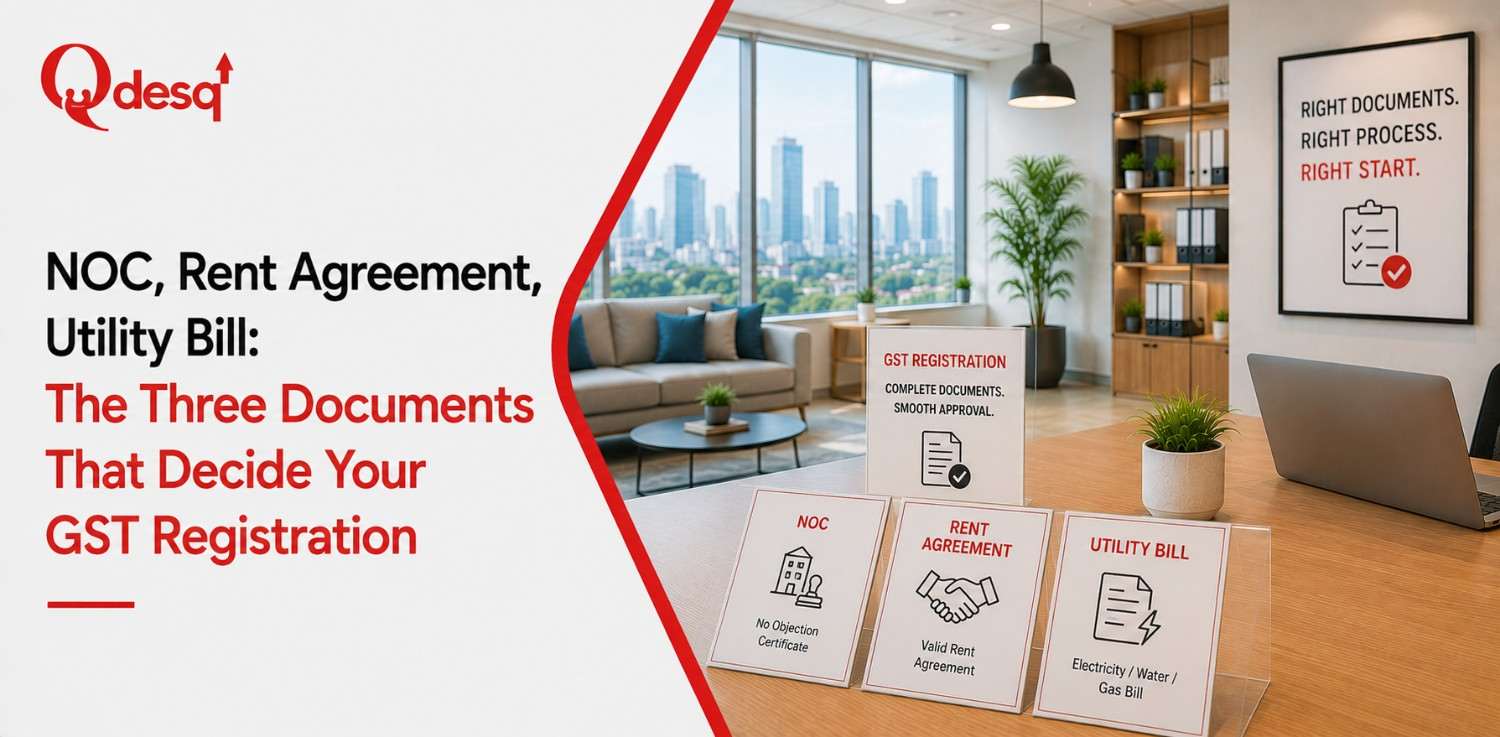
Your address proof for GST is a No Objection Certificate, a rent or leave-and-licence agreement, and a utility bill. That is the whole set — whether the premises are your own, a leased office, or a virtual office address. Get all three right and the application clears; get one wrong and you receive a Form GST REG-03 clarification notice, lose a week to ten days, and re-file. This is what each document has to contain, what invalidates it, and what actually happens if an officer comes to look.
A city-specific worked example of the full set is in documents required for setting up a virtual office in Delhi NCR.
Document 1 — The NOC for GST registration
An NOC for GST registration is a letter from the owner or authorised occupier of the premises stating they have no objection to your business using the address to register. It is the document officers scrutinise most closely, because it is the one most often produced casually.
A valid NOC for GST registration has all six of these:
- Printed on the official letterhead of the owner or virtual office provider
- The full legal name of your business, spelled exactly as on your PAN and application
- The complete address of the premises — building, floor, unit number, locality, city, state, PIN
- An explicit statement of no objection to use for GST registration (registration purposes should be named, not implied)
- The company stamp or seal
- The signature and name of an authorised signatory, with designation
What invalidates it: plain paper instead of letterhead. A missing stamp. A signature with no name or designation. A generic “no objection to use this address” that never mentions GST. Or — the most common — a business name that differs by a word from your PAN.
Ask your provider to send the draft NOC before you file, and read it against your PAN card side by side.
Document 2 — The rent or leave-and-licence agreement
This is the formal agreement between your business and the owner or provider granting you the right to use the premises. Under Instruction No. 03/2025-GST, dated 17 April 2025, a registered rent agreement together with proof of the lessor’s ownership is sufficient for rented premises — and officers were directed not to demand the lessor’s identity documents on top of that.
What it must show:
- Both parties named correctly — your business exactly as registered, and the owner or provider
- The premises described in full, matching the NOC and the utility bill word for word
- A clear term, with the start date on or before your filing date
- Signatures of both parties
On notarisation: it is not a national requirement, but several state GST offices process notarised agreements executed on stamp paper more smoothly, and providers who notarise as standard tend to see fewer clarification notices. If your provider treats notarisation as a paid add-on, take it — the cost is trivial against a ten-day delay. In Maharashtra the convention is a registered leave-and-licence agreement, so confirm what your Mumbai or Pune provider includes before you file.
Where it goes wrong: an agreement dated after the application. A term that has already expired. A different unit number from the one on the NOC. Or an unsigned draft sent by mistake.
Document 3 — The utility bill
The utility bill establishes that the premises physically exist and are being paid for. In practice this is an electricity bill from the relevant state distribution company, in the owner’s or provider’s name.
Two rules, both absolute:
- Dated within the last two months at the time of filing. Not the last quarter, not “the most recent one we have on file.” Ask for a fresh bill when you are ready to file, not when you sign up.
- Address identical to the NOC and the agreement. A shortened building name, a missing floor, an old plot number — any of these reads as a mismatch.
A property tax receipt or municipal khata copy is accepted as an alternative where ownership rather than tenancy is being established. For virtual offices, the electricity bill in the provider’s name is the standard route — a BESCOM bill for a Bangalore address, a BSES bill for Delhi, a DHBVN bill for Gurgaon, and so on.
The six reasons applications get a REG-03 notice
| Reason | What it looks like | The fix |
|---|---|---|
|
Name mismatch |
“Pvt Ltd” on the NOC, “Private Limited” on the PAN |
Reconcile character-for-character across PAN, NOC, agreement and application before filing |
|
Stale utility bill |
Bill more than two months old at filing |
Request a current bill inside your filing window |
|
Address inconsistency |
Floor or unit number differs between the three documents |
Have the provider reissue all three from one master address string |
|
Weak NOC |
Plain paper, no stamp, no designation, GST not named |
Insist on a formatted NOC; do not accept a letter |
|
Failed verification |
Premises unmarked, unstaffed, or not matching the file |
Choose a staffed centre with signage and prior verification experience |
|
Address density flag |
Very high number of GSTINs at one premises with no operational presence |
Ask the provider how many entities are registered there and whether the address has been flagged |
Our complete guide to virtual offices for GST registration, MCA compliance and bank approval covers what happens on the MCA and banking side of the same document set. A Form GST REG-03 notice is a request for clarification, not a rejection. You get a defined window to respond in Form GST REG-04. Answer it precisely — attach the corrected document, explain the discrepancy in one paragraph, and do not re-argue points that were not raised. Ignoring it, or responding after the window, is what converts a clarification into a rejection.
What a physical verification actually checks
Under Rule 25 of the CGST Rules, 2017, applications assessed as risky — or where Aadhaar authentication was not completed — are referred for physical verification. An officer visits, records findings with photographs, and uploads a report in Form GST REG-30, generally at least five working days before the decision deadline.
There is a persistent myth that the officer is checking whether you work there. They are not. They are confirming three things:
- The premises exist and are identifiable. The building, floor and unit on the application match what is physically there.
- You have a legitimate right to be there. The documents on file correspond to the arrangement in reality.
- The business can be contacted at that address. Someone can receive a notice, a courier or a visitor.
Which is why the difference between a virtual office that passes and one that fails has nothing to do with the concept and everything to do with the operator. Signage displaying registered company names, staff present during business hours, a receptionist who knows what to do when a GST officer arrives — those are the variables. Completing Aadhaar authentication at the application stage also materially reduces the likelihood of being referred in the first place.
This matters most in the cities with the densest concentration of flexible workspace registrations — Bangalore, Delhi, Gurgaon, Mumbai and Hyderabad — where state officers see the same addresses repeatedly and know which ones are staffed.
Sellers registering across several states hit these failure modes repeatedly — maximising GST benefits with virtual offices covers the multi-state version of this checklist.
The pre-filing checklist
Run this the day before you file, not the day you sign up.
- Business name matches character-for-character across PAN, incorporation documents, NOC, agreement and application.
- NOC is on letterhead, stamped, signed with name and designation, and names GST registration explicitly.
- Agreement is executed, currently in term, and notarised where your state office prefers it.
- Utility bill is dated within the last two months and in the provider’s name.
- The address string — building, floor, unit, locality, PIN — is identical on all three documents.
- Aadhaar authentication is complete for the primary authorised signatory and at least one promoter or partner.
- The premises are in the correct state for the GSTIN you are applying for.
- You have confirmed the provider has handled a physical verification at this centre before.
Eight checks, perhaps twenty minutes. Against a clarification notice that costs seven to ten days, it is the highest-return twenty minutes in the whole process.
Frequently asked questions
What should an NOC for GST registration contain?
An NOC must be on the owner’s or provider’s official letterhead and include your full legal business name as it appears on your PAN, the complete premises address, an explicit statement of no objection to using the address for GST registration, the company stamp, and the signature, name and designation of an authorised signatory. A plain-paper letter without a stamp is routinely rejected.
Is a notarised rent agreement mandatory for GST registration?
Not as a national requirement. However, several state GST offices process agreements notarised on stamp paper more smoothly, and providers who notarise as standard report fewer clarification notices. Instruction No. 03/2025-GST confirms that a registered rent agreement plus proof of the lessor’s ownership is sufficient for rented premises.
How recent must the utility bill be for GST registration?
Within the last two months at the time of filing. An older bill is one of the most common reasons a Form GST REG-03 notice is issued. Request a fresh bill from your provider when you are ready to submit rather than relying on the copy you received at onboarding.
Why do GST registration applications get rejected?
Most rejections trace to six causes: a business name mismatch across documents, a utility bill older than two months, address inconsistency between the NOC, agreement and bill, a weakly drafted NOC, a failed physical verification, or a flag raised by an unusually high number of registrations at one premises. Almost all are preventable before filing.
What is a REG-03 notice and how do I respond?
Form GST REG-03 is a request for clarification issued when the officer finds a discrepancy or needs additional information. You respond in Form GST REG-04 within the stated window, attaching the corrected document with a brief, specific explanation. It is not a rejection — but failing to respond in time becomes one.
What does a GST officer check during physical verification?
Under Rule 25 of the CGST Rules, 2017, the officer confirms that the premises exist and match the building, floor and unit stated in the application, that your documented right to use them is genuine, and that the business can be identified and contacted there. Findings and photographs are filed in Form GST REG-30. The officer is not assessing whether you work at the address daily.
The practical takeaway
Three documents, eight checks. The businesses that clear GST registration first time are not the ones with the best lawyers — they are the ones who read the NOC against their PAN card before filing and asked for a current utility bill instead of an old one.
Qdesq works with virtual office providers who issue formatted NOCs, notarised agreements and current utility bills as standard, and who have handled physical verification at their centres before.
Find a GST-ready virtual office address in the state you need, or share your requirement and we’ll match you to providers whose document sets clear first time.


