


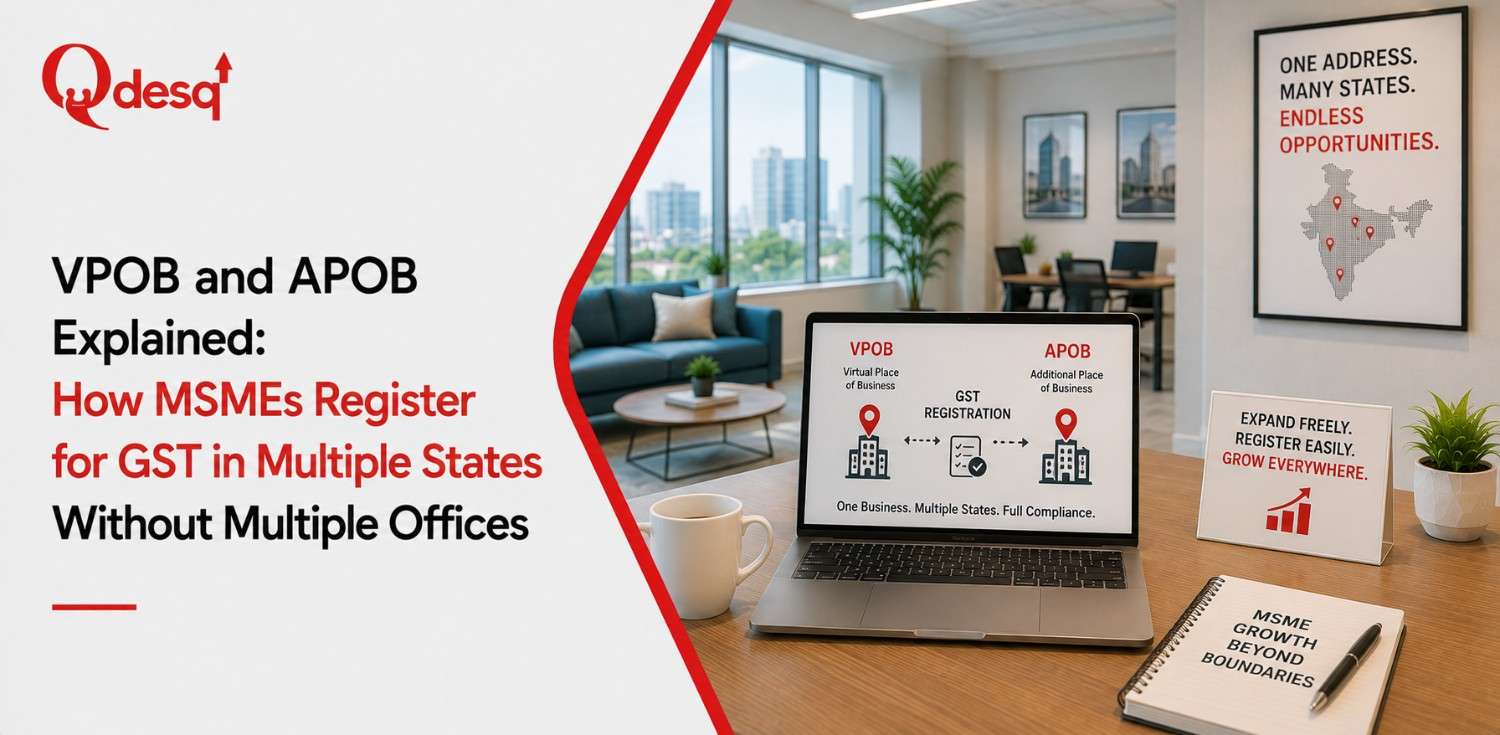
A Jaipur homeware brand wants to sell nationally and hold stock in six fulfilment centres. Their accountant quotes the traditional route: an office in each of six states, at ₹25,000 a month, is ₹18 lakh a year before deposits and fit-out — for premises nobody will ever sit in, because the actual inventory lives in a third-party warehouse. The virtual route costs roughly ₹65,000 to ₹1.3 lakh a year for the same six state registrations. Same compliance, same GSTINs, same legal standing.
That gap is the entire reason VPOB and APOB have become standard vocabulary for Indian sellers. India’s e-commerce market is projected to reach US$163 billion by 2026 at a 27% CAGR, with more than 1.2 million active marketplace sellers — and every one of them holding stock outside their home state faces the same arithmetic.
Here is what the two terms mean, why multi-state registration is compulsory rather than optional, and how the sequencing actually works. For the seller-side view of the same problem, see maximising GST benefits with virtual offices for eCommerce sellers.
VPOB and APOB — what each term means
These get used interchangeably in sales copy. They are not the same thing, and confusing them produces filings that bounce.
|
Term |
Full form | What it is |
Status in GST law |
|---|---|---|---|
|
PPOB |
Principal Place of Business | The main location from which business is carried on in a given state, declared in Form GST REG-01 |
A statutory concept under the CGST Act, 2017 |
|
VPOB |
Virtual Place of Business | An industry term for a PPOB supplied by a virtual office provider rather than premises you lease |
Not a statutory term — it describes *how* you obtained your PPOB |
|
APOB |
Additional Place of Business | Any further premises in the same state under the same GSTIN — warehouse, fulfilment centre, branch |
A statutory concept; added by amending your registration |
The important nuance: VPOB is not a special category in GST law. There is no “virtual” registration type. You are declaring a Principal Place of Business, exactly as any business does. The word “virtual” only describes where the address came from. Officers assess it against the same Form GST REG-01 document list as any other rented premises.
Why multi-state registration is compulsory, not optional
GST registration is state-wise, not national. There is no single Indian GSTIN. If you have a taxable presence in a state, you register in that state.
For sellers, the trigger is inventory. The moment your goods are physically stored in a state — in an Amazon fulfilment centre, a Flipkart facility, a 3PL warehouse or your own godown — you have a place of business there and need a GSTIN for that state. Marketplaces enforce this at the platform level: you cannot activate a fulfilment centre in a state without producing a GSTIN for it.
This is not a formality that can be deferred. Storing stock in a state without registration exposes you to tax demands, penalties and, in practice, deactivation of the fulfilment option that made the expansion worthwhile in the first place.
This is the mechanism behind how virtual offices help businesses establish a pan-India presence. The same logic increasingly applies beyond marketplaces. ONDC had onboarded over 1.16 lakh retail sellers across 630+ cities as of December 2025; distribution businesses, D2C brands and B2B suppliers moving stock across state lines face an identical requirement.
The cost model
Six states, one year, comparing like for like.
| Physical office per state | Virtual office (VPOB) per state | |
|---|---|---|
|
Monthly cost |
₹25,000 (conservative) |
₹900–₹1,800 |
|
Annual cost per state |
₹3,00,000 |
₹10,800–₹21,600 |
|
Six states, annual |
₹18,00,000 |
₹64,800–₹1,29,600 |
|
Security deposit |
3–6 months rent per state |
Typically nil |
|
Fit-out |
₹2–5 lakh per state |
Nil |
|
Setup time |
6–12 weeks per state |
2–5 working days |
|
Operational value |
None, if stock sits in a 3PL |
None — and none is required |
The point is not that virtual is cheaper. It is that the physical office in each state is doing no work at all in this scenario. The inventory is in a fulfilment centre. The team is in the home state. The premises exists solely to satisfy a state-wise registration requirement — which is precisely what a documented address is for.
The sequencing that works
Order matters. Doing this out of sequence is the most common source of delay.
- Establish the state GSTIN first, using a VPOB as your PPOB. File Form GST REG-01 with the virtual office as Principal Place of Business, supported by the provider’s NOC, agreement and current utility bill. If your monthly output tax liability on supplies to registered persons stays under ₹2.5 lakh, the Rule 14A simplified route — in force since 1 November 2025 — grants registration electronically within three working days.
- Then add the fulfilment centre as an APOB under that same GSTIN, by amending your registration. You will need the warehouse address and the operator’s supporting documentation.
- Then activate the fulfilment option with the marketplace, quoting the state GSTIN.
- Repeat per state. Mumbai for Maharashtra, Gurgaon for Haryana, Bangalore for Karnataka, Chennai for Tamil Nadu, Hyderabad for Telangana, Noida for Uttar Pradesh, Jaipur for Rajasthan, Indore for Madhya Pradesh, and so on.
The same sequencing underpins how virtual offices help startups build a pan-India brand presence. Trying to register the warehouse itself as your PPOB rarely works, because the operator will not issue an NOC naming your business for a shared fulfilment facility. The VPOB exists to solve exactly that gap.
How to add an Additional Place of Business in GST
Adding an Additional Place of Business in GST is an amendment to an existing registration, not a fresh application.
- Log in to the GST portal and open Services → Registration → Amendment of Registration (Core Fields).
- Select the Additional Place of Business tab.
- Enter the complete address of the new premises — warehouse, fulfilment centre or branch — with the nature of possession and the reason for the addition.
- Upload supporting documentation for the premises.
- Verify with DSC or EVC and submit.
Core field amendments require officer approval. Where the documentation is clean, this typically completes within a few working days; where it isn’t, expect a clarification notice on the same grounds that trip up fresh registrations.
Where this goes wrong
Treating VPOB as a loophole. It isn’t one — the document standard is identical to any other registration, as set out in virtual office in India for GST and company registration. The premises must be real, the provider must be genuinely in occupation, and the address must survive a Rule 25 physical verification. Buying the cheapest address in the state, from a provider with no signage and no staff, is how a multi-state expansion becomes a multi-state problem.
Registering the wrong state. Your VPOB must be in the state whose GSTIN you want. A Navi Mumbai address gives you Maharashtra; it does nothing for Gujarat, however close the border.
Address density. State GST offices increasingly look at how many active registrations sit at one premises. Ask your provider directly how many entities are registered at that address and whether it has been flagged before. A good provider answers; a poor one deflects.
Forgetting the APOB. Registering the state GSTIN and then storing stock at an unregistered warehouse leaves you exposed. The APOB filing is not optional housekeeping — it is what makes the inventory location lawful.
Skipping Aadhaar authentication. Applications without it are materially more likely to be referred for physical verification, which turns a three-day process into a multi-week one across every state simultaneously.
Frequently asked questions
What is the difference between VPOB and APOB?
A VPOB (Virtual Place of Business) is an industry term for a Principal Place of Business supplied by a virtual office provider — the address on which you obtain a state GSTIN. An APOB (Additional Place of Business) is a statutory concept: any further premises in the same state added under that same GSTIN, typically a warehouse or fulfilment centre. You need the VPOB first, then add the APOB to it.
Do I need GST registration in every state where I store inventory?
Yes. GST registration is state-wise. Once goods are physically stored in a state — including at a marketplace fulfilment centre or a third-party warehouse — you have a place of business there and require a GSTIN for that state. Marketplaces enforce this before activating fulfilment in a new state.
How do I add an Additional Place of Business in GST?
Adding an Additional Place of Business in GST is done by amending your existing registration. Log in to the GST portal, go to Services → Registration → Amendment of Registration (Core Fields), open the Additional Place of Business tab, enter the full address with nature of possession and supporting documents, then verify with DSC or EVC. Core field amendments require officer approval and typically complete within a few working days.
Can I use a virtual office as my Principal Place of Business for e-commerce?
Yes. A virtual office is accepted as a PPOB where the documentation matches Form GST REG-01 — NOC, rent or leave-and-licence agreement and a utility bill dated within the last two months. This is the standard route for sellers who need a state GSTIN but hold inventory in a third-party fulfilment centre rather than their own premises.
How much does multi-state GST registration cost with virtual offices?
Virtual office GST packages generally run ₹900–₹1,800 a month per state, so six states cost roughly ₹65,000 to ₹1.3 lakh a year. Leasing physical premises in six states at ₹25,000 a month would come to about ₹18 lakh a year before deposits and fit-out.
How long does it take to get GST registration in a new state?
Under the Rule 14A simplified route, in force since 1 November 2025, eligible applicants receive registration electronically within three working days. Applicants outside that route depend on officer processing, and a physical verification under Rule 25 of the CGST Rules, 2017 extends the timeline.
The practical takeaway
Multi-state GST is not a tax problem, it is an address problem — and it has an address-shaped solution. Register the state GSTIN on a properly documented virtual office, add the fulfilment centre as an APOB underneath it, and spend the ₹17 lakh you didn’t put into six empty offices on inventory instead.
Qdesq lists GST-ready virtual office addresses across 120+ cities, so a seller expanding into six states can source all six PPOBs from one place.
Set up your state GSTIN addresses across India, or share your expansion plan and we’ll map an address to every state you need to register in.


