


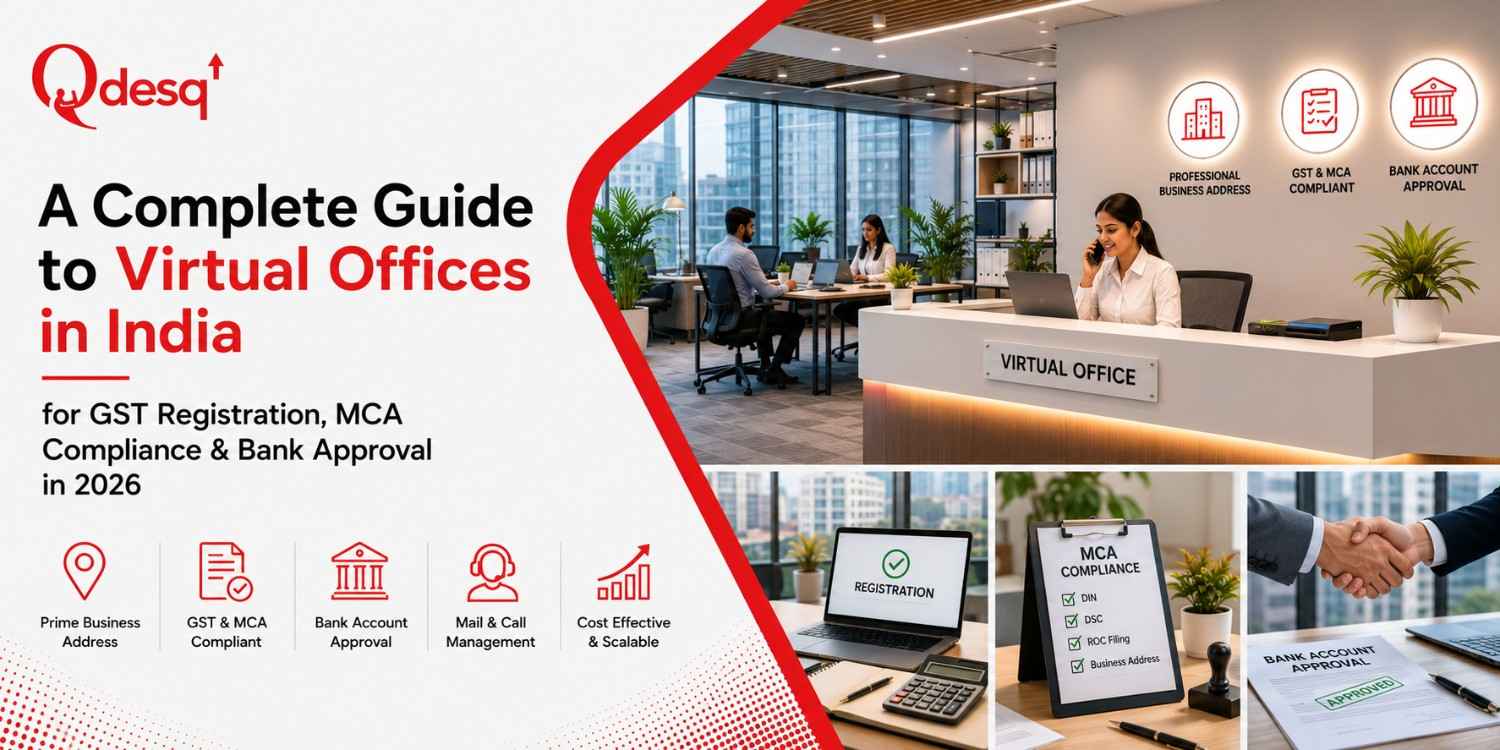
Is a virtual office address legally valid for GST registration and company incorporation in India? The short answer is yes — a virtual office address is legally valid for GST registration and company incorporation in India, provided you choose the right setup and documentation.
Virtual offices have surged in popularity as businesses seek cost-effective ways to establish a professional presence across multiple states. Yet the compliance landscape remains nuanced, with many applications still facing rejection due to incomplete paperwork or unsuitable providers.
This in-depth guide answers the central question for CFOs, legal heads, and finance leaders: What exactly do the GST department, MCA, and banks accept — and what leads to outright rejection? We draw from official rules, recent CBIC circulars, and field experience as of mid-2026.
Related: Virtual Office in India for GST & Company Registration — Full Guide
Understanding Virtual Offices in the Indian Context
What Exactly Is A Virtual Office, And How Does It Differ From Other Arrangements?
A virtual office delivers a commercial business address, mail management, and communication services without requiring full-time physical occupancy. It serves as a legitimate base for official registrations while supporting remote or distributed teams.
Three Main Plan Types Commonly Available in 2026
- Compliance-Focused GST and MCA Plans: These include comprehensive documentation packages — notarised lease agreements, NOCs, and utility bills — plus support for physical verifications. Designed specifically for registrations.
- Business Address and Mail Handling Plans: Provide a prestigious address, scanned mail forwarding, call answering, and occasional access to meeting rooms.
- Basic Address Services: Minimal offerings that may suffice for branding but often fall short for regulatory scrutiny.
Key distinction: Genuine virtual offices operate from real commercial premises with proper infrastructure. Pure PO boxes or residential setups typically fail compliance checks.
What Businesses Need to Know About the Requirements of the CGST Act and Rules
Can you obtain GST registration using a virtual office address in India? Yes — it is fully permissible when the address qualifies as a ‘place of business’ and is backed by appropriate evidence.
The CGST Act, 2017 (Section 2(85)) broadly defines a place of business to include premises from which business is carried out or where goods/services are supplied. There is no explicit prohibition on managed or shared addresses. The focus remains on verifiability and the ability to receive official communications.
Core Documents Typically Required for GST Approval
- Valid rent or service agreement (notarised where demanded)
- No Objection Certificate (NOC) from the property owner or provider
- Recent utility bill (electricity or water, usually within 2-3 months)
- Proof of business activity such as a name board or operational records
CBIC Instruction No. 03/2025-GST emphasises adherence to prescribed documents and discourages arbitrary additional demands when basic proofs are in place.
State-Specific Nuances and Verification Practices
- Maharashtra, Karnataka, and Delhi often conduct physical inspections more rigorously
- Providers with established commercial buildings and signage generally pass these checks smoothly
- Rejection commonly occurs with generic templates, blacklisted addresses, or lack of mail-handling capability
GST registration via virtual office succeeds consistently when premises are authentic and documentation clearly establishes right to use — a pattern confirmed by AAR rulings and field practices observed across 2025-2026.
Detailed Comparison of GST-Compliant vs. Problematic Virtual Office Setups
| Feature | Compliant Setup (High Approval Rate) | Risky Setup (Frequent Rejections) |
| Address Nature | Commercial building with signage and visitor access | Residential or PO Box equivalent |
| Documentation Package | Notarised agreement + NOC + utility bill + support letters | Basic consent letter or mismatched docs |
| Physical Verification | Provider coordinates visits, maintains records | No response or inaccessible during business hours |
| Mail & Communication | Official handling with logs and forwarding | No dedicated receiver or proof of delivery |
| Provider Experience | Multiple successful registrations, established track record | New entrant with limited track record |
MCA and Company Registration: Distinct Requirements
Does the Ministry of Corporate Affairs (MCA) accept virtual office addresses for registered offices? Yes — under Section 12 of the Companies Act, 2013, as long as the address can receive and acknowledge communications.
Companies file via SPICe+ (INC-32) and may need INC-22 for changes. Required proofs mirror GST but emphasise ongoing functionality.
Key Conditions
- The registered office must be functional for the service of notices
- Name board and visibility requirements apply
- Frequent address changes attract scrutiny and fees
Recent MCA focus targets non-compliant or shell setups, but genuine virtual offices with proper agreements continue to be widely approved. Small companies benefit from simplified norms.
| Aspect | MCA (Companies Act) | GST (CGST Framework) |
| Primary Focus | Registered office for communications | Place of business for tax and operations |
| Verification | ROC scrutiny during incorporation/inspections | Field visits by GST officers |
| Document Overlap | Agreement, NOC, utility bill | Same + emphasis on business activity proof |
| Change Process | Form INC-22 within 30 days | Amendment via GST portal |
| Penalty Risk | High for non-functional address | Cancellation or notices for unverifiable address |
The Often Overlooked Challenges of Banking and KYC Compliance
Will banks accept a virtual office for opening a current account? Many do — but it depends on internal risk policies rather than a uniform RBI rule.
RBI KYC Master Directions prioritise customer due diligence, allowing flexible proofs for genuine addresses. However, banks may request site visits, business proofs, or KYC alignment for directors.
Common Bank Practices in 2026
- Acceptance of virtual addresses from reputable providers with full documentation
- Video KYC or Contact Point Verification (CPV) increasingly used
- Stricter scrutiny for high-risk sectors or large transaction profiles
Factors for Smoother Bank Approval
- Opt for Grade A/B commercial locations
- Prepare comprehensive files including GST certificates and incorporation documents
- Engage with relationship managers early and test with smaller banks if needed
- Leverage RBI’s risk-based approach for startups
Essential Criteria for Selecting a Reliable Virtual Office Provider
- Address Quality and Commercial Validity: Located in verifiable commercial zones with proper infrastructure. Avoid high-density suspicious clusters.
- Documentation Strength: Robust, customisable agreements and NOCs that withstand audits. Providers should offer liability support.
- Mail and Communication Reliability: Professional handling with digital tracking, scanning, and secure forwarding. Critical for official notices.
- Access and Verification Support: On-demand meeting rooms, visitor management, and coordination for GST/MCA/bank visits.
- Scalability Across Cities: Presence in 50+ locations with consistent standards for multi-state GST and expansion.
| Criteria | What to Verify | Red Flags to Avoid |
| Compliance Track Record | Client testimonials, success rate data | Vague claims, no references |
| Cost Structure | Transparent pricing, no hidden renewal fees | Extremely low rates signalling poor service |
| Technology & Support | Online portal for mail, responsive support | Manual processes, poor responsiveness |
| Legal Backing | Agreements vetted for regulatory use | Generic templates without customisation |
| Multi-State Capability | PAN-India network with state-specific docs | Limited geography |
Strategic Advantages of Virtual Offices for 2026
Virtual offices enable rapid market entry into new states without significant upfront capital commitments. Unlike traditional office leases — which often require security deposits, fit-out costs, and long-term lock-ins — virtual offices offer a more flexible and cost-efficient alternative that can meaningfully reduce occupancy and setup costs while maintaining a professional business presence.
For international companies, virtual offices simplify multi-state compliance presence. Startups benefit from focusing resources on growth rather than real estate management.
Also see: Maximising GST Benefits with Virtual Offices — A Strategic Guide
Frequently Asked Questions
Is a virtual office address valid for GST registration in India?
Yes — a virtual office is a legally valid address for GST registration in India under the CGST Act, 2017, provided the address is a genuine commercial premises and you submit the correct documentation: a notarised service/lease agreement, NOC from the property owner, recent utility bill, and evidence of business activity. States like Maharashtra, Karnataka, and Delhi conduct stricter physical inspections, so provider quality matters significantly.
Can I use a virtual office for company registration under MCA?
Yes. Under Section 12 of the Companies Act, 2013, a virtual office address qualifies as a registered office as long as it can receive and acknowledge communications, meets name board requirements, and has proper documentation. The filing is done through SPICe+ (INC-32) and any address changes require Form INC-22 within 30 days.
Will banks accept a virtual office address for opening a current account?
Many banks do, but acceptance depends on the bank’s internal risk policy rather than a uniform RBI mandate. To improve approval chances: choose a Grade A/B commercial address, prepare a full documentation package including GST certificate and incorporation documents, and engage the relationship manager before applying. Video KYC is increasingly used as an alternative to physical site visits.
What documents are needed for virtual office for GST registration in India?
The standard required documents are: (1) valid rent or service agreement (notarised in states that require it), (2) No Objection Certificate from the property owner or operator, (3) recent utility bill for the premises (electricity or water, within 2-3 months), and (4) evidence of business activity such as a name board photograph. CBIC Instruction No. 03/2025-GST discourages GST officers from demanding documents beyond these prescribed proofs.
What is the cost of a virtual office in India for GST compliance?
Virtual office plans in India for GST registration typically range from ₹1,500 to ₹5,000 per month depending on the city, provider reputation, and documentation package included. Premium Grade A business addresses in Gurugram, Mumbai BKC, or Bengaluru’s outer ring road command higher rates but offer significantly better compliance success rates and bank acceptance.
| If you’re planning to register a company, obtain GST registration for virtual office, or expand into new markets without the cost of a traditional office, Qdesq can help simplify the process. With GST-ready virtual offices across 120+ cities, comprehensive documentation support, and access to premium business addresses, Qdesq enables businesses to build a compliant presence quickly and efficiently. Start your virtual office setup with Qdesq today and build your presence anywhere in India. |


