


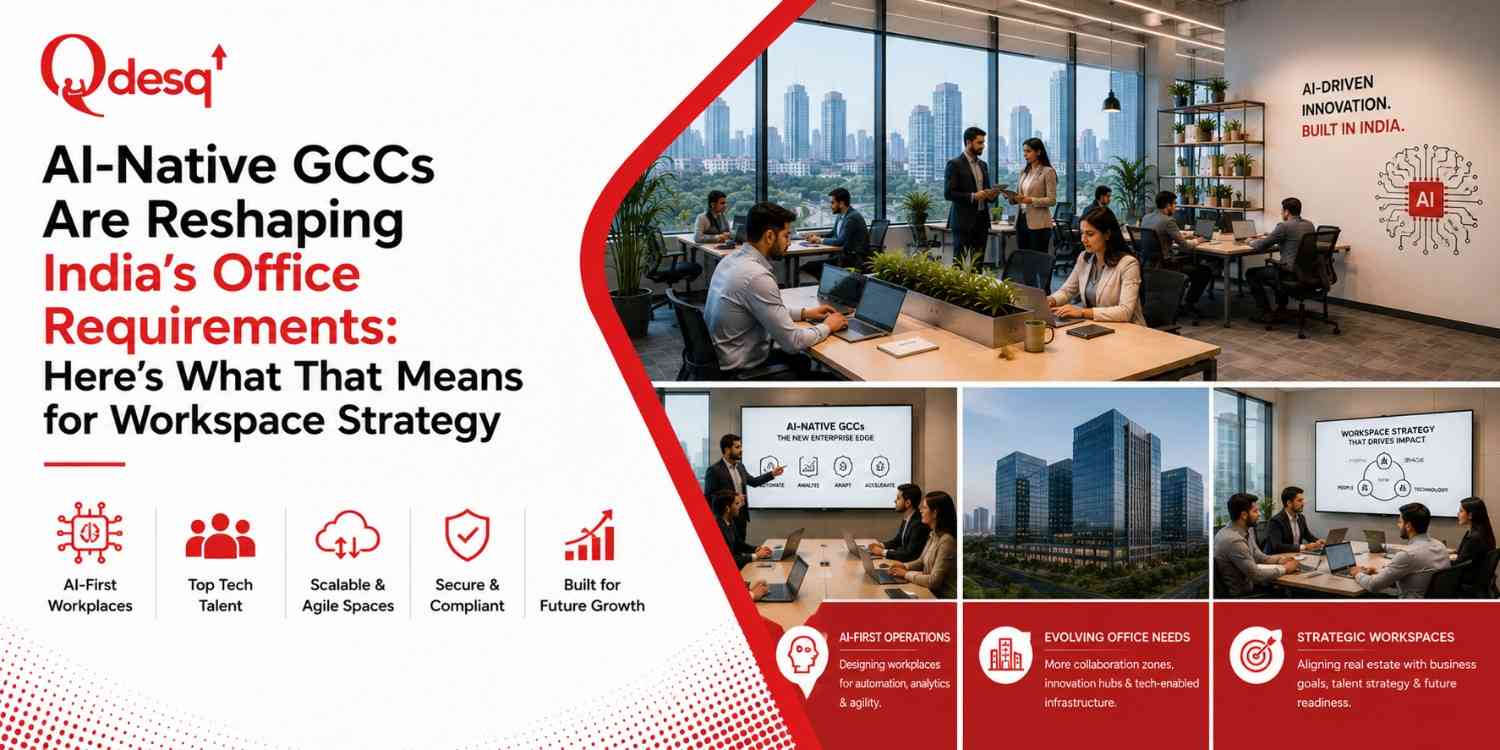
For nearly two decades, the Global Capability Centre (GCC) model in India was built on a simple equation: Headcount = Output. The playbook was straightforward. Hire thousands of engineers for process delivery, IT support, and maintenance. Put them in large, efficient office layouts. Measure success by how fast the team scaled.
That era is ending. In 2026, the conversation among GCC Heads and COOs is not about ‘cost per seat’ anymore. It is about AI-native transformation. The mandate from global headquarters has shifted from ‘deliver cheaper’ to ‘deliver autonomously.’
According to the EY GCC Pulse Report 2025, 83% of GCCs are already investing in Generative AI, with pilots increasing from 37% in 2024 to 43% in 2025. This is not just about chatbots; it is about Agentic AI — autonomous systems handling complex reasoning tasks, moving beyond Robotic Process Automation (RPA) to meaningful automation of routine operational workflows.
If your GCC is going AI-native, the old office — designed for heads-down processing — will actively work against you. You do not just need a different lease; you need a different managed office space India strategy.
Also read: GCC Office Space Requirements: Compliance, Security & Scalability
What AI-Native Actually Means for GCC Headcount and Team Structure
The first question every GCC leader asks is: Does AI mean I hire fewer people? The short answer is yes, but only if you are hiring for routine roles. The longer answer is that business growth will outpace headcount growth. We are entering an era of leaner, higher-velocity teams.
Data from The Economic Times and staffing firm NLB Services indicates a structural shift in hiring. Backfill mandates — replacing every employee who leaves — have dropped to 70-75 replacements per 100 exits, down from 85-90 in prior years. Companies are consolidating responsibilities rather than doing one-to-one replacements.
The Team Restructure
- The Disappearing Middle: Certain middle-management layers that primarily handled information routing, reporting, and basic quality control are being restructured as AI absorbs those coordination functions.
- The Rise of the AI-Led Pod: A typical team in 2026 looks like: 1 Product Architect (Human), 1 AI/ML Engineer, 3 Subject Matter Experts (Prompt Engineers/Validators), and autonomous agents handling the execution layer.
- Skill Inflation: According to Neeti Sharma, CEO of TeamLease Digital, hiring demand for niche AI, Data, Cloud, and Cybersecurity skills has risen by 40-50%, while demand for generalist entry-level IT support is collapsing.
| Metric | Traditional GCC | AI-Native GCC |
| Primary Role | L1 Support / Manual QA | AI Model Trainers / Validators |
| Hiring Focus | Volume (Generalists) | Precision (Niche AI/Cyber) |
| Team Structure | Rigid Hierarchy (5+ layers) | Agile Pods (2-3 layers) |
| Backfill Rate | 85-90% | 70-75% |
| Growth Driver | Headcount Addition | Output per Employee |
The Workspace Implication: Less Desk Space, More Brain Space
If you are currently negotiating a lease based on a 100 sq. ft. per person ratio for a processing centre, stop. The AI-native GCC needs a fundamentally different office design. When you automate the routine, the humans left in the office are doing strategic oversight, exception handling, and creative problem-solving. Your managed office space India setup is no longer a factory floor; it is a collaboration hub.
Key Design Changes for AI-Augmented Teams
1. The Death of the Individual Cubicle Farm
If the majority of routine tasks are automated, humans are not typing spreadsheets all day. They are reviewing AI outputs, debugging logic flows, or brainstorming. This requires collaboration-heavy layouts.
- Reduce individual workstations by up to 40%. Increase team pods, war rooms, and huddle spaces.
- For every 10 technical staff, you now need 3 small collaboration rooms instead of 1 large meeting room.
2. The Emergence of the AI Ethics & Governance Zone
Research from EY’s GCC Pulse and other industry analyses points to a significant portion of GCCs establishing dedicated AI governance teams by 2026. These teams require visual privacy and secure display zones — you cannot have an open office layout where someone is reviewing sensitive model output on a screen visible from the common area.
3. Infrastructure for Human-in-the-Loop (HITL) Operations
Agentic AI still needs human validation for high-stakes decisions. Your managed office must support high-bandwidth, low-latency connectivity to handle real-time data streaming between the human validator and the AI model. Cognizant’s India AI Lab in Bengaluru specifically co-locates AI researchers with design studios to shorten the innovation loop — a model increasingly replicated across GCC India setups.
The Talent Brief Has Changed: Choosing the Right City
The war for talent has shifted geography. While Bengaluru remains the AI capital for deep research, cost and attrition pressures are driving a strategic pivot. NASSCOM reports that over 50% of new GCC expansions are moving beyond Tier-1 cities.
| Capability | Tier-1 Champion | Tier-2 Challenger | Why the Shift? |
| Core AI / Deep Learning | Bangalore (IISc Corridor) | Hyderabad | Bangalore for R&D leadership; Hyderabad for scaled AI execution at lower cost |
| Cloud & DevOps | Hyderabad | Kochi | Kochi offers strong retention for cloud infrastructure teams vs higher metro attrition |
| QA Automation | Pune | Coimbatore | Coimbatore and similar Tier-2 hubs offer stable, long-term validation teams |
| Scalable Engineering | Hyderabad/Pune | Indore | Lower costs and stable attrition; ideal for backend/APIs feeding AI models |
Use a bipolar strategy for 2026: Leadership and complex R&D stay in Bangalore or Hyderabad where the senior architects live. Scaled execution and platform stability move to Indore, Coimbatore, or Kochi. This hub-and-spoke approach is increasingly the playbook for AI-native GCC India operations.
See: Beyond Bengaluru: The Strategic Imperative for Tier-2 GCC Expansion
Security and Compliance Infrastructure for AI Operations
The move to AI-native operations introduces a non-negotiable requirement: Sovereign AI and Data Governance. Unlike standard IT support, AI models consume your company’s proprietary data.
Sify Technologies has highlighted that GCCs now require a ‘Sovereign AI Digital Foundation’ — which includes zero-trust security architectures covering the entire AI lifecycle from data ingestion to model execution. This has direct physical implications for office design.
- Physical Data Zones: Your office layout must segment ‘Red Zones’ (where live customer data or model training occurs) from ‘Yellow Zones’ (general admin). Access must be biometric and logged.
- High-Density Compute Adjacency: AI teams often need on-premise sandboxes. Your managed office provider must offer enterprise-grade IT infrastructure and the ability to physically lock down server rooms.
Office Design for AI-Native GCCs: The 2026 Specification
The Old Checklist (2023)
- Low cost per seat
- Cafeteria quality
- Proximity to the metro
The AI-Native Checklist (2026)
- High-Bandwidth Redundancy: AI teams cannot have lag. You need dedicated fibre with failover. Managed offices often excel here — 30-day setup vs 9-18 months for direct lease fit-outs.
- Flexible Scaling: The ‘start lean, scale later’ model is dominant. Nearly 60% of new GCC setups come from mid-market firms with 50-300 FTE. You need managed office space India that can grow without relocating.
- Designated Focus Zones: To build AI, humans need deep focus time. Your layout needs quiet zones for complex problem-solving alongside loud zones for collaboration.
- Continuous L&D Infrastructure: With skills evolving rapidly, you need on-demand training rooms. Space for upskilling is now an operational expense, not a perk.
| Feature | Direct Lease (Grade A) | Managed Office (Plug & Play) |
| Time to Occupancy | 9-18 months | 30-60 days |
| CapEx Requirement | High (₹800-1500/sq ft fit-out) | Zero |
| IT/Security Setup | You build it (Slow) | Pre-installed enterprise-grade |
| Governance Zones | Customisable (Expensive) | Often flexible/adaptable |
| Best For | Mature, 500+ FTE, stable layout | Agile, AI pods, 50-400 FTE |
Final Words
The GCC in India is no longer a back-office support centre. In 2026, it is the engineering brain of the global enterprise. To support a brain, you cannot use a factory floor. Your workspace strategy must enable precision collaboration, not just bulk processing. You need lower attrition from Tier-2 cities, higher bandwidth from managed infrastructure, and layouts that prioritise human-to-human interaction for the tasks AI cannot do.
As you plan your next phase of growth, do not look for the cheapest square footage. Look for the ecosystem that understands AI-native operations and can deliver enterprise-grade managed office space India at the speed and scale your GCC model demands.
Frequently Asked Questions
What type of managed office space does an AI-native GCC in India need?
An AI-native GCC needs: (1) dedicated Red/Yellow data zones with biometric access controls, (2) high-bandwidth redundant connectivity with sub-20ms latency for real-time AI validation workflows, (3) collaboration-heavy layouts with 3 small huddle rooms per 10 staff rather than traditional open plan, (4) lockable on-premise server infrastructure for AI sandboxes, and (5) on-demand L&D spaces for rapid upskilling. Managed offices typically deliver this in 30-60 days versus 9-18 months for direct lease fit-outs.
Which Indian cities are best for AI and data science talent for GCCs in 2026?
Bengaluru’s IISc corridor remains the primary destination for core AI research and deep learning talent. Hyderabad is the strongest challenger for scaled AI execution at lower cost. Pune is strong for QA automation and analytics. For stable, cost-effective backend engineering that feeds AI models, Tier-2 cities like Indore, Coimbatore, and Kochi are increasingly chosen — with significantly lower attrition than metro hubs.
How does a managed office support an AI-native GCC’s operations better than a direct lease?
Managed offices offer three AI-specific advantages over direct leases: (1) 30-60 day setup time versus 9-18 months for fit-outs, allowing GCCs to operate and iterate before committing to permanent layouts; (2) pre-installed enterprise IT with scalable bandwidth and security zoning that can be adapted as AI workflows evolve; (3) flexible seat counts that match the GCC’s ‘start lean, scale rapidly’ model without relocation costs.
What is a Red Zone in an AI-native GCC office?
A Red Zone is a physically segregated area within the office where live customer data processing, model training on proprietary datasets, or AI inference on sensitive inputs takes place. It requires biometric access control, CCTV with audit logs, no shared network infrastructure, and often restricted personal device policies. Red Zones are distinct from Yellow Zones (general admin and collaboration areas), and this physical segregation is increasingly required by RBI, GDPR, and HIPAA compliance frameworks for BFSI and healthcare GCCs.


