


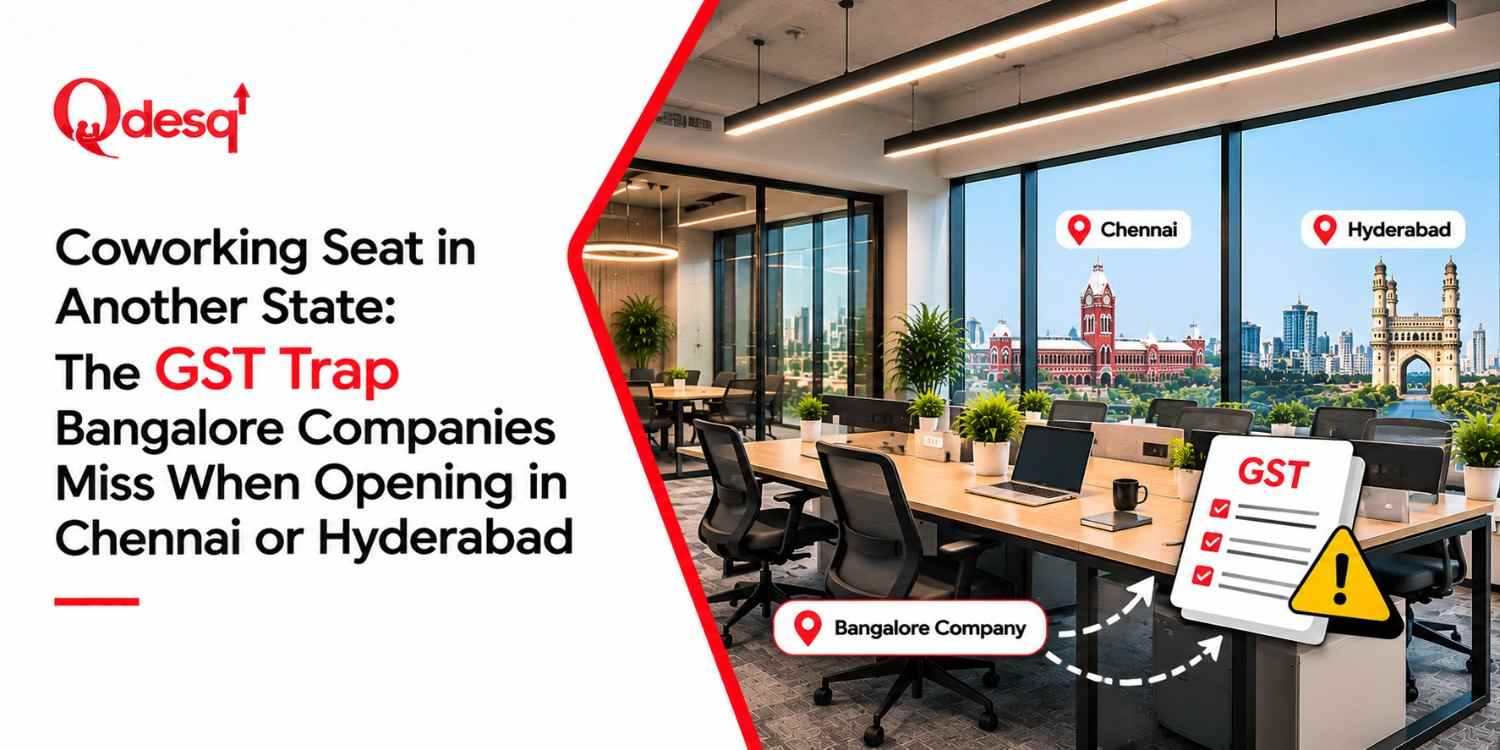
The most expensive line on a branch-office invoice is often the tax you cannot claim. A Bangalore company that takes a coworking seat in Chennai or Hyderabad can pay 18% GST every month and still be unable to set it off against anything.
GST on office rent follows the location of the property, not the location of your head office. If a Karnataka-registered company rents a coworking seat in Chennai, the operator charges Tamil Nadu CGST and SGST, and the credit is generally available only to a person registered in Tamil Nadu. Without that registration, the 18% is effectively a cost unless you register in that state or route the credit through an input service distributor. This article explains the rule, the options and the invoice checks. It is general information, not tax advice; confirm your structure with a chartered accountant.
Key takeaways
|
Why GST on office rent follows the property
Under Section 12(3) of the IGST Act, the place of supply for services connected with immovable property, including renting, is where the property is located. Your own registration state does not decide it. Tax commentary (ClearTax) records the consequence: CGST and SGST credit of one state cannot be used to set off the liability of another, so a business with no registration in the property’s state has nothing to set the credit against.
| Scenario | Property and operator | What the operator charges | Can a Karnataka GSTIN use the credit? |
|---|---|---|---|
| Seat in Bangalore | Karnataka | Karnataka CGST + SGST at 18% | Yes, if the invoice carries your GSTIN and ITC conditions are met |
| Seat in Chennai, no Tamil Nadu registration | Tamil Nadu | Tamil Nadu CGST + SGST at 18% | Not against Karnataka liability; the tax is a cost |
| Seat in Chennai, Tamil Nadu registration and invoice on that GSTIN | Tamil Nadu | Tamil Nadu CGST + SGST at 18% | Against Tamil Nadu output tax, if any |
| Seat in Hyderabad, Telangana registration and invoice on that GSTIN | Telangana | Telangana CGST + SGST at 18% | Against Telangana output tax, if any |
Rent on non-residential property is commonly billed at 18% under SAC 997212. Operators may classify membership fees differently, so ask which code your invoice will carry.
What it costs when the credit cannot be used
The leakage is simple arithmetic. Twenty seats at listed prices produce a monthly GST bill that never comes back if there is no matching registration.
| City | Per seat (₹) | 20 seats (₹) | GST at 18% a month (₹) | Over 12 months (₹) |
|---|---|---|---|---|
| Chennai (decent campus, starting price) | 8,000 | 1,60,000 | 28,800 | 3,45,600 |
| Hyderabad (decent campus, starting price) | 7,000 | 1,40,000 | 25,200 | 3,02,400 |
Illustrative arithmetic on decent-campus starting prices per desk (₹8,000 in Chennai, ₹7,000 in Hyderabad), November 2026. Not a tax computation.
In scale terms, the ₹3,45,600 a year lost on 20 Chennai seats would pay the rent of about 3.6 more seats for the same year. Even a ten-seat team feels it. Ten seats in Chennai at ₹8,000 carry ₹14,400 of GST a month, or ₹1,72,800 a year, which is why the registration question deserves an answer before the lease is signed.
Do you need a GST registration in the other state?
Not automatically. Establishments in different states under the same PAN are treated as distinct persons for GST, and registration in a state is linked to taxable supplies made from it. Hiring a seat for staff who support sales booked from Bangalore does not by itself trigger a registration in Tamil Nadu, although tax commentary notes that such fact patterns need case-specific review. Within one state, a new location is added as an additional place of business under the existing GSTIN; across states, it needs a fresh registration.
If you decide to register in the other state, the coworking address becomes your registered address there, which means it must hold up to a physical verification. For multi-state registration without a lease in every state, see VPOB and APOB Explained: How MSMEs Register for GST in Multiple States Without Multiple Offices.
A worked example: a 15-person Hyderabad hub (illustrative)
A Karnataka-registered software company opens a 15-seat engineering hub in Hyderabad, serving clients it invoices from Bangalore. Fifteen seats at ₹7,000 come to ₹1,05,000 a month, plus ₹18,900 of Telangana GST. Because the hub makes no taxable supplies, a Telangana registration would only collect credit it cannot yet use. The sensible questions are whether the hub will eventually invoice from Hyderabad, whether ISD fits, and whether 18% on ₹1,05,000 is simply a budgeted cost for the first year. The answer changes the day the hub starts billing clients.
Your options for GST on office rent in another state, from simplest to most structured
Four routes exist, from paying the tax to restructuring who contracts the seat. The right one depends on seat count, commitment length and whether the branch will invoice customers.
- Accept the tax as a cost. Reasonable for one or two seats on a short commitment. Budget 18% on top of every invoice and stop looking for credit.
- Register in the other state and take the invoice on that GSTIN. The credit can be set off against Tamil Nadu or Telangana output tax, if the branch supplies anything. If it does not, the credit accumulates rather than disappears, which still needs planning.
- Use the input service distributor mechanism. From 1 April 2025, ISD registration is mandatory for businesses that centrally receive and allocate credit on common input services, and the distributor allocates credit by turnover, converting CGST and SGST into IGST for units in other states. TaxGuru’s summary says a Section 122 penalty of the greater of ₹10,000 or the credit irregularly distributed can apply to failing to register where required and to distributing wrongly, and wrongly allocated credit is recovered with interest.
- Restructure the arrangement. In some cases the right answer is a different contracting entity or a different place of supply. That is an advisory call, not a template.
ISD applies to services used across more than one registration under one PAN. Whether a single-branch seat fits that definition, or is simply better invoiced to the branch’s own GSTIN, is the question to put to your CA first.
Which route fits which situation
Seat count, length of commitment and whether the branch will invoice customers decide the route more than anything else. This table is our read, not tax advice; put it to your CA.
| Your situation | Route to discuss with your CA | Why |
|---|---|---|
| One or two seats, under six months | Accept the 18% as a cost | The effort of a new registration outweighs the tax |
| The branch will invoice customers from the other state | Register there and take the invoice on that GSTIN | The credit sets off against that state’s output tax |
| A branch of 50 to 100+ seats that will invoice | Register in that state and take a managed floor on that GSTIN | A managed office scales past 100 seats, and one agreement gives one state-wise invoice stream |
| The branch only supports head-office sales, ten or more seats, long commitment | Ask whether ISD or a different invoicing entity fits | The leak is largest here: 20 seats at ₹8,000 lose ₹3,45,600 a year |
| The seat is booked in a founder’s or parent’s name | Fix the contracting entity before you sign | An invoice in the wrong name produces no usable credit |
Operator invoice checks before you sign
Check five things on the first invoice before you sign, because a seat billed to the wrong entity or state produces credit you cannot use.
- The operator’s GSTIN is in the same state as the property. Otherwise the tax split will differ from what you expect.
- Your legal entity and GSTIN are on the agreement and invoice. A seat contracted in a founder’s name produces an invoice you cannot use.
- Separate invoices for each state. If you take seats in both Chennai and Hyderabad, do not accept a combined bill; ask every operator for the same terms by posting one requirement that covers both cities.
- SAC code and tax split are shown clearly. Query anything that reads IGST on a same-state property.
- The monthly invoice date is stable. Credit is claimed in the month of the invoice, subject to reconciliation in GSTR-2B.
Frequently asked questions
Is GST charged on coworking space?
Yes. GST on office rent applies to coworking too: seat and cabin rent is generally billed at 18% GST, and the same applies to virtual office plans. The tax is charged on the invoice and, for a registered business in the same state as the property, is normally claimable as input tax credit subject to the usual conditions.
Can I claim input tax credit on coworking rent in another state?
Only against a registration in that state. The place of supply for property rent is the property’s location, so the operator charges that state’s CGST and SGST, and one state’s credit cannot be used against another’s liability. Without a local registration, treat the tax as a cost.
Do I need GST registration in another state for a coworking seat?
Not merely because you rent a seat. Registration is linked to taxable supplies made from a state, and establishments under one PAN in different states are distinct persons. If you want to claim credit locally or supply from that state, you will need one. Get a CA’s view on your facts.
What is an input service distributor and is it mandatory?
An ISD is a registration that receives invoices for common services and distributes the credit to branches. From 1 April 2025 it is mandatory for businesses that centrally receive and allocate credit on common input services. A Section 122 penalty of ₹10,000 or the credit amount, whichever is higher, can apply to failing to register or distributing wrongly.
Which SAC code applies to coworking rent?
Rent on non-residential property is commonly classified under SAC 997212 at 18%. Some operators bill membership or business-support services under a different code. Ask the operator which code appears on the invoice and why, because the code and the tax split must agree with the place of supply.
What to watch next
Hyderabad’s office leasing rose 47% year on year to 9.4 million sq ft in January to September 2026, according to Colliers, and flex space took 12.6 million sq ft nationally, up 37%. More Bangalore companies are about to open seats in Hyderabad and Chennai, and the GST question will arrive with the first invoice. Settle the treatment of GST on office rent before the lease, not after the first return.
Opening in both Chennai and Hyderabad? Put it in one requirement. Qdesq quotes seats in Chennai and Hyderabad from 6,000+ centres across 140+ cities, with a separate state-wise invoice and the operator’s GSTIN for each city stated before you sign. Post one requirement covering both cities, your entity and GSTIN, and your expected start of invoicing, and compare quotes on the same terms.
Related reading
Two published guides cover GST across states.
- Maximizing GST Benefits with Virtual Offices | A Strategic Move for eCommerce Sellers: how multi-state sellers use virtual addresses
- How Virtual Offices Help Businesses Establish Pan-India Presence: how one team covers several states


