


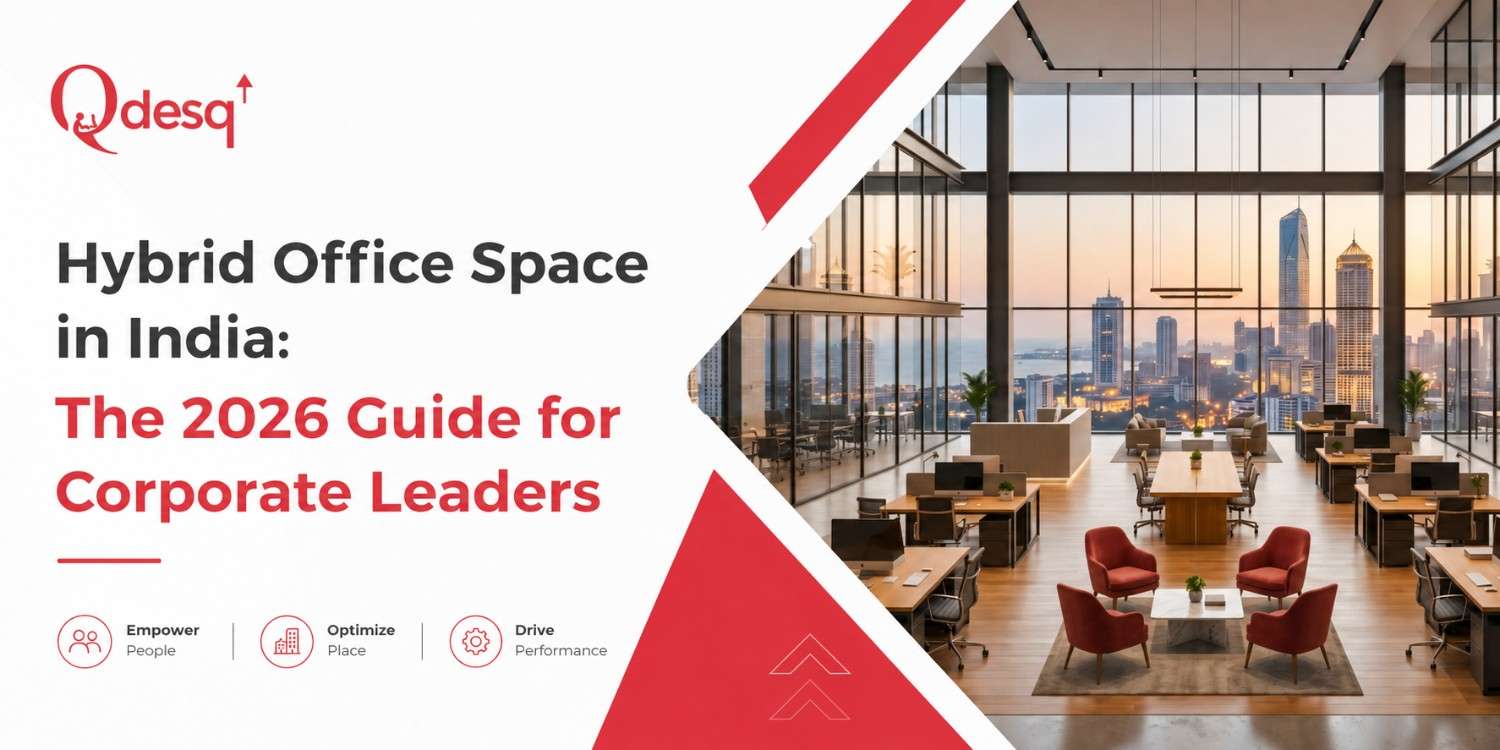
Remember when “hybrid work” was just a desperate Zoom call from a kitchen table? Fast forward to 2026, and the landscape in India has shifted so fundamentally that the term “office” no longer even means a building; it’s an ecosystem.
If you’re leading a corporate team or a Global Capability Centre (GCC) in India right now, you aren’t just managing real estate; you’re managing an experience. The “Great Return to Office” debate is officially over, and what’s left is a sophisticated, high-stakes game of flexibility. Here is your guide to navigating the hybrid office in India this year.
Beyond Seat Utilisation: The Strategic Shift to Purpose Density
For decades, success for Indian corporate leaders was often tied to physical presence at fixed workstations. In 2026, that metric is dead. The most successful leaders have pivoted to Purpose Density.
Recent data shows that over 60% of large organisations in India now operate on a hybrid model. But here’s the thing no one is telling you: the office isn’t for “work” anymore. It’s for connection. If your team comes in just to sit on laptops and ignore each other, you’ve failed.
2026 is the year of Activity-Based Workstations (ABW). Instead of assigned desks, your office should look more like a collection of “zones”:
- The War Room: For high-stakes brainstorming.
- The Library: For deep, silent focus.
- The Lounge: Biophilic breakout zones where “watercooler moments” actually happen.
The Rise of the “Hub-and-Spoke” 2.0
We’ve moved past the “one big HQ in Gurgaon or Bangalore” phase. Why? Because the 2-hour commute through peak traffic is the #1 killer of retention.
In 2026, we are seeing a massive shift toward secondary cities and Suburban hubs.
- The Hub: A flagship experience centre in a Tier-1 city for brand culture and client meetings.
- The Spoke: Managed offices or coworking spaces in Tier-2 cities like Jaipur, Indore, and Kochi, or even suburban clusters like Noida Sector 2 & 3.
Research indicates that demand in non-metro markets is growing nearly twice as fast as in Tier-1 cities. By placing “Spokes” where your talent actually lives, you aren’t just saving on Grade-A rentals; you’re giving your employees 10 hours of their life back every week. That is the ultimate 2026 “perk.”
Sustainability is a Talent Magnet
If your 2026 ESG goals are still just a PDF on your website, your Gen Z recruits are already looking elsewhere. 62% of Gen Z employees now coach their older colleagues on AI, but they are also the ones demanding designs that don’t feel like a concrete box.
The “Biophilic” trend has matured. It’s no longer about putting a snake plant on a desk. We’re talking about:
- Smart HVAC: Systems that track CO2 levels to prevent the “afternoon slump.”
- Low-Carbon Fit-outs: Using reclaimed wood and textiles that improve acoustics.
- Adaptive Lighting: Lights that mimic the sun’s natural cycle to support circadian rhythms.
When you walk into a top-tier coworking space in 2026, it should feel “life-friendly.” This isn’t just about aesthetics; it’s about psychological safety.
AI: Your Invisible Workplace Concierge
In 2026, technology is the AI Copilot that runs the building.
The biggest challenge leaders face is “The Hybrid Gap”, when three people are in a room, and four are on a screen.
The 2026 solution? Video-first collaboration suites and AI-driven room bookings. Imagine an office that “knows” your team is coming in on Wednesday and automatically reserves a cluster of desks near the coffee machine because that’s where you usually brainstorm. Or AI tools that summarise the physical whiteboard notes for remote participants in real time.
The “Culture Dilution” Trap (And How to Avoid It)
Here is the uncomfortable truth: Hybrid work can make your company feel like a group of freelancers working under the same logo.
To combat Culture Dilution, corporate leaders are moving away from “mandated days” to “Anchor Events.” Instead of saying “Be here Tuesday,” try “Wednesday is our Deep-Dive Day.”
Pro-Tip for 2026 Leaders: Focus on Unedited Authenticity. In your internal branding, stop showing polished, stock-photo offices. Show the real behind-the-scenes struggles, the messy whiteboards, and the authentic stories of how your team solved a problem. This builds a “creator-led” internal culture that feels more like a community and less like a hierarchy.
The Compliance and GST Headache
Let’s talk logistics. If you’re expanding into Tier-2 cities, you don’t always need a physical lease. Virtual Offices have become the secret weapon for GCCs in India for 2026. They allow you to maintain a legal registered address for GST compliance and official communication without the overhead of a 10-year lease. This “asset-light” approach is exactly how you stay agile in an unpredictable market.
Quick Check: Is Your 2026 Strategy Ready?
| Feature | Traditional Office | 2026 Hybrid Hub |
| Primary Goal | Occupancy | Purpose Density |
| Design | Cubicles/Open Plan | Biophilic |
| Location | CBD (Central Business District) | Hub-and-Spoke (Tier-2 focus) |
| Tech | Wi-Fi & Projectors | AI Copilots & IoT Tracking |
| Culture | Top-Down | Authentic & Creator-led |
The Future of Work is Human-Centric
In 2026, a hybrid office is a strategic asset for building culture and retaining top-tier talent. As a leader, your challenge is about creating an ecosystem where “Purpose Density” replaces the old metrics of mere attendance. Whether you are scaling a GCC or optimising a domestic team, success lies in balancing high-tech AI integration with high-touch human experiences, such as spontaneous chai-break conversations and biophilic design.
Qdesq helps you navigate this complex shift by discovering flexible workspaces across India that align with your 2026 vision. From managed offices in Tier-2 hubs to premium “Spoke” locations near the Blue Line, Qdesq provides 100% transparency and expert guidance to help you move into a space built for what’s next. Stop searching for desks and start building your team’s future with Qdesq today.


