


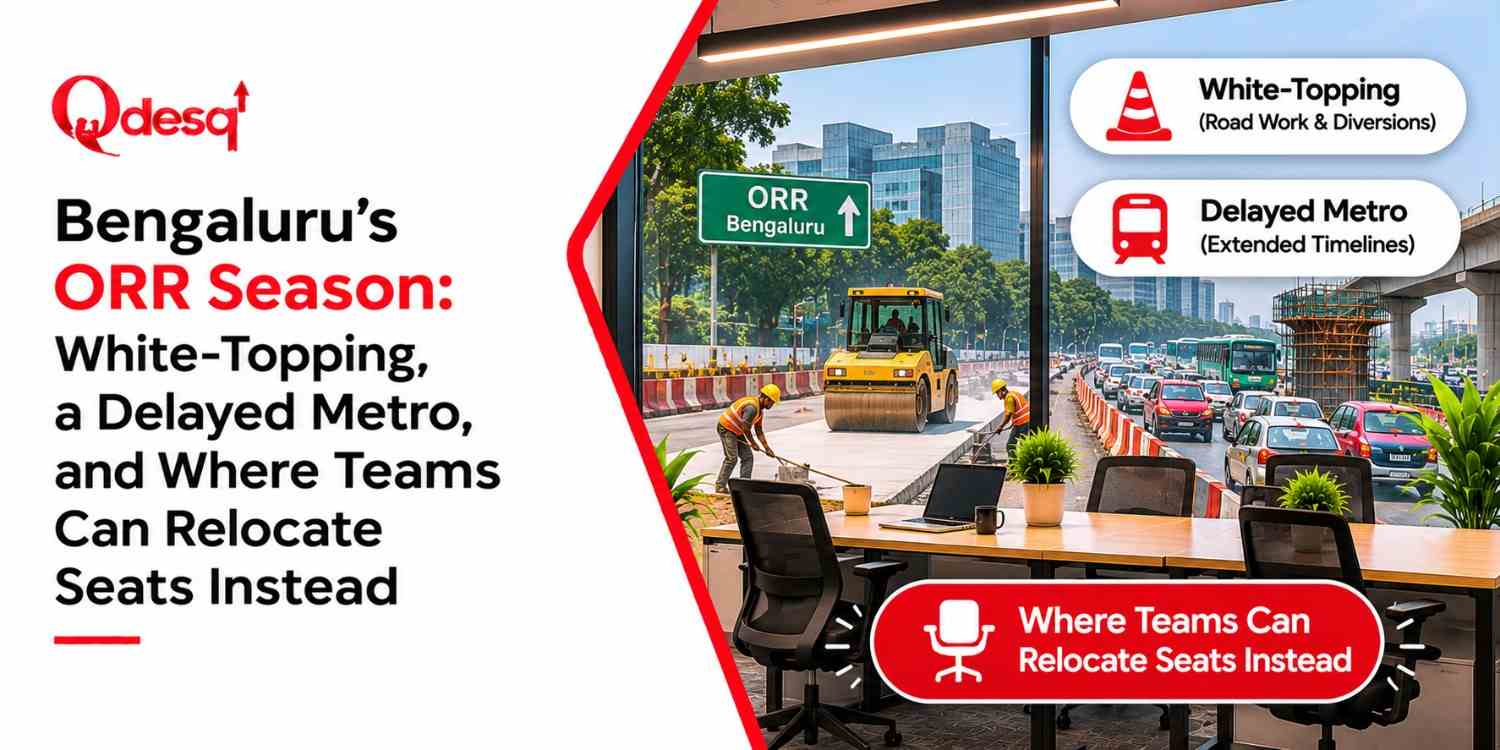
More than 500 companies, and by NativePlanet’s account 8 to 10 lakh employees, depend on the same 17-km stretch of Bengaluru’s Outer Ring Road. Between October 2026 and January 2027 that stretch is slated to be dug up for white-topping, and the metro meant to relieve it will still be months away.
For a team based between Silk Board and KR Puram, the workable answer is to split seats rather than wait out the works: keep a core group on the corridor and move people whose commute crosses the worst junctions into a coworking space in HSR Layout, Whitefield or Hebbal, closer to where they live. This article sets out what has been announced, what is still unconfirmed, and how to build a split-seat plan you can scale up or down as the roadworks move.
Key takeaways
|
What is confirmed about the ORR white-topping, and what is not
The ORR white-topping is a proposed ₹450-crore concrete resurfacing of about 17 km between Silk Board Junction and KR Puram, planned for October 2026 to January 2027, according to August 2026 reports.
- Scope and cost: ₹450 crore for the Silk Board–KR Puram stretch (BusinessToday, 18 Aug 2026).
- Window: October 2026 to January 2027 (NativePlanet).
- Objection: the Bengaluru Outer Ring Road Companies Association (ORRCA), which represents 500+ firms, wants major works to follow the metro opening and has asked for a technical comparison of white-topping and black-topping, plus a traffic simulation, a diversion plan and a construction-management plan coordinated with the Bengaluru Traffic Police and the Metro construction schedule.
- Reported mitigation: BusinessToday says officials were directed to facilitate 50% work-from-home arrangements so that construction can proceed. We did not find the detail of how this would apply to companies.
- Not confirmed: we did not find a published junction-by-junction schedule, so treat the October start and the phasing as provisional and check the latest Bengaluru Traffic Police advisories.
Why the metro delay matters more than the roadworks
The Namma Metro Blue Line was supposed to give ORR commuters an alternative before the road surface changed; on current timelines it will not. Reports put the ORR section at around June 2027, the Hebbal–airport section at September 2027, KR Puram–Hebbal in early 2028, and the full corridor at March 2028.
| Item | Reported timing | What it means for commuters |
|---|---|---|
| ORR white-topping (Silk Board–KR Puram) | Oct 2026 – Jan 2027 | Diversions and slower peak-hour movement on the corridor |
| Blue Line, ORR section | Around June 2027 (trial runs from October 2026, per NativePlanet) | No metro relief during the works |
| Blue Line, Hebbal–airport | Sept 2027 | North-side relief is later still |
| Blue Line, KR Puram–Hebbal / full corridor | Early 2028 / Mar 2028 | Full network benefit sits well beyond this winter |
| Pink Line, Bannerghatta Road elevated stretch | Interim speed certificate 12 Aug 2026; opening was targeted for late Sept after CMRS clearance and had not happened by then | South-side metro relief still awaiting approvals |
Sources: BusinessToday (18 Aug 2026); NativePlanet. Timelines are as reported and may change.
Four responses to the ORR works, in order of cost
Most companies will mix these rather than pick one, and the right mix depends on how much of your work needs a fixed place.
- Stagger start times. Free, but it only shifts the queue by an hour, and it does little for teams that run in shifts or need overlap with clients in other time zones.
- Anchor work-from-home days. Officials have been reported as directed to facilitate 50% work-from-home arrangements so construction can proceed, yet ORRCA’s position is that “Work From Home cannot be a substitute for effective infrastructure planning and traffic management.” Teams that need labs, hardware or client-facing days cannot lean on it, and managers of hybrid teams will tell you that two fixed days a week still means two heavy commute days.
- Add satellite seats near home. Cuts the number of people on the corridor without cutting office days. It is the only option here that keeps the in-person rhythm and shortens the commute at the same time.
- Relocate. Worth considering only where a lease is expiring anyway. A full move during the works trades a temporary problem for a permanent address change, with GST, vendor and employee-notification consequences.
Where to put satellite seats: a coworking space in HSR Layout, Whitefield or Hebbal
Match the satellite to where staff live, not to where the office sits: HSR Layout for south Bengaluru, Whitefield for the east, Hebbal for the north. One caveat applies to HSR Layout: it sits beside the Silk Board end of the works, so it suits people who already live south, not people arriving from the east or north. Whitefield suits the east because staff who live there can work close to home without joining the Silk Board–KR Puram stretch at all, though people who travel in from Marathahalli or KR Puram should check their own route; the Mahadevapura coworking spaces sit on that side. Hebbal does the same for the north, since the planned works end at KR Puram and do not cover the northern ORR. The Outer Ring Road page lists centres around HBR Layout, Banaswadi and Kammanahalli, beyond the end of the planned works.
| Staff home cluster | Satellite | Median desk price (₹/month) |
|---|---|---|
| South (JP Nagar, Jayanagar, Bannerghatta Road) | Coworking space in HSR Layout | ₹10,000 |
| East (Marathahalli, Varthur, Whitefield) | Coworking space in Whitefield | ₹9,500 |
| North (RT Nagar, Yelahanka, Hebbal) | Coworking space in Hebbal | ₹6,000 |
| For comparison: on the corridor | Bellandur | ₹9,500 |
| For comparison: central south | Koramangala | ₹9,000 |
Source: Qdesq listing data, per-desk monthly prices, October 2026, before 18% GST. Medians are of the listings shown on each micromarket page, not a market-wide survey.
On these listings, a coworking space in HSR Layout (₹10,000) costs slightly more per desk than Bellandur (₹9,500), while Hebbal (₹6,000) costs about 37% less. Choose HSR Layout for the commute it saves, not for the rent.
A split-seat plan for a 120-person team (illustration)
Start with home pin codes, not job titles. An illustrative split, which you should rebuild from your own data:
| Group | Seats | Where | Rule |
|---|---|---|---|
| Lab, hardware and client-facing roles | 50 | Stay on ORR | Fixed desks, all-week access |
| South-Bengaluru residents | 25 | HSR Layout | Month-to-month or short lock-in |
| East-Bengaluru residents | 25 | Whitefield | Month-to-month or short lock-in |
| North-Bengaluru residents | 20 | Hebbal | Month-to-month or short lock-in |
Three rules keep the plan reversible:
- One anchor day a week. Book a meeting room for the whole team so culture does not depend on the corridor.
- Short commitments. If the diversions are lighter than feared, you lose a month’s rent, not a year’s.
- A trigger for scaling. Agree in advance which announcement (a junction closure, a diversion order) moves another 10 people out.
What the split costs
Moving seats off the corridor costs about the same as keeping them there if your ORR seats are priced like Bellandur. In the illustrative plan above, the 70 satellite seats cost ₹6,07,500 a month at median prices before GST (25 × ₹10,000 in HSR Layout, 25 × ₹9,500 in Whitefield and 20 × ₹6,000 in Hebbal), or ₹7,16,850 with 18% GST.
The same 70 seats at the ₹9,500 Bellandur median would cost ₹6,65,000, so the split saves ₹57,500 a month before GST, about 9%, almost all of it from the Hebbal seats. The real return is commute time. At 120 seats, ask for a managed-office quote for one cluster instead of three separate coworking contracts: one agreement, one seat band and your branding on the door.
What to check before you sign a satellite seat
Five checks matter more than the seat price: guaranteed anchor-day seats, exit terms, the commute, internet redundancy and your GST registration.
- Whether seats are guaranteed on your anchor day, not just “available”.
- Lock-in, notice period and deposit refund terms.
- Distance from the nearest metro or bus corridor, and parking.
- Internet redundancy: ask for two providers.
- Whether the seat needs to be added to your Karnataka GST registration as an additional place of business. Ask your CA.
Frequently asked questions
When will the ORR white-topping start?
Reports from August 2026 give a planned window of October 2026 to January 2027 for the ₹450-crore, 17-km Silk Board–KR Puram stretch. A junction-wise schedule had not been published when we checked, so confirm the current phasing with Bengaluru Traffic Police advisories before changing your seating plan.
When will the Namma Metro Blue Line open?
Reported timelines differ by section: around June 2027 for the ORR section, September 2027 for Hebbal to the airport, early 2028 for KR Puram to Hebbal, and March 2028 for the full corridor. None of these gives relief during the winter 2026–27 roadworks.
Is a coworking space in HSR Layout cheaper than one in Bellandur?
No. On October 2026 listing data, the median desk in HSR Layout is ₹10,000 against ₹9,500 in Bellandur, so you pay slightly more for the shorter commute. Hebbal is the cheaper satellite at ₹6,000. These are medians of listed desks, so quotes for your headcount and lock-in will differ.
Can I keep my GST or registered-office address on the ORR if staff sit elsewhere?
Yes. Your registered office and principal place of business do not change because some employees work from satellite seats. If the new seat is used for business activity, ask your CA whether it must be added to your Karnataka GST registration as an additional place of business.
Will companies on the ORR be asked to allow work from home?
BusinessToday reported in August 2026 that officials were directed to facilitate 50% work-from-home arrangements so that construction can proceed. We did not find a binding order for companies, and ORRCA has said work from home cannot replace proper traffic management.
What to watch next
Three signals decide how much of the corridor you can safely keep: a published junction-wise schedule, any change to the Blue Line section dates, and the outcome of ORRCA’s talks with the government. If the schedule slips, an unused satellite seat costs a month’s rent; an unmanaged commute costs attrition.
Send Qdesq your team’s home pin codes before the works start. From 6,000+ centres in 140+ cities, we will map the nearest seats to where people live, such as HSR Layout, Whitefield and Hebbal, on month-to-month terms with anchor-day seats guaranteed. Compare Bangalore coworking spaces or post your requirement with your split by cluster.
Related reading
Four published guides cover flexible office choices in Bangalore.
- Shared Office vs. Managed Office Spaces in Bangalore | Which One Fits Your Needs?: which format fits which team
- Maximise Savings with Coworking Spaces in Bangalore: where flexible seats save money
- Bengaluru – The Largest Market for Office Space in India: how the city’s office market is structured
- Why India’s Top Corporates Are Choosing Flex Spaces in 2026: why large teams are moving to flex


