


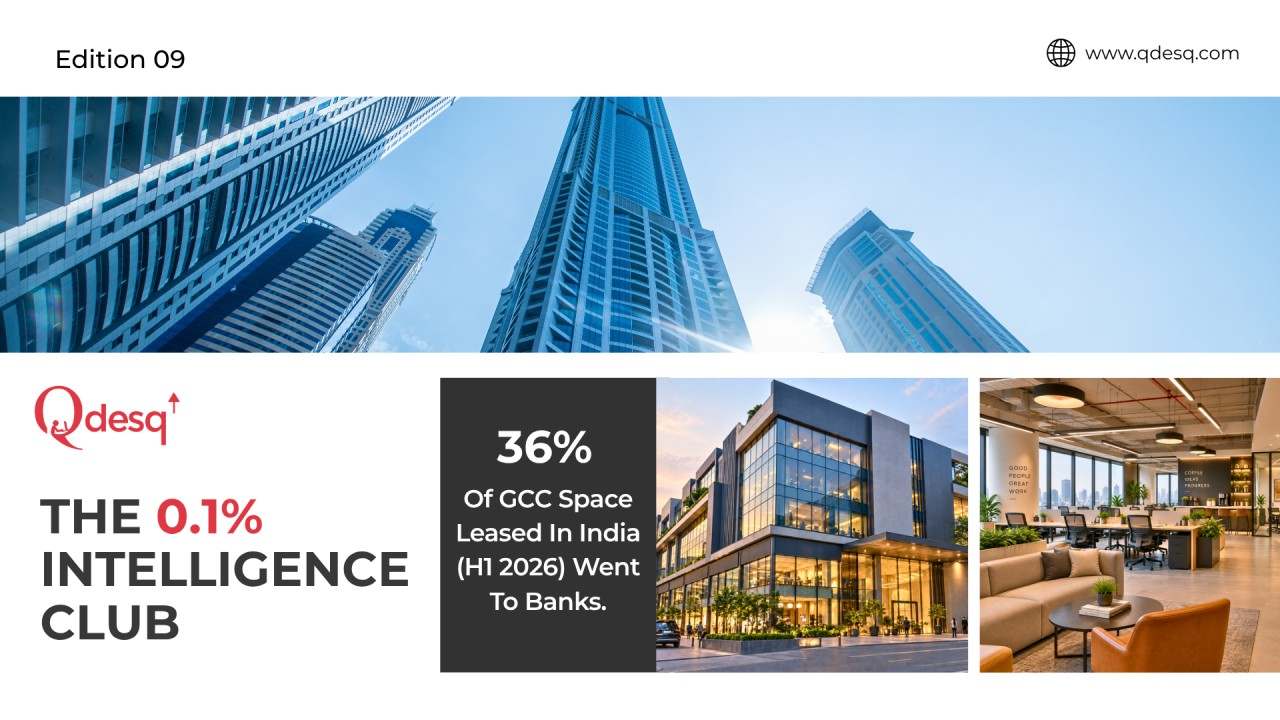
In H1 2026, banks and financial-services firms leased more GCC office space in India than tech companies: 7.32 million sq ft against 4.13 million sq ft (Knight Frank India). With the order flipped, BFSI is now the largest sector by GCC office leasing nationally.
What is this edition about?
The sector shift behind India’s GCC leasing, and one real BFSI lease broken down term by term.
India’s GCC leasing market has shifted. In H1 2026, BFSI firms leased 7.32 million sq ft, 36% of all national GCC leasing, surpassing IT/ITeS for the first time. This edition covers the sector shift, analyses a ₹180 crore Hyderabad transaction to show what a 2026 BFSI GCC lease looks like at contract level, and maps what this means for real estate strategies built on legacy tech assumptions.
Has BFSI overtaken IT/ITeS in GCC office leasing in India?
Yes. In H1 2026, BFSI leased 7.32 million sq ft against 4.13 million sq ft for IT/ITeS.
A year ago, tech led GCC leasing. Not anymore. In H1 2025, IT/ITeS companies leased 5.71 million sq ft of GCC office space against BFSI’s 4.31 million sq ft. By H1 2026 that had inverted: BFSI leasing rose 70% year on year to 7.32 million sq ft, while IT/ITeS fell 28% to 4.13 million sq ft (Knight Frank India, H1 2026 GCC report, via Business Standard). BFSI now holds a 3.19 million sq ft lead. For anyone modelling GCC demand around tech, H1 2026 upends that assumption.
How much GCC office space did each sector lease in H1 2026?
BFSI 7.32 msf (36%), other services 5.10 msf, IT/ITeS 4.13 msf and global manufacturing 4.05 msf.
BFSI now drives 36% of GCC office leasing in India, ahead of every other sector.
| Sector | H1 2025 (msf) | H1 2026 (msf) | Change |
|---|---|---|---|
| BFSI | 4.31 | 7.32 | +70% YoY |
| IT/ITeS | 5.71 | 4.13 | −28% YoY (now second overall) |
| Other services | 4.41 | 5.10 | Up |
| Global manufacturing | 4.67 | 4.05 | Down |
Total GCC leasing across Mumbai, Delhi-NCR, Bengaluru, Pune, Hyderabad, Chennai, Ahmedabad and Kolkata came to 20.6 million sq ft in H1 2026.
What does a 2026 BFSI GCC lease look like on paper?
CIBC’s first India GCC lease: 120,708 sq ft in Hyderabad, ₹180 crore over 5 years, at ₹225 per sq ft per month with 5% annual escalation.
The macro number is 7.32 million sq ft. Here is what one transaction looked like. In August 2026, CIBC signed its first India GCC lease: 120,708 sq ft across the 4th and 6th floors of Meenakshi Eco Park, Tower 1, Hyderabad. The deal is worth ₹180 crore over 5 years, at ₹225 per sq ft per month with 5% annual escalation, which reconciles arithmetically to the reported ₹180 crore. CIBC also posted a ₹16.30 crore security deposit (Business Standard; headline figures corroborated via NoBroker).
What it signals: a 5-year term with fixed annual escalation shows long-horizon commitment. Choosing a 5-year lease over a flexible entry reflects underwriting conviction in the India GCC model. For CRE leads and CFOs benchmarking BFSI GCC deals, this is a fully verified anchor point with real numbers attached.
Why do BFSI GCCs cluster in the same buildings?
They cluster near firms that share their compliance language, which is why flex and managed offices matter to the strategy.
BFSI entrants aren’t leasing in isolation. CIBC’s building, Meenakshi Eco Park Tower 1, also houses Uber, Invesco (a global asset manager) and Synechron (a capital markets and insurance tech consultancy). Choosing this location gives immediate proximity to tenants who have already cleared the same vendor, security and compliance diligence. Managed and flex spaces let BFSI entrants test these compliance-cluster locations before committing to long-term leases, which de-risks site selection without delaying entry.
Scoping a compliance-cluster building in Hyderabad for a BFSI GCC entry? Explore Qdesq’s Hyderabad workspace options.
How should real estate teams respond to the BFSI shift in H2 2026?
Stop benchmarking BFSI GCC real estate against tech-sector assumptions. They are no longer the same buyer.
- Re-segment your comparables. A BFSI GCC lease benchmark built on IT/ITeS data targets the wrong sector. Use BFSI-specific deals like CIBC’s, not blended averages.
- Underwrite for longer terms. CIBC signed a 5-year lease with fixed escalation. Model BFSI GCC demand as long-horizon commitment, not pilot behaviour.
- Map compliance clusters. Co-location of regulated tenants is now a site-selection signal independent of headline rent.
- Use flex to de-risk entry. A managed suite in a compliance cluster lets new BFSI entrants validate sites before committing long term.
- Recheck quarterly. Sector rankings shift fast, so verify H1 2026 trends each report cycle.
What does Qdesq see across its network?
Across our 6,000+ workspace centres in 140 cities, the fastest-growing demand over the last two quarters comes from banks, asset managers and insurers expanding into India.
For a decade, tech occupiers drove the GCC office market, and most real estate playbooks still reflect that. They ask different questions: compliance-grade fit-outs, phased ramp timelines and exit flexibility before a long lease. Standard tech playbooks simply misread what a BFSI GCC needs.
“For a decade, tech occupiers drove the GCC office market, and most real estate teams still pattern-match against that playbook. Across Qdesq’s network, the fastest-growing demand over the last two quarters comes from banks, asset managers, and insurers setting up in India. Their questions: compliance-grade fit-outs, phased ramp timelines, and exit flexibility before a long lease.”
— Prem Kumar, Director South, Transactions, Qdesq Proptech Group
Key takeaways from Edition 09
- BFSI leased 7.32 msf in H1 2026 (36% share, +70% YoY), surpassing IT/ITeS (4.13 msf, −28% YoY) for the first time.
- BFSI built a 3.19 msf lead over IT/ITeS in a single year, reversing the previous year’s trend.
- CIBC’s ₹180 crore, 120,708 sq ft, 5-year Hyderabad lease signals a long-horizon commitment, not a pilot entry.
- Clustering matters: co-locating near compliance-adjacent neighbours like Invesco and Synechron guides site selection for regulated entrants.
- Re-segment benchmarks: BFSI GCC occupiers operate differently from IT/ITeS buyers, so avoid tech-sector averages.
What is coming in the next edition?
What happens the first time a regulator asks where a bank’s data actually sits.
The next question isn’t how much space banks are leasing in India. It’s what happens when a regulator asks where their data sits.
A closing note
Every edition starts with the same discipline: don’t trust a number until it’s verified twice. This edition’s core figures cleared that bar easily. Leasing data matched across independent outlets, and the CIBC deal’s terms reconcile to the crore. One claim was cut: a compliance deadline that traced back to a single source. The story is stronger without it.
Frequently asked questions
Which sector leads GCC office leasing in India in 2026?
BFSI. In H1 2026, BFSI firms leased 7.32 million sq ft (36% of national GCC leasing), ahead of IT/ITeS at 4.13 million sq ft (Knight Frank India).
How much did BFSI GCC leasing grow in India?
BFSI GCC leasing rose 70% year on year, from 4.31 msf in H1 2025 to 7.32 msf in H1 2026, while IT/ITeS fell 28%, from 5.71 msf to 4.13 msf.
What are the terms of CIBC’s Hyderabad GCC lease?
120,708 sq ft across the 4th and 6th floors of Meenakshi Eco Park, Tower 1, for ₹180 crore over 5 years, at ₹225 per sq ft per month with 5% annual escalation and a ₹16.30 crore security deposit (Business Standard; NoBroker).
Who else is in CIBC’s Hyderabad building?
Meenakshi Eco Park Tower 1 also houses Uber, Invesco and Synechron.
Why does co-location matter for BFSI GCCs?
Neighbouring tenants have already cleared similar vendor, security and compliance diligence, so clustering is now a site-selection signal independent of headline rent.
Why use managed office space for a BFSI GCC entry?
A managed suite lets new entrants test a compliance-cluster location before committing to a long-term lease, which de-risks site selection without delaying entry.


