


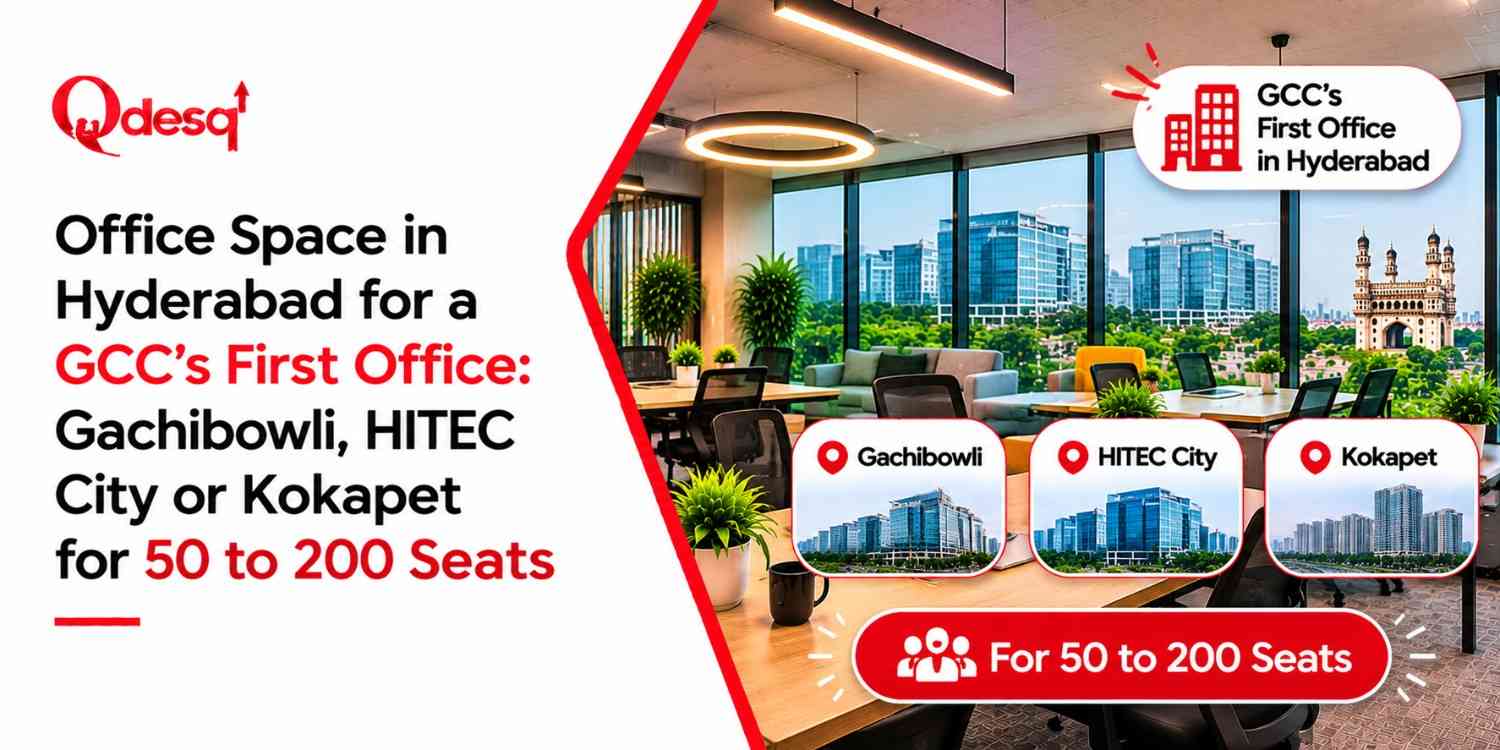
Hyderabad’s global capability centres took 3.4 million of the 7.5 million sq ft leased in the first half of 2026, according to Knight Frank, yet the question most first-time GCC leaders ask is only which corridor to pick. The better question is how many seats the parent company will approve in month 13.
For a GCC’s first office space in Hyderabad, the safe default is a managed office of about 50 seats, with a written right to expand to 100, 200 and beyond, in Gachibowli, HITEC City or the Financial District and Kokapet belt. A managed floor keeps working at 100+ seats, with your branding, a locked suite and no fit-out cheque. The managed-office guide puts Hyderabad at ₹8,500 to ₹18,000 per seat a month, while a lean lease costs about ₹16,200 per seat all-in at 100 seats under our model, with ₹2.6 crore of fit-out cash due up front. Below are the market picture, a corridor table, costs at 50, 100 and 200 seats, a staged plan and a security checklist.
Key takeaways
|
How big is the GCC wave behind office space in Hyderabad?
Hyderabad holds about a fifth of India’s GCC base, and JLL has it as the city where rents rose fastest in the second quarter. The indicators below come from five sources and measure different things, so read each against its own source.
| Indicator | Figure | Source |
|---|---|---|
| GCCs in Hyderabad | 515+ (March 2026), about 20% of India’s base; 70+ added in FY25 | Business Standard, 23 Sep 2026 |
| GCC share of H1 2026 leasing | 45% (3.4 of 7.5 million sq ft) | Knight Frank |
| Average rent | ₹80 per sq ft per month, up 7% year on year | Knight Frank |
| Rent growth, Q2 2026 | 3.6% on the quarter, 11.9% on the year; fastest of any city | JLL |
| Most active corridor, Q2 2026 | Gachibowli, followed by Madhapur | Cushman & Wakefield |
| Projected extra demand | 8 to 12 million sq ft over 3 to 5 years | Anarock, via Storyboard18 |
Vacancy readings diverge: Knight Frank reports 11.5% for H1 2026 and Cushman & Wakefield 19.1% for Q2, so ask any broker which stock a vacancy figure covers. The large 2026 deals reported by Business Standard, including Charles Schwab at 345,000 sq ft and Invesco and LPL Financial at 270,000 sq ft each, show the scale at which GCCs end up. Your first office is a different problem: certainty of headcount matters more than scale.
Gachibowli, HITEC City or Kokapet: choosing the corridor
Choose the corridor by where your first leaders and hires will live, then by price and by how likely you are to grow into a floor. The table compares what each corridor offers a first office.
| Corridor | What it offers a first GCC office | Listed desk range (₹/seat/month) |
|---|---|---|
| Gachibowli | Most active corridor in Q2 2026 (Cushman & Wakefield) | 6,599–17,000 |
| HITEC City and Madhapur | Raidurg Metro Station is 150 to 410 m from listed HITEC City spaces | 6,999–20,000 (HITEC City); 5,899–15,000 (Madhapur) |
| Financial District (Nanakramguda coworking spaces) and Kokapet | Business Standard names the Financial District and Kokapet corridor as emerging for large occupiers | 7,999–20,000 (Financial District) |
Source: Hyderabad listings, 1 Oct 2026, before 18% GST. Kokapet-specific prices were not listed, so the Financial District range is shown.
Two practical points follow. First, a corridor with big-tenant momentum helps you hire, because candidates recognise the address, but it also means competition for the same cabins and floors. Second, the Financial District and Kokapet belt is where Business Standard sees large occupiers heading, so a first office there should come with a clear right to expand. The Future of GCCs: 15 Micromarkets Driving India in 2026 puts Hyderabad’s corridors beside the other GCC cities.
What 50, 100 and 200 seats cost: managed office versus lease
A managed office at the low end of the Hyderabad range costs about half the all-in cost of a lean lease and needs no fit-out cash; only quotes near ₹18,000 exceed it. The table prices both routes for office space in Hyderabad at three team sizes.
| Seats | Managed office at ₹8,500 per seat (₹/month) | At ₹18,000 per seat (₹/month) | Lease, lean fit-out, all-in (₹/month) | Up-front fit-out cash a lease needs (lean) |
|---|---|---|---|---|
| 50 | 4,25,000 | 9,00,000 | 8,70,000 | ₹1.3 crore |
| 100 | 8,50,000 | 18,00,000 | 16,20,000 | ₹2.6 crore |
| 200 | 17,00,000 | 36,00,000 | 31,20,000 | ₹5.3 crore |
Before GST. Managed-office figures use the ₹8,500 to ₹18,000 per seat range in the managed-office guide for Hyderabad. Lease figures are from our own cost model, not a market quote: ₹80 per sq ft rent (Knight Frank’s Hyderabad H1 2026 average), 90 sq ft per seat, ₹12 per sq ft maintenance, fit-out at half the Cushman & Wakefield 2026 benchmark of ₹5,847 per sq ft amortised over 60 months, a six-month deposit carried at 10%, ₹2,000 per seat in operations and ₹1.2 lakh a month in fixed administration. The fit-out cash column is the up-front spend that the amortised figure spreads out.
In the model, cost per seat in Gachibowli falls 18% between 25 and 100 seats, from about ₹19,800 to ₹16,200, but only about 4% between 100 and 200, to ₹15,600. Scale helps less than people expect. What moves the lease number most is the fit-out budget and how many years you stay. At a full benchmark fit-out the same 100-seat lease rises to about ₹20,600 per seat, so a plain lean specification matters.
The up-front items sit outside the monthly figure: roughly ₹43,000 per seat of deposit (six months’ rent at ₹7,200 per seat) and the fit-out cash. For a 100-seat lease that is about ₹3 crore before anyone sits down; a managed office asks for a deposit and nothing else.
Three numbers to carry into the quote meeting
If a managed-office quote at your seat count comes in below the figure in this table, you pay less than a lean lease and keep the fit-out cash. If it comes in above, ask a second operator to quote the same seat band and term. The figures come from our cost model, not a market quote.
| Seats | Walk-away price per seat a month (lean lease, all-in) | Fit-out cash a managed office lets you keep |
|---|---|---|
| 50 | ₹17,400 | ₹1.3 crore |
| 100 | ₹16,200 | ₹2.6 crore |
| 200 | ₹15,600 | ₹5.3 crore |
The comparison assumes a lease of seven or more years. On a shorter horizon the managed office wins at even higher prices, because the fit-out cash cannot be spread thin enough.
A staged plan: start with 50 seats, grow into a floor
Stage the commitment to the approval, not to the ambition. The table is our rule of thumb for how a first GCC office can grow from a cabin to a custom-built managed floor.
| Stage | Seats | Suggested format | Move on when |
|---|---|---|---|
| Months 0 to 12 | 25 to 50 | Private cabin or managed office, 12 to 24 month term | The parent approves a year-two hiring plan |
| Months 12 to 24 | 50 to 100 | Managed floor with expansion rights | Headcount holds above 100 for two quarters |
| Year 3 onward | 100 to 200+ | Custom-built managed floor, 60 to 90 days to set up | The parent signs off the layout and a three-to-five-year term |
Negotiate three things in the first agreement: a first call on adjoining space, a step-up price for added seats agreed now, and the right to scale down by a set percentage. Managed Office vs Coworking for GCCs: What’s the Right Fit? sets out when a GCC moves from one to the other.
What a parent company’s security team will ask of a first office
Parent companies usually test the premises before the first employee badges in, so settle these points with the operator or landlord early. They are typical requests, and your own group policy sets the final list; GCC Office Space Requirements: Compliance, Security & Scalability goes deeper.
- Dedicated space. A locked suite or full floor, not open seating, with controlled entry.
- Network. Your own internet lines and firewall, separated from other occupants.
- Access records. Badge logs and CCTV retention that match the group’s audit rules.
- Resilience. Generator capacity, UPS hours and a second internet route.
- Contract entity. The seat agreement signed by your Indian subsidiary, and invoices on its Telangana GSTIN so that GST credit is usable. If you hire before the subsidiary exists, take advice on the permanent establishment question.
Frequently asked questions
Which is the best area in Hyderabad for a GCC’s first office?
Gachibowli suits teams that want to be near other GCCs, HITEC City and Madhapur suit teams that want metro access at Raidurg, and the Financial District and Kokapet belt suits teams planning a larger later build. Choose by where your first hires live, then compare quotes from two corridors.
How much does office space for 100 seats cost in Hyderabad?
A managed office costs about ₹8,50,000 to ₹18,00,000 a month before GST at ₹8,500 to ₹18,000 per seat, per the managed-office guide; a decent coworking campus starting near ₹7,000 would be ₹7,00,000. Our model puts a lean lease at about ₹16,20,000 a month all-in, plus roughly ₹2.6 crore of fit-out cash.
Should a new GCC take a managed office or lease?
Take a managed office. It starts in weeks, scales past 100 seats and needs no fit-out cheque, while a lean lease demands about ₹2.6 crore of cash at 100 seats before anyone sits down. Under our model, a lean lease costs more per seat than a managed quote at the low end of Hyderabad’s ₹8,500 to ₹18,000 range at every size.
Can a GCC start in a managed office before it has an Indian entity?
The seat agreement must be signed by a legal entity, so the choice is usually an employer of record or the incorporated subsidiary. Teams doing core work from a seat in the foreign parent’s name risk a permanent establishment question, so take tax advice before signing.
How much fit-out money does a first GCC office need?
At half the Cushman & Wakefield 2026 benchmark of ₹5,847 per sq ft and 90 sq ft per seat, a lean fit-out is about ₹2.6 lakh per seat: ₹1.3 crore for 50 seats, ₹2.6 crore for 100 and ₹5.3 crore for 200. A full-benchmark fit-out costs about twice that.
What to watch next
Demand shows no sign of cooling: JLL records Hyderabad as the fastest-rising rental market in Q2 2026, and Anarock expects 8 to 12 million sq ft of further GCC-driven demand over the next three to five years. With rents rising and vacancy falling on Knight Frank’s measure, the leverage in a first agreement sits in the price per seat and the expansion terms, not in the headline rate. Lock both for the whole term before the second wave of GCCs arrives.
Bring the parent’s security checklist and your year-one, year-two and year-three seat plan. Qdesq will shortlist managed floors across 6,000+ centres in 140+ cities, starting with Hyderabad’s Gachibowli, HITEC City and Madhapur, each quoted with expansion rights and a step-up price written in. See managed offices built for GCCs, start smaller with private offices in Hyderabad, or post your requirement with your seat plan and security needs.
Related reading
Four published guides and one LinkedIn article cover the GCC model.
- The Future of GCCs: 15 Micromarkets Driving India in 2026: where GCC demand is concentrating
- Managed Office vs Coworking for GCCs: What’s the Right Fit?: when to move from one to the other
- GCC Office Space Requirements: Compliance, Security & Scalability: what parent security teams test
- 10 Reasons GCCs in India Are Choosing Managed Office Spaces Over Traditional Leases: why speed and capital efficiency decide it
- Global capability centres and flex spaces (LinkedIn article): a short read on why GCCs use flexible space


