


Flex space took 12.6 million sq ft of leasing across India’s top seven cities in January to September 2026, up 37% year on year, according to Colliers. Behind every one of those seats is an agreement that decides what happens when your headcount changes, and it is rarely the page the sales tour covered.
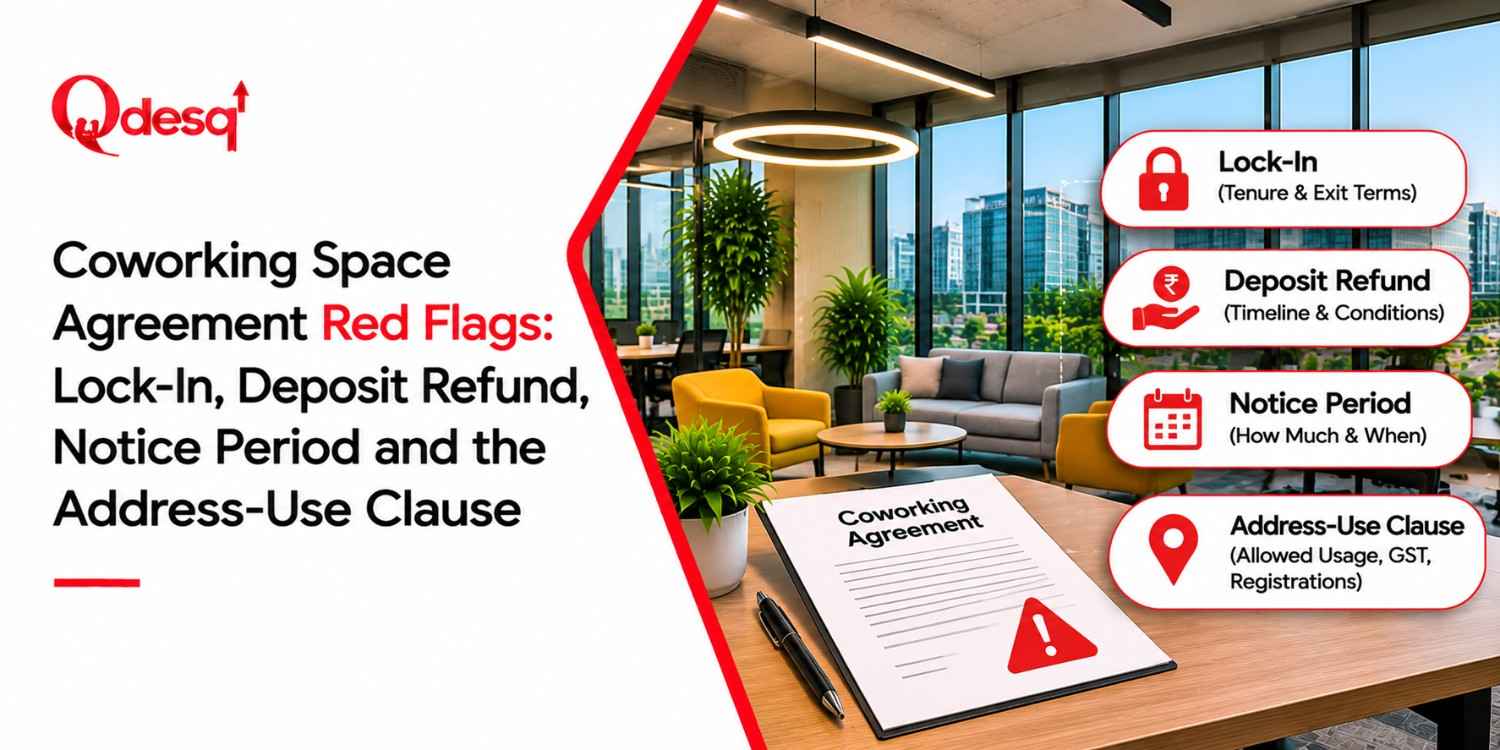
A coworking space agreement in India is normally a licence, not a lease: you buy a right to use a seat, not an interest in the property. That is why a handful of clauses decide whether it protects you: lock-in, deposit refund, notice period, address use, relocation, and the operator’s own authority to license the space. This article gives you the clause table, the cost of a bad lock-in, and the address-use language that GST and company-registration officers care about. It is general information, not legal advice; have a lawyer review the document you are actually given.
Key takeaways
|
A coworking space agreement is usually a licence, not a lease
A licence gives you permission to use space on terms; a lease transfers an interest in the property. Under Section 52 of the Indian Easements Act, 1882, a licence is a right to do something on another’s property that would otherwise be unlawful, without creating an interest in it. Section 105 of the Transfer of Property Act defines a lease of immovable property as a transfer of a right to enjoy it for a fixed time or in perpetuity, in return for a price or other consideration. Most coworking agreements are drafted as licences.
Three practical consequences follow:
- The operator can move you. Without exclusive possession, relocation within the building or to another centre is often written in.
- Stamp duty and registration depend on the document type and the state. Ask the operator how the agreement will be stamped.
- You inherit the operator’s chain of rights. If the operator’s own lease ends, your licence ends with it unless the agreement says otherwise.
Eight clauses to check, and what to ask for
Read your coworking space agreement against the table below. The red flags are the patterns that most often cost teams money or paperwork; the asks are what to request in writing.
| Clause | Red flag | What to ask for |
|---|---|---|
| Lock-in | Long lock-in with no step-down, no early-exit option | A shorter initial term, or a defined early-exit fee |
| Notice period | Notice counted from month-end, or notice only by a form you cannot find | Clear notice mechanics, by email, effective from the date sent |
| Security deposit | Deductions not itemised, refund date “after settlement” | A refund deadline in days and a list of permitted deductions |
| Escalation | Automatic percentage increase at renewal | A cap or a fixed schedule |
| Address use | No promise of documents for GST or registered-office use | Named obligation to issue agreement, NOC and utility bill, and to keep them valid |
| Relocation | Operator may move you anywhere, with no notice | Same-locality only, minimum notice, and updated address documents at its cost |
| Sub-licence authority | No proof of the operator’s rights from the landlord | A copy of the head lease clause or landlord consent |
| Liability and exit | Liability capped at one month’s fee; broad exit charges | Mutual caps, itemised exit charges |
What a bad lock-in costs
Lock-in is the clause that turns a cheap seat into an expensive one. If you take 20 seats at ₹9,000, the starting price of a decent campus in HSR Layout or Whitefield, the monthly fee is ₹1,80,000 before GST. Leave after month three and your exposure is the unexpired portion.
| Lock-in term | Months left if you exit at month 3 | Exposure before GST (₹) |
|---|---|---|
| 3 months | 0 | 0 |
| 6 months | 3 | 5,40,000 |
| 12 months | 9 | 16,20,000 |
Illustrative arithmetic: 20 seats at ₹9,000 a month, assuming the full unexpired fee is payable. Check whether your agreement allows early exit with a fee, a sub-let or a replacement.
Compare quotes on the same lock-in, not the same headline price; post one requirement so every operator quotes the same terms.
Teams of 50 to 100+ seats usually sign a managed-office agreement instead of a seat agreement. The eight clauses above still apply, with two additions: a seat band that lets headcount flex up or down, and a step-up price for added seats.
The address-use clause: the one registrations depend on
If you plan to use the address for GST or as a registered office, the agreement must say so. A silent agreement leaves you arguing with an officer, or a Registrar, about whether the operator ever consented. Ask for these in writing:
- Permission to use the address as principal place of business and registered office.
- Documents: a stamped agreement identifying your unit, a no-objection certificate, and the latest utility bill, delivered within a stated number of days.
- Duration: the address stays available for the full term, and for a stated period after you leave, so registrations are not left dangling.
- Visit handling: the operator receives GST officers, confirms your presence and signs where required.
- Documentation error remedy: if a registration is rejected because the operator’s documents were wrong, a refund or reissue at no cost.
- No relocation of your registered address without notice and fresh documents.
The Registrar’s address check and the GST visit both ask for the same proof of the right to use the premises; one clean set serves both. A weak address clause is the most common reason an otherwise good seat becomes a compliance problem.
Money clauses that surprise people
When a coworking space agreement arrives as a one-page order form with terms “as per website”, ask for the full document first. The money clauses are usually in the part you were not shown.
- Deposit. Ask the amount, where it is held, the refund deadline in days, and the deductions allowed. A deposit refunded “after settlement” with no date is a loan to the operator.
- Seat naming. “Hot desk”, “dedicated desk” and “private cabin” mean different things at different operators. Ask which seat is yours, when, and with what access hours.
- Meeting-room credits. Check whether unused hours expire monthly and what overage costs.
- GST and extras. Seat fees carry 18% GST, and printing, parking and storage may be billed separately.
- Renewal terms. Auto-renewal for the full original term is a common trap; prefer month-to-month after the lock-in.
Operational and risk clauses
Five operational clauses decide how the space works on a bad day: service levels, access, hiring restrictions, disputes and termination for operator breach.
- Service levels. Ask for an uptime commitment on internet and a response time for faults.
- Access and security. Confirm access hours, visitor policy and how your IT equipment is protected.
- Poaching and non-solicit. Some operators bar members from hiring each other’s staff; understand what you are agreeing to.
- Dispute resolution. Note the arbitration seat and governing law; a seat in a distant city makes disputes harder to pursue.
- Termination for operator breach. You should be able to leave without penalty if the operator cannot provide the space or the documents.
Five lines to paste into your reply to the operator
Clear answers in writing are the cheapest test of an operator’s paperwork. Copy these into your next email and replace the brackets.
- “Please confirm the lock-in period, the early-exit fee and the renewal terms in writing.”
- “Please state the deposit amount, where it is held, the refund deadline in days and the permitted deductions.”
- “Please confirm we may use the address as our principal place of business and registered office, and that you will supply a stamped agreement naming our unit, a no-objection certificate and a recent utility bill within [number] days.”
- “Please share the landlord’s consent or the head-lease clause that lets you sub-license this space.”
- “Please confirm you will not relocate our registered address without [number] days’ notice and fresh documents at your cost.”
Frequently asked questions
Is a coworking agreement a lease or a licence?
Usually a licence. You get permission to use a seat or cabin on stated terms, not an interest in the property. That is why operators can often relocate you and why your rights depend on the operator’s own rights over the building. Ask to see proof of landlord consent.
What is a typical lock-in period in a coworking space?
Terms vary by operator, seat type and city, and some offer month-to-month plans at a higher price. Do not accept a figure from a broker; ask for the lock-in, the early-exit fee and the renewal terms in writing, and compare quotes on the same commitment period.
How long does a coworking deposit take to be refunded?
It depends on the agreement, so insist on a number of days and an itemised list of deductions before you sign. A clause that says only “after settlement” gives you no date to enforce. Ask who holds the deposit and whether it earns anything.
Can I use a coworking address as my registered office?
Yes, if the operator agrees in writing and supplies a stamped agreement, a no-objection certificate and a recent utility bill. Put the permission, the documents and the duration in the agreement itself, and keep the same set for your GST registration.
Can I leave a coworking space early?
Only on the terms of your agreement. If there is a lock-in, you may owe the unexpired fees unless the agreement allows an exit fee, a replacement member or a sub-let. Negotiate the exit mechanics before you sign, not when the headcount drops.
What to watch next
Flex space now takes a large share of leasing: Knight Frank puts it at about 20% of the space transacted in Bengaluru in H1 2026 and about 30% in Chennai. As more large teams sign with operators, expect standard agreements to improve on exit and address terms, but only for buyers who ask. Treat the first draft as an opening position.
Pick the seat after you have read the paper. Across 6,000+ centres in 140+ cities, Qdesq can get you the draft agreement, the address-document list and the exit terms before you commit, whether you want coworking spaces in Bangalore or Chennai, an address-only virtual office, or a managed floor for 50+ seats. Post your requirement with your lock-in limit and quotes arrive on the same terms.
Related reading
Four published guides cover the contract side of flexible space.
- Red Flags in Managed Office Agreements Every Tenant Should Spot: the same checks for a managed floor
- The Ultimate Checklist for Choosing a Flexible Office Space Provider in India: a seven-point provider checklist
- The Cost Benefits of Moving to a Managed Office: what a managed contract includes
- What Clients Look for in Managed Office Spaces: the terms buyers ask for first


