


GCCs in India leased a record 9.1 million sq ft in Q1 2026 alone, according to CBRE, accounting for 44% of total office absorption. JLL reports similar figures around 9.8 million sq ft, underscoring explosive demand.
For country leads, COOs, and Real Estate Heads at MNCs racing to operationalise their first or second India centre under tight mandates, the workspace choice is no longer a detail; it is a multi-year strategic bet.
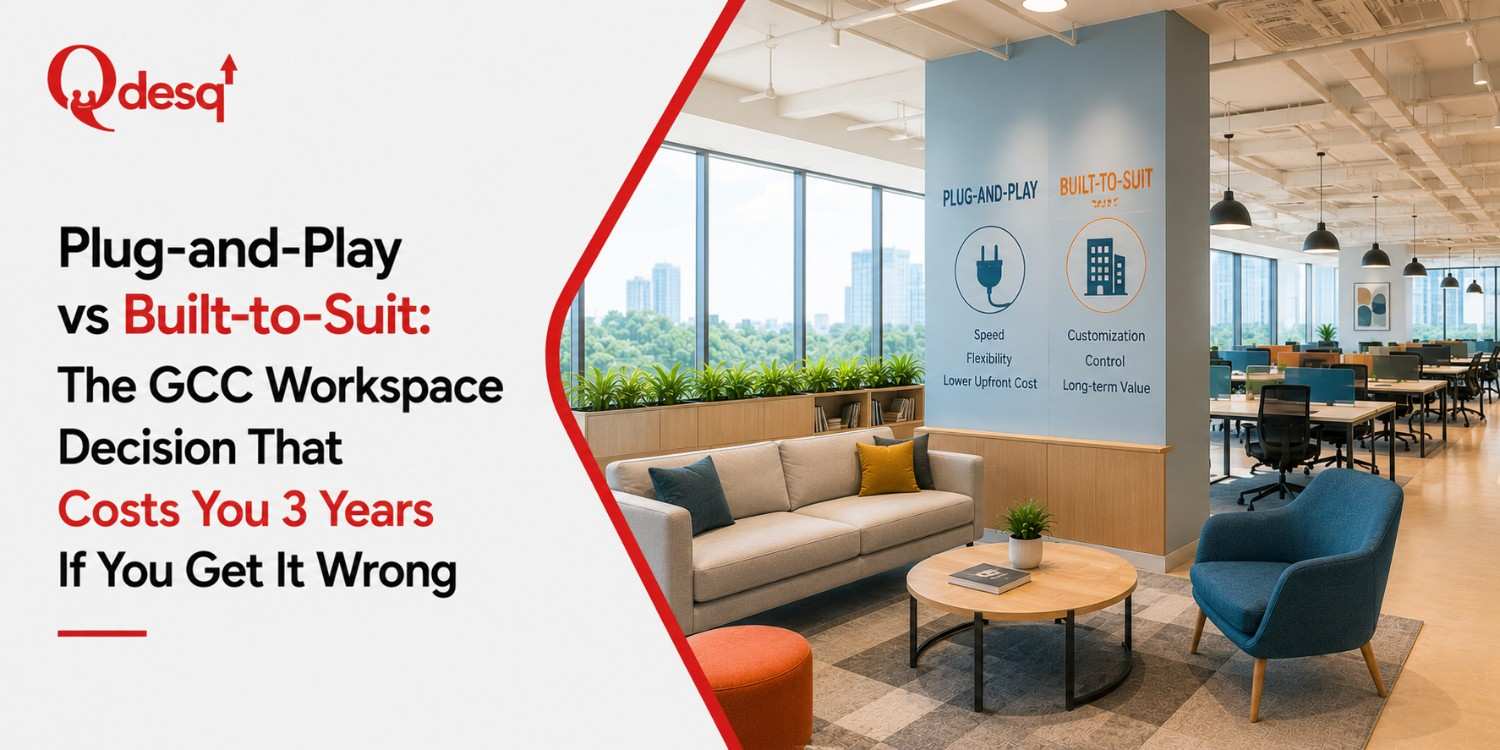
Plug-and-play (serviced/managed offices) gets you live in as little as weeks. Built-to-suit (BTS) or full custom fit-out delivers exactly what your brand, culture, and specialised functions (AI labs, secure environments, client showcases) demand—but typically takes 12–24+ months.
Get this wrong, and the delay can cost three years of momentum: lost hiring velocity, delayed innovation pipelines, higher attrition during limbo periods, and forfeited competitive positioning in India’s GCC ecosystem, now home to over 2,100 centres generating nearly $100 billion in value.
The Speed-to-Operate Imperative in 2026
India’s GCC market has matured beyond cost arbitrage. Centres now drive AI, product engineering, ER&D, and strategic innovation. Speed separates leaders from laggards. See: Managed Office Space Guide 2026: Enterprise & GCC Strategy for more.
- Record Q1 2026 leasing: GCCs dominated, with American firms accounting for ~73% of activity; sectors like e-commerce (24%), BFSI (20%), and tech (20%) led.
- Talent wars: AI skills power ~64% of new GCC hiring in 2026. Fast operational workspaces help secure top talent before competitors do.
- Micro-market realities: Demand concentrates in high-activity zones like Bengaluru’s ORR and Whitefield, Hyderabad’s SBD/Gachibowli, where residential proximity reduces attrition.
CRE heads face pressure: deliver functional space quickly without sacrificing long-term configurability.
Understanding How Plug and Play Offices Deliver Operational Readiness in Weeks
Plug-and-play (also called managed/serviced offices or Workspace-as-a-Service) offers fully furnished, IT-ready spaces with bundled amenities, often on flexible license agreements.
Key Advantages:
- Timeline: Move-in in 2–4 weeks (or days for smaller setups). Ideal for pilots, rapid team ramp-up, or interim spaces during larger builds.
- Costs: Zero or minimal CapEx. Predictable OpEx (₹8,000–18,000/seat/month in many markets). No fit-out headaches.
- Flexibility: Easy scaling, contraction, exits (1–3 months’ notice). Great for uncertain growth or testing cities.
- GCC Relevance: Suits nano/mid-market GCCs, project teams, or initial phases. Providers handle compliance basics, allowing focus on hiring and knowledge transfer.
Limitations:
- Restricted branding and configuration: Limited ability to install specialised labs, secure data rooms, or fully embed company culture.
- Higher per-seat costs in the long term for large teams (>200–300 seats).
- Less control over infrastructure for high-compliance or AI-heavy work.
In Bengaluru’s Whitefield or ORR, plug-and-play options in tech parks enable quick access to deep engineering talent. Hyderabad’s Gachibowli offers similar speeds at lower costs and a lower residential density for retention.
How Built-to-Suit and Custom Fit-Outs Secure Long-Term Corporate Identity
Built-to-suit involves leasing raw or warm-shell space and customising it (or developing it via a developer partnership). This includes full interior fit-outs, specialised infrastructure, and branding.
Key Advantages:
- Full Expression: Tailored layouts for AI/ML labs, collaboration zones, client experience centres, or security requirements. Reflects brand identity, boosting recruitment and retention.
- Long-Term Efficiency: Optimised for scale, potentially lower costs per seat over 5–10 years. Better integration with proprietary tech stacks.
- Value Creation: Strategic asset for innovation hubs. Supports complex functions that plug-and-play cannot accommodate.
Challenges:
- Timeline: 12–24 months (or longer) from lease to occupancy, including design, approvals, construction, and IT setup. Delays compound with regulatory and supply chain issues.
- Upfront Investment: Significant CapEx for fit-outs (₹1,200–4,000+/sq ft depending on spec), plus project management overhead.
- Risk: Market shifts or slower ramp-up can leave expensive space underutilised.
Larger GCCs favour BTS in Bengaluru ORR for talent depth or Hyderabad SBD for value scaling. Pune’s Kharadi or Chennai’s OMR suit engineering-focused builds with stable talent pools.
A Comprehensive Strategic Decision Matrix for Corporate Real Estate Heads
Use this framework tailored to GCC realities (timelines, talent impact, costs approximate for 2026 Grade A markets):
| Criteria | Plug-and-Play | Built-to-Suit | Hybrid
Recommendation |
|---|---|---|---|
| Time to Operational | 2–6 weeks | 12–24+ months | Start plug-and-play;
transition |
| Team Size Initial | <200–300 seats | 300+ seats | Scale-dependent |
| Customization/Branding | Limited | High | High priority? BTS or
phased |
| Cost Structure | High OpEx, low CapEx | Lower long-term, high
initial |
OpEx for speed, CapEx
for legacy |
| Best For GCC Stage | First center, pilots,
nano/mid-mar ket |
Mature/strategic
expansion |
Most first/second centers |
| Talent/Attrition Impact | Faster hiring start | Stronger long-term
retention via culture |
Hybrid wins |
| Risk if Wrong | Scalability limits, re-fit
costs |
Multi-year delay in value
creation |
Missed windows |
Hybrid Approach (Increasingly Popular): Launch with plug-and-play or GCC-as-a-Service (6–12 weeks go-live) for initial 100–300 seats while building BTS in parallel. Many use BOT (Build-Operate-Transfer) models to compress timelines. For more, see: Managed Office Space Trends in India: What to Expect in 2025.
Real-World Trade-Offs and Insights
- Speed Wins Talent: A 3–6-month delay can cost 20–30% of target hires to faster competitors. In competitive micro-markets like Bengaluru Whitefield, quick occupancy signals seriousness.
- Cost Over Time: Plug-and-play saves initial cash but premiums add up. BTS amortises better for large, long-term footprints (GCCs often occupy 100k+ sq ft).
- Brand and Innovation: Innovation hubs need environments that inspire. Custom spaces that integrate wellness, collaboration, and tech outperform generic ones for AI/ER&D teams.
- Micro-Market Nuances: Residential-heavy areas (e.g., Hyderabad Off-SBD, Pune Baner-Balewadi) favour models balancing speed and employee experience. ORR Bengaluru offers infrastructure but at higher costs.
GCCs are shifting from back offices to enterprise nerve centres. Workspace decisions must align with this evolution.
Actionable Recommendations for 2026 GCC Setup
- Assess Mandate Urgency: Tight timeline or pilot? Prioritise plug-and-play/GCCaaS.
- Model Hybrid: Use managed spaces for Year 1; commit to BTS for core functions.
- Location-First Analysis: Match talent needs (Bengaluru for depth, Hyderabad/Pune for value/stability) with micro-market availability.
- Partner Early: Engage operators, developers, and enablers for parallel tracks. Partner-led models (assisted/BOT) now dominate new setups, significantly shortening timelines.
- Quantify the “Three-Year Cost”: Model lost productivity, hiring delays, and opportunity cost. Factor AI-driven growth needs.
- Future-Proof: Prioritise AI-ready infrastructure, ESG features, and flexibility across models.
The right choice accelerates your GCC from setup to strategic impact. In India’s hyper-competitive landscape, speed-to-operate—balanced with long-term vision—is the defining differentiator.
Final Words
Choosing between a plug-and-play workspace and a built-to-suit office is no longer just a real estate decision; it is a strategic business decision that directly impacts your GCC’s speed, scalability, talent acquisition, and long-term competitiveness.
While plug-and-play enables organisations to establish operations within weeks and capitalise on India’s fast-moving talent market, built-to-suit creates the customised, future-ready environment required for innovation, enterprise collaboration, and sustained growth. Related reading: Top Amenities That Define Managed Office Success.
For many global organisations, the smartest strategy isn’t choosing one over the other; it’s combining both through a phased, hybrid approach that delivers immediate operational readiness without compromising future ambitions.
Qdesq simplifies your workspace journey by helping you compare, evaluate, and secure the right managed office, enterprise workspace, or built-to-suit solution across India’s leading business hubs. Whether you need to be operational in weeks or are planning a long-term headquarters, Qdesq provides expert advisory, location intelligence, and end-to-end workspace solutions tailored to your GCC strategy. Visit Qdesq.com today and find the workspace that accelerates your GCC success.


