


India’s GCC office market absorbed 35.7 million sq ft in H1 2026 — a 6% year-on-year increase, and the ninth straight quarter above 15 MSF. On paper, that’s an unambiguously strong number. On the ground, it describes two entirely different markets wearing one headline.
GCCs drove 45.5% of all Q1 2026 leasing nationally, but that leasing went almost entirely to two cities. Hyderabad is rising fast enough to unseat Bengaluru as India’s top-ranked GCC rental market. Mumbai and Pune are declining. New supply, meanwhile, dropped sharply enough that Bengaluru’s core micro-markets are now running below 2% vacancy.
This edition maps the H1 2026 bifurcation, the supply crunch behind it, and three compliance shifts — data protection, transfer pricing, and permanent establishment risk — that most GCC business cases written before 2023 never priced in. H2 2026 planning needs to account for all of it at once.
01 · The Two-Speed Market
India’s office market absorbed a record 35.7 million sq ft in H1 2026 — the ninth consecutive quarter above 15 MSF (Colliers India H1 2026). That headline number isn’t the story. The divergence underneath it is.
Bengaluru remains the anchor, absorbing 10.5 MSF — 29% of the national total. Hyderabad is surging, with demand at 7.2 MSF, the fastest growth of any major Indian city in H1 2026. Together, the two cities accounted for close to half of all H1 2026 leasing nationally.
Mumbai and Pune tell a different story. Both absorbed 4–5 MSF in H1 2026, but the trend line is negative — Q2 uptake fell 25–30% year-on-year in both cities. In Mumbai, large-format transactions above 100,000 sq ft dropped from 41% of activity in Q1 to just 13% in Q2 — a visible reorientation away from big-block commitments.
Three forces are driving the bifurcation. Location-led demand: GCCs are congregating in Bengaluru and Hyderabad for ER&D talent clusters, BFSI ecosystems, and campus-format supply. Unwinding hedges: the small, exploratory leases GCCs took on as options during 2023–24 uncertainty are being let go. And GCC dominance itself: GCCs accounted for 45.5% of Q1 2026 gross leasing nationally (JLL India), effectively reshaping the market in their own image.
H1 2026 City Snapshot
| City | H1 2026 Demand Signal | Supply & Vacancy Position | H2 2026 Read |
|---|---|---|---|
| Bengaluru | Anchor market — 10.5 MSF, 29% national share | Core micro-markets near sub-2% vacancy | Grade A supply effectively unavailable for 2027; pre-commit or managed-office bridge required |
| Hyderabad | Fastest-growing major city — 7.2 MSF demand | New completions down 95% QoQ; GCC-CPRI #1 at 212.1 | “Bengaluru-minus-30%” pricing model is obsolete; recalibrate to “-10 to -15%” |
| Mumbai | 4–5 MSF; Q2 down 25–30% YoY | Prime districts sub-2–4% vacant despite softening demand | Value plays only — large-format momentum has reversed |
| Pune | 4–5 MSF; Q2 down 25–30% YoY | More accessible supply than Bengaluru/Hyderabad | Best for back-office/KPO; lacks large-deal momentum |
India’s office market is no longer moving as one cycle. Bengaluru and Hyderabad are pulling ahead of it.
02 · The Supply Trap
While market commentary focuses on record demand, supply tells the more urgent story. New completions across India’s top eight cities fell 18% year-on-year and 43% quarter-on-quarter in Q1 2026 — the sharpest decline in seven quarters.
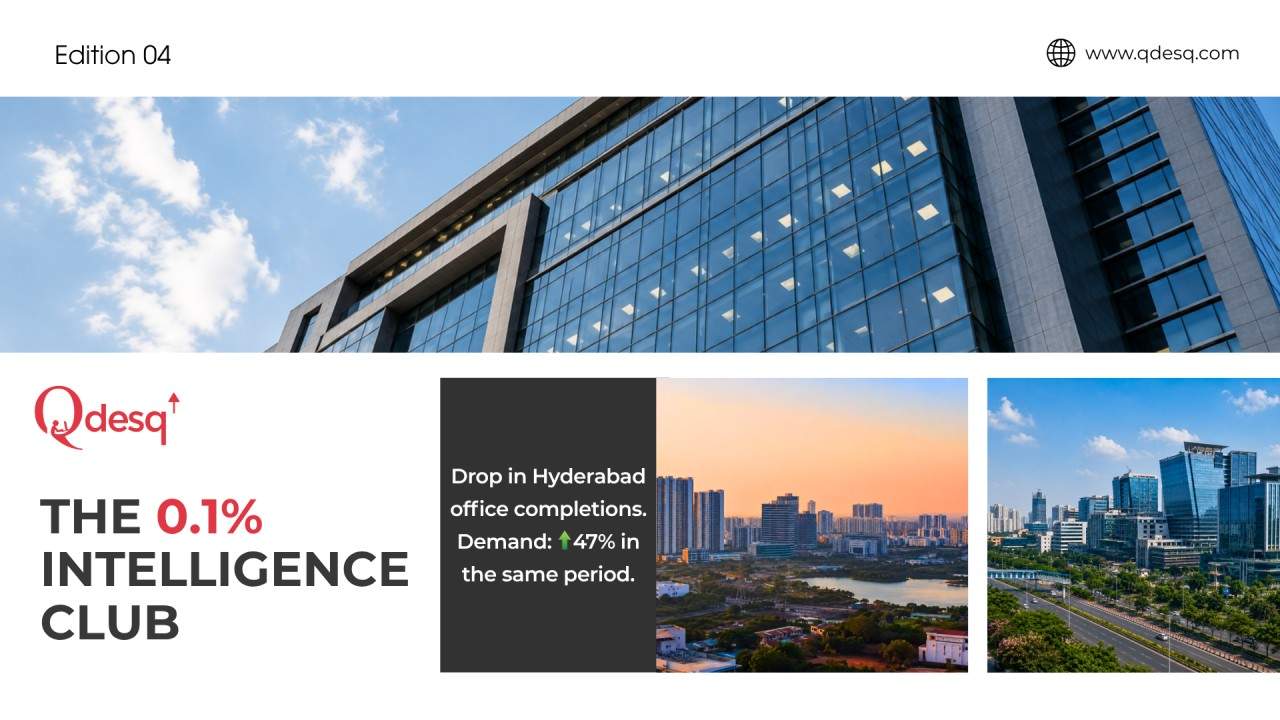
Hyderabad is the extreme case. Despite leading GCC demand growth, new completions collapsed 95% in Q1 2026 — from 6.0 MSF in Q4 2025 to just 0.3 MSF.
The imbalance is tightening conditions across the board. Pan-India vacancy now sits at 14.7%, a five-year low. Bengaluru’s core micro-markets and Mumbai’s prime districts are running at an estimated sub-2–4% vacancy. Rental floors are rising in step: Bengaluru and Delhi NCR have both crossed ₹100 per sq ft per month, and Hyderabad is leading rental appreciation at 5.3% year-on-year — an 11.1% three-year CAGR in Hitec City specifically.
The reality for GCC occupiers: Grade A office space for 2027 launches is effectively unavailable in prime corridors. GCCs entering these markets now face a binary choice — a long-term pre-commitment of 15 to 24 months, or an immediate-activation managed office. Sub-2% vacancy leaves no comfortable middle ground.
This is precisely the corridor where managed office deployment changes the calculus. Qdesq, which operates 5,500+ workspace centres across 120+ cities, has seen GCC clients activate 30–90 day managed office footprints inside exactly these sub-2% vacancy micro-markets — buying time to complete a longer-term site-selection process without losing a hiring quarter.
Office space demand is outrunning deliveries — and the gap widens every quarter it’s left unaddressed.
03 · The Hyderabad Moment (India’s New GCC Rental Capital)
The Q1 2026 IIM Bangalore–CRE Matrix GCC Rental Index (GCC-CPRI) confirms a structural shift: Hyderabad is now India’s top-ranked GCC office market, at an index value of 212.1. GCCs are paying a 15% premium over non-GCC occupiers for space in the city — a sign of how intense the competition for prime floor plates has become. Hitec City rents specifically show an 11.1% three-year CAGR.
June 2026 data confirms the confidence with a wave of decade-long commitments, all signed within a single week: Accenture (1 million+ sq ft), Tech Mahindra (approximately 400,000 sq ft), and Hartford Global Services (approximately 160,000 sq ft). These aren’t opportunistic transactions. They are decade-long strategic bets on the city’s trajectory.
New site-selection baseline: site-selection teams need to update their models. The conventional framing of “Bengaluru-minus-30%” as Hyderabad’s discount is obsolete. Current data points to a narrower gap — closer to Bengaluru-minus-10 to 15%.
Hyderabad is no longer pricing like a challenger market. It’s pricing like a GCC capital.
04 · The Compliance Layer
Most GCC business cases written between 2020 and 2023 have no provisions for the compliance shifts now landing on executive desks in H1 2026. Three operational realities require action before the next board review — not after it.
The DPDP Act
India’s Digital Personal Data Protection Act, 2023 framework is now live, with the DPDP Rules 2025 in force and a fixed full-compliance deadline of May 13, 2027. GCCs are classified as Data Fiduciaries, and penalties reach ₹250 crore per breach. Yet a February 2026 survey found 70% of organisations still unprepared. Consent architecture and breach-notification protocols need updating now — not closer to the deadline.
Transfer Pricing
There’s a genuine upside here. Union Budget 2026–27 raised the transfer pricing safe harbour threshold to ₹2,000 crore, with a unified 15.5% margin for IT and R&D services. Per KPMG’s March 2026 analysis, effective April 1, 2026, most GCCs need to re-evaluate their safe harbour eligibility and Form 49 disclosures against the new threshold.
PE Risk
As GCCs shift from pure execution to product and innovation mandates, they take on rising Permanent Establishment (PE) risk — Fixed Place, Service, or Agency PE. A June 2026 GCC compliance guide flags TP/PE risk as a top priority for 81% of leaders surveyed. If a centre’s mandate has expanded beyond what its original incorporation documents describe, its tax position needs refreshing immediately.
Compliance Snapshot — H2 2026
| Compliance Area | What Changed | Deadline / Threshold | Action Required |
|---|---|---|---|
| DPDP Act, 2023 | DPDP Rules 2025 now active; GCCs classified as Data Fiduciaries | Full compliance by May 13, 2027; up to ₹250 crore penalty per breach | Update consent and breach-notification protocols now — 70% of orgs surveyed remain unprepared |
| Transfer Pricing Safe Harbour | Threshold raised to ₹2,000 crore; unified 15.5% margin for IT/R&D | Effective April 1, 2026 | Re-evaluate safe harbour eligibility and Form 49 disclosures |
| Permanent Establishment Risk | Expanding mandates create Fixed Place / Service / Agency PE exposure | Flagged a top priority by 81% of GCC leaders (June 2026 guide) | Refresh tax position if mandate has grown beyond incorporation documents |
Build the compliance layer before the deadline builds the pressure for you.
05 · The Decision Architecture (H2 2026 Action Plan)
Five intelligence-backed conclusions to stress-test any H2 2026 strategy against.
- Bengaluru: your anchor, not an easy option. Core micro-markets are sub-2% vacant, and large-format Grade A space is effectively unavailable. New requirements now need either a 15–24 month pre-commit pipeline or a managed-office bridge.
- Hyderabad: recalibrate the price. With demand up sharply and top-tier rental rankings, the “Bengaluru-minus-30%” model is obsolete — the current reality is closer to “Bengaluru-minus-10%.” Update site-selection assumptions immediately.
- Mumbai & Pune: seek value, not velocity. Q2 softening looks structural rather than seasonal. Mumbai’s prime space faces genuine supply constraints; Pune remains accessible for back-office and KPO functions but lacks large-deal momentum.
- Rental floors: the new baseline is ₹100 per sq ft per month for prime Grade A space in Bengaluru and Delhi NCR. Modelling H2 2026 decisions on 2024 cost assumptions is now a material CFO-level error — CapEx projections need rerunning.
- Compliance is a leasing decision: treat it as one. Verify tax position for any SEZ-based operation, add a DPDP infrastructure provision if the business case predates August 2023, and refresh transfer pricing documentation if the mandate has expanded. These are Q3 2026 priorities, not 2027 planning items.
THE QDESQ LENS
H1 2026 data — from Qdesq’s 5,500+ workspace centres across 120+ cities — reveals a market where activation speed now rivals cost as the deciding site-selection variable. Core micro-markets are at capacity, pre-commitment pipelines are stalling, and the compliance layer that most 2020–23 business cases ignored is now an operational reality. The H2 2026 question for a GCC head isn’t just “which city?” anymore. It’s “which city, on what timeline, and with what compliance plan?”
“In India’s tightening office space market, the companies that secured the best spaces didn’t get lucky — they committed early. That window is materially narrower for H2 2026, putting significant time pressure on enterprises navigating both lease decisions and new compliance shifts.”
— Prem Kumar, Director – South, Transactions, Qdesq Proptech Group
Key Takeaways for H2 2026
- India absorbed a record 35.7 MSF of office space in H1 2026 (+6% YoY, the ninth straight quarter above 15 MSF) — but the growth is concentrated almost entirely in Bengaluru and Hyderabad, not distributed nationally.
- Supply, not demand, is the real constraint. New completions fell 43% quarter-on-quarter nationally and 95% in Hyderabad specifically; Bengaluru’s core micro-markets are sitting at the lowest vacancy in the country.
- Hyderabad is now India’s #1-ranked GCC rental market (GCC-CPRI: 212.1). GCCs are paying a 15% premium there, and June 2026 alone saw Accenture, Tech Mahindra, and Hartford Global Services sign 10-year deals worth well over ₹1,000 crore in a single week.
- Compliance has become an operational, not theoretical, variable: the DPDP Act’s May 2027 deadline carries penalties up to ₹250 crore per breach, the transfer pricing safe harbour threshold has been raised to ₹2,000 crore at a 15.5% margin, and Permanent Establishment risk is now a top-3 priority for 81% of GCC leaders.
- Flex leasing is running roughly 90% above its five-year average — no longer a hedge, but the fastest practical route into supply-constrained markets, activating in under 90 days against a 12–24 month conventional pre-commit timeline.
Frequently Asked Questions
Why is Hyderabad outperforming Bengaluru in GCC office demand in 2026?
Hyderabad posted the fastest office demand growth among major Indian cities in H1 2026 (7.2 MSF), driven by 10-year commitments from Accenture, Tech Mahindra, and Hartford Global Services signed in a single week in June 2026. The IIM Bangalore–CRE Matrix GCC Rental Index ranks Hyderabad India’s top GCC office market at 212.1, with GCCs paying a 15% premium over non-GCC occupiers.
What is the GCC-CPRI index?
The GCC Rental Index (GCC-CPRI), published quarterly by the IIM Bangalore–CRE Matrix, ranks Indian cities by GCC-specific office rental performance rather than headline city-wide rents. In Q1 2026, it confirmed Hyderabad as India’s top-ranked GCC office market, ahead of the traditional Bengaluru benchmark.
How does the DPDP Act 2023 affect GCCs operating in India?
Under the Digital Personal Data Protection Act, 2023 and the DPDP Rules 2025, GCCs are classified as Data Fiduciaries and face penalties of up to ₹250 crore per breach. Full compliance is due by May 13, 2027, but a February 2026 survey found 70% of organisations are still unprepared on consent and breach-notification protocols.
What changed in India’s transfer pricing safe harbour rules for GCCs?
Union Budget 2026–27 raised the transfer pricing safe harbour threshold to ₹2,000 crore and introduced a unified 15.5% margin for IT and R&D services, effective April 1, 2026. Per KPMG’s March 2026 analysis, most GCCs now need to re-evaluate their safe harbour eligibility and Form 49 disclosures.
Is managed office space a faster way to enter India’s supply-constrained GCC markets in 2026?
Yes. With Grade A pre-commitment pipelines running 12–24 months and core Bengaluru micro-markets near sub-2% vacancy, managed office deployments that activate in under 90 days are the fastest route into supply-constrained corridors. Flex leasing volumes are currently running roughly 90% above their five-year average.
What is Permanent Establishment (PE) risk for a GCC in India?
PE risk arises when a GCC’s evolving mandate — moving from pure execution to product or decision-making authority — creates a taxable presence under Fixed Place, Service, or Agency PE rules, beyond what the original incorporation documents anticipated. A June 2026 GCC compliance guide flags TP/PE risk as a top priority for 81% of GCC leaders surveyed.


