


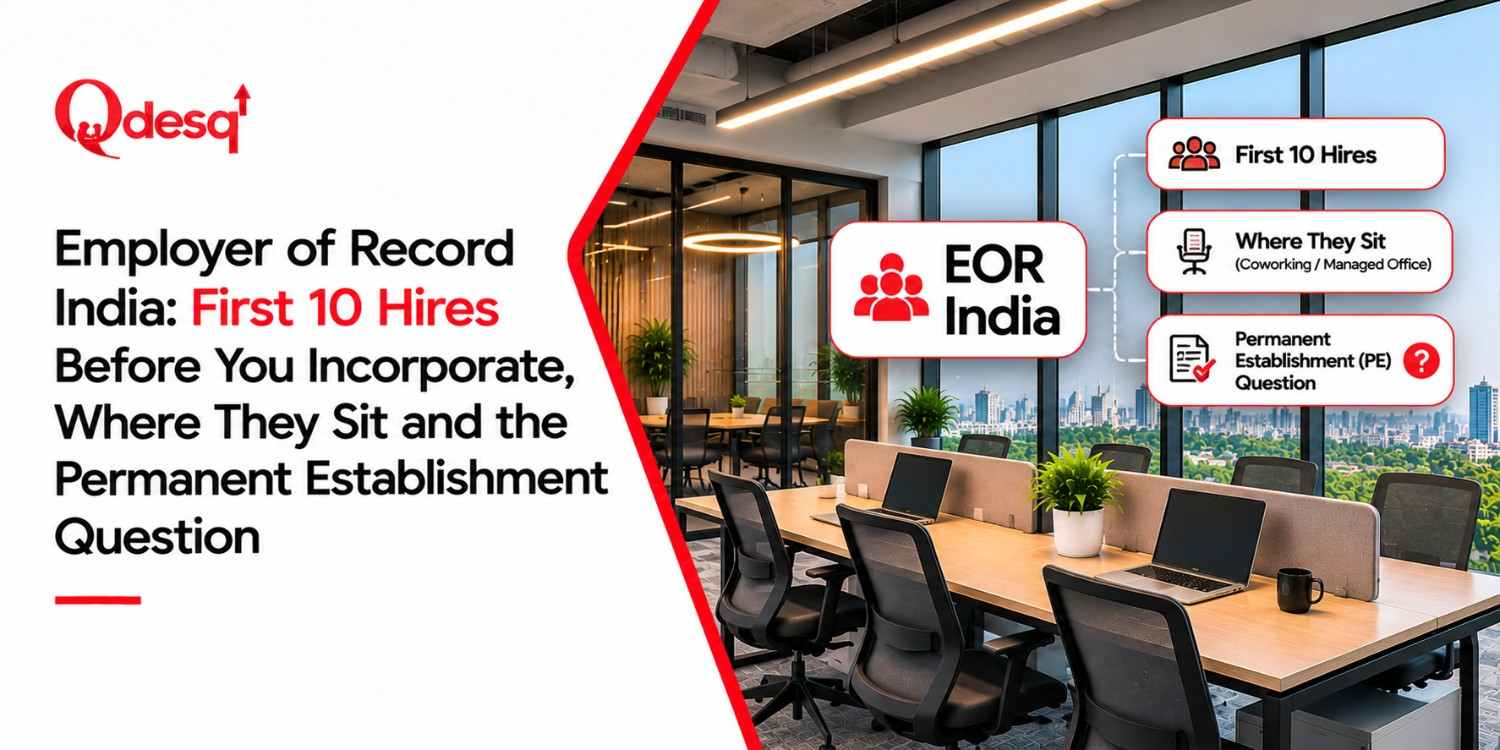
If a foreign company has ten people in India and no Indian entity, whose office is it? The answer decides whether the company has quietly created a taxable presence in India, and it often turns on a single line in a coworking agreement.
You can employ your first ten people in India without a company through an employer of record India arrangement (EOR), but where they sit matters as much as who pays them. A seat contracted in the foreign parent’s name, used for core business work, is the pattern that Indian courts could treat as a fixed-place permanent establishment (PE). A seat contracted by the EOR, or by an Indian subsidiary once you incorporate, carries less exposure. This article sets out the options, the Supreme Court’s 2025 reasoning and a 90-day sequence. It is general information, not tax or legal advice; take advice on your treaty and facts.
Key takeaways
|
Employer of record India vs subsidiary: three ways to employ, three ways to seat
Start with two questions: who is the employer, and whose name is on the seat. The table maps the combinations most foreign entrants consider.
| Option | Who employs | Who holds the seat | PE exposure | Notes |
|---|---|---|---|---|
| Employer of record | The EOR | Employees work remotely, or the EOR contracts the seat | Lower, not zero | Fast start; payroll and statutory filings handled |
| Indian subsidiary (private limited) | The subsidiary | The subsidiary | Lower, if it does not act as the parent’s agent | Needs incorporation, bank account, registrations |
| Liaison office | The foreign company, with RBI approval | The liaison office | Depends on activities | Limited to liaison; cannot earn income |
| Seat in the parent’s name | The EOR or the parent | The foreign parent | Highest | Fixed-place PE pattern |
An employer of record India provider is a local entity that becomes the legal employer, runs payroll, and files provident fund, state insurance and professional tax. It solves the employment compliance problem, but it does not by itself answer the tax question about what your employees do and where. Fees are typically a monthly charge per employee on top of salary, so get quotes from more than one provider.
What the Supreme Court said in Hyatt (2025)
In Hyatt International Southwest Asia Ltd v Additional DIT [2025] 478 ITR 238 (SC), a case about a UAE company’s hotel operations in India, the Supreme Court held that a foreign enterprise can have a fixed-place PE in India without exclusive possession of the premises. According to commentary from RSM, Alvarez & Marsal and Bloomberg Tax, the Court looked at whether the place was at the enterprise’s disposal and used to carry on core business functions, treated continuity of business presence in aggregate as more important than any one employee’s tenure, and preferred substance to formal legal rights. The earlier benchmark is the Supreme Court’s 2017 Formula One decision, which also turned on whether the premises were at the enterprise’s disposal.
For a team of ten, three consequences follow:
- Our reading: a coworking seat can be “at disposal”. Hyatt concerned hotels, not coworking, so applying it to a regular desk used for core work is our inference. Take advice before relying on it.
- Rotation does not help. If staff change but the presence is continuous, the aggregate presence is what counts.
- Substance beats paperwork. A lease in the EOR’s name does not help if your managers direct the work daily and sell from that seat.
None of this means a PE exists in your case. It means that the facts, not the contract headings, will be examined.
Where the first ten should sit
Pick the seat arrangement that matches your risk tolerance and your timeline to incorporate. The table orders the common choices from lowest to highest signal.
| Seating choice | PE signal | When it is reasonable |
|---|---|---|
| Employees work from home | Low | Support roles, short runway |
| Seat contracted by the EOR | Low to moderate | Early hiring with a firm plan to incorporate |
| Seat contracted by the Indian subsidiary | Low | You have incorporated |
| Day passes and rotating hot desks in the EOR’s name | Moderate | Occasional meetings, not daily work |
| Seat contracted by the foreign parent, with its signage and its managers | High | Avoid; revisit with a tax adviser |
In cost terms, ten dedicated desks in a decent Bangalore campus at a starting price of about ₹9,000 come to ₹90,000 a month, or ₹1,06,200 with 18% GST, based on Qdesq listings in October 2026. The seat’s cost is a small fraction of the cost of getting its contracting entity wrong. The GST angle matters too: credit follows the entity named on the invoice, so a seat in the wrong name also strands tax.
Red flags that tend to attract questions
Five facts about the seat tend to raise a permanent establishment question, so avoid them in the first year.
- Foreign parent named on the seat agreement or the door. The easiest fact for an auditor to find.
- Parent-company managers working from the seat for long stretches. Aggregate presence counts.
- Contract negotiation and signing from India. Concluding contracts habitually can raise a dependent-agent question.
- Core functions, not support, done from the seat. Engineering, sales leadership and product decisions are core; back-office support is less so.
- A liaison office doing more than liaison. Revenue-earning activity in a liaison office is a mismatch with its approval.
Some treaties also contain service-PE provisions that apply based on the duration of services performed through personnel. Read the specific treaty before assuming Article 5 works as it does elsewhere.
Five questions to put to your tax adviser before you sign a seat agreement
Bring these to the first meeting; the answers decide the seat structure more than any price quote.
- Whose name is on the seat agreement and on the door? The foreign parent’s name is the easiest fact for an auditor to find.
- Which work happens at the seat? Engineering, sales leadership and product decisions are core; support is less so.
- Who negotiates and signs contracts from India? Habitually concluding contracts can raise a dependent-agent question.
- How many days a year will parent-company managers sit there? Aggregate presence counts.
- What does the treaty with the parent’s home country say, and when will you incorporate? Service-PE clauses vary, and a dated plan to incorporate shows the arrangement is temporary.
A 90-day sequence from first hire to subsidiary
Hire through an employer of record first, incorporate by day 60, and move the people and the seat into the subsidiary by day 90.
- Days 0 to 30: engage an employer of record India provider. Hire the first employees through it, keep the seat in the EOR’s or a neutral name, and write down the intent to incorporate.
- Days 30 to 60: incorporate the subsidiary. File SPICe+, arrange the registered office and complete registrations; the UK & EU GCC India Playbook 2026: Setup, Cities & Real Costs shows how parallel-track setups avoid months of delay.
- Days 60 to 90: transfer employment and the seat. Move employees from the EOR to the subsidiary with continuity of service, and have the seat agreement re-papered in the subsidiary’s name. If the team will pass 25 people, move to a managed office built for GCCs: it holds 100+ seats, and the agreement sits in the subsidiary’s name from day one.
- After 90 days: review. Check what the subsidiary is doing for the parent, the intercompany agreement and the transfer pricing documentation.
Frequently asked questions
What is an employer of record in India?
An employer of record India provider is a local company that legally employs your staff on your behalf, handling the contract, payroll and statutory filings such as provident fund and state insurance. You direct the work; it carries the employment compliance. It does not remove the need to consider permanent establishment risk.
Can I hire in India without a company?
Yes, through an employer of record, or by engaging individuals as employees of a local entity. You do not need your own Indian company to start. But long-term, core-function teams usually move into an Indian subsidiary to simplify compliance, tax treatment and benefits.
Does a coworking seat create a permanent establishment?
Not automatically. A fixed-place PE depends on whether the place is at the foreign enterprise’s disposal and used for its core business. Following the Supreme Court’s 2025 Hyatt ruling, exclusive possession is not required, so the contracting entity and the work done there both matter.
What is the difference between a liaison office and a subsidiary in India?
A liaison office is an extension of the foreign company, set up with RBI approval through an authorised dealer bank, limited to liaison activities and unable to earn income. A subsidiary is a separate Indian company that can employ, contract and earn revenue. Teams that will do real work need a subsidiary.
When should I incorporate in India?
Incorporate when the team is doing core work, when you want to sign local customers or when you are about to sign a seat agreement for more than a handful of people. An EOR bridges the gap, but treat it as a bridge, with a plan and a date to incorporate.
What to watch next
Knight Frank reports that global capability centres accounted for 60% of the office space transacted in Bengaluru in the first half of 2026, which means the ten-person teams of today are the 100-person centres of tomorrow. Whether you start with an employer of record India provider or an Indian subsidiary, decide the contracting entity for your first seat as though it will still be there at 100 people, because contracts have a way of staying.
Hiring your first ten in India? Settle whose name goes on the seat before you sign anything. Qdesq can set the first ten up from 6,000+ centres across 140+ cities: a registered address while the subsidiary is incorporated, dedicated desks in Bangalore from about ₹9,000 a seat, and a managed floor once you pass 25. Post your requirement with your EOR plan and incorporation date, and ask for the agreement to be drafted so it moves into the subsidiary’s name on day 90.
Related reading
Two published guides cover flexible space for a first Indian team.
- Coworking Spaces – A perfect place for startups to flourish: why flexible space suits new teams
- The Evolution of Workspaces: From Traditional Offices to Coworking Hubs: how workspace formats developed


