


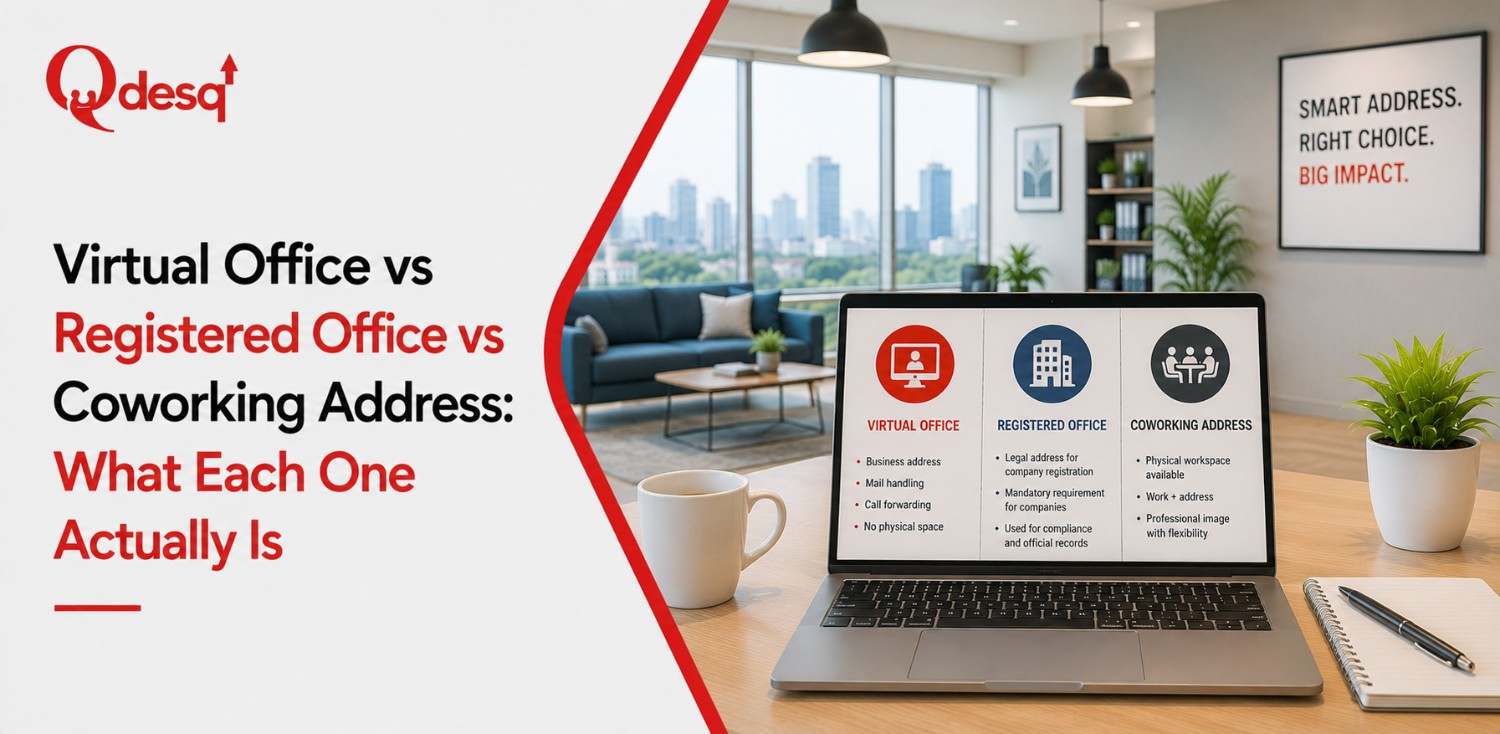
Most articles on this subject open by comparing a virtual office to a registered office, as though you have to pick one. That framing is a category error, and it produces genuinely bad decisions.
**A registered office is a legal status. A virtual office is a service that supplies an address. They are not alternatives — a virtual office very often *is* your registered office.** Asking which to choose is like asking whether to buy a car or a driving licence.
If you are weighing the underlying trade-off rather than the terminology, start with virtual office vs physical office: what works best for SMEs. The reason this matters: an Indian business does not have one address. It has up to five, they serve different regulators, and they do not all have to be the same. Getting the mapping right is what stops filings from bouncing.
The five addresses your business actually has
| Address | Who requires it | What it is | Can they differ? |
|---|---|---|---|
|
Registered office |
MCA, under Section 12, Companies Act 2013 | The company’s official legal address on the MCA register; receives all statutory notices |
Must be in the state of your ROC |
|
Principal Place of Business (PPOB) |
CBIC, under the CGST Act 2017 | The main location from which business is carried on in that state, declared in Form GST REG-01 |
Must be in the state you’re registering the GSTIN in |
|
Additional Place of Business (APOB) |
CBIC | Any further premises in the same state — warehouse, fulfilment centre, branch |
Optional; added under the same GSTIN |
|
Correspondence / communication address |
Nobody, legally | Where you actually want post and couriers to arrive |
Entirely your choice |
|
Operational address |
Nobody, legally | Where your team physically works |
Entirely your choice |
Every one of these can be a virtual office. Several of them can be the *same* virtual office. And crucially, they do not all have to match — a company can have its registered office in Delhi, a PPOB in Karnataka, an APOB at a fulfilment centre in Haryana, and a team working from home across six cities. All of it is compliant.
What a registered office actually is
A registered office is a legal designation, not a type of property. Section 12 of the Companies Act, 2013 requires every company to have one within thirty days of incorporation, capable of receiving and acknowledging all communications and notices.
Practically, it means four things:
- It goes on public record — visible on the MCA portal to anyone who looks.
- It is where statutory notices are legally served. Anything sent there is deemed delivered, whether or not you read it.
- It determines your ROC jurisdiction and therefore which state your company is domiciled in.
- Changing it requires a Form INC-22 filing within thirty days, plus a board resolution — and Regional Director approval if the move crosses state lines.
What it does not mean: that you own it, lease it in your own name, occupy it, or work from it. Those are assumptions people import from the phrase “office”, and the Act does not make them.
What a virtual office actually is
A virtual office is a service. You buy the documented right to use a commercial premises as your address, plus handling of whatever physically arrives there, plus meeting rooms on demand.
The service delivers three documents, and those documents are the entire point:
- a No Objection Certificate on the provider’s letterhead, stamped and signed;
- a rent or leave-and-licence agreement between your business and the provider;
- a utility bill for the premises, dated within the last two months.
That set is what converts an address into a legally usable one — for a registered office filing, a GST PPOB declaration, or both. Which is why “virtual office vs registered office” dissolves as a question: the virtual office is the mechanism, the registered office is the status it lets you claim.
Where a coworking address fits
A coworking address is a third thing again — a workspace membership that *sometimes* comes with the registration document set and often doesn’t.
If the operator issues a proper NOC and agreement, a coworking space address works exactly like a virtual office address for filing purposes, and you get desks as well. If they don’t — and many operators decline to issue incorporation NOCs — then your membership is not address proof, no matter how genuine your presence there is.
Ask before you assume. The question is not “can I work here?” but “will you issue a signed NOC, an executed agreement and a current utility bill in your name?”
Side by side
| Registered office | Virtual office | Coworking address | Serviced / managed office | |
|---|---|---|---|---|
|
What it is |
Legal status | Address service | Workspace membership |
Fully fitted private space |
|
Typical monthly cost |
N/A — depends on the address behind it | ₹750–₹4,200 | ₹5,000–₹15,000 per seat |
₹12,000–₹25,000 per seat |
|
Desk included |
Not necessarily | No | Yes |
Yes |
|
Registration documents |
Required from whoever supplies the address | Included as standard | Operator-dependent |
Usually available |
|
Appears on public record |
Yes | Only if used as the registered office | Only if used as the registered office |
Only if used as the registered office |
|
Best for |
— | Statutory address, multi-state compliance, market entry | Small teams needing desks and an address |
Teams of 25+ wanting a branded floor |
Which address goes where
The clearest way to think about this is to stop asking “what address should my business have?” and start asking “what does each regulator need from me?”
- Incorporating a company or LLP → you need a registered office in your chosen state. A virtual office supplies it.
- Registering for GST in a state where you have no premises → you need a PPOB in that state. A virtual office supplies it.
- Storing inventory at a fulfilment centre → that warehouse becomes an APOB under the same state GSTIN. A virtual office cannot substitute for it, because goods are physically there.
- Wanting a credible address on your website and invoices → any of the above, or a mailing-address-only plan. Client trust starts with a business address explains why this is worth more than it looks.
- Needing your team somewhere daily → coworking or a managed office. This is a workspace question, not an address question.
A concrete example. A Pune-based D2C brand incorporates with a registered office in Maharashtra, then sells nationally. It takes a virtual office in Bangalore as its Karnataka PPOB so it can hold a Karnataka GSTIN, adds the Bengaluru fulfilment centre as an APOB under that GSTIN, keeps a virtual office in Gurgaon for its Haryana registration and one in Chennai for Tamil Nadu, and has no physical office anywhere. Every filing is clean. Nothing about that arrangement is unusual — it is now standard practice for multi-state sellers.
The mistakes this confusion causes
Assuming the registered office and the GST PPOB must match. They frequently don’t, and there is no requirement that they do. They must each be in the correct state for their respective registration.
Buying a mailing-address plan and expecting to incorporate on it. Mailing-address tiers usually exclude the NOC and agreement. Read what the plan entitles you to, not what the address looks like — our cost versus benefit analysis sets out what each tier actually buys.
Choosing the micromarket before the state. The state determines your ROC and your GST authority. A BKC address and a Navi Mumbai address are both Maharashtra; a Delhi address and a Noida address are not the same jurisdiction at all.
Treating a coworking membership as address proof. It is a workspace contract — see how operators differ in our Kharadi, Pune coworking guide. Whether it produces a filing-grade document set is a separate question you have to ask explicitly.
Frequently asked questions
What is the difference between a virtual office and a registered office?
A registered office is a legal status under Section 12 of the Companies Act, 2013 — the official address of your company on the MCA register. A virtual office is a service that supplies an address plus the NOC, agreement and utility bill needed to register it. They are not competing options; a virtual office is one of the ways to obtain a registered office.
Can a virtual office be used as a registered office address?
Yes. Provided the provider issues a properly executed NOC, a rent or leave-and-licence agreement and a utility bill dated within the last two months, a virtual office address can be filed as your registered office through SPICe+ or Form INC-22 for a Private Limited company, LLP, OPC or proprietorship.
Is a registered office address the same as a principal place of business?
No. The registered office is an MCA concept under the Companies Act, 2013. The Principal Place of Business is a GST concept under the CGST Act, 2017, declared per state in Form GST REG-01. They can be the same address, but they serve different regulators and often sit in different states.
Can my registered office and GST address be different?
Yes, and for multi-state businesses they usually are. Your registered office sits in one state under one ROC. You then hold a separate GSTIN, with its own PPOB, in every state where you have a taxable presence.
Does a registered office address appear on public record?
Yes. It is visible on the MCA portal and appears on your incorporation certificate, invoices and statutory filings. This is a common reason businesses prefer a commercial virtual office over a residential address.
Can I use a coworking address as my registered office?
Only if the operator issues the registration document set — a signed NOC, an executed agreement and a current utility bill in their name. Many coworking operators do not issue incorporation NOCs, so confirm before you commit. A membership by itself is not address proof.
The practical takeaway
Stop treating these as competing options. Map each regulator to the address it needs, then choose the cheapest compliant way to supply it. For most businesses that means one registered office, one virtual office PPOB per state they trade in, and workspace bought separately when headcount actually requires it.
Qdesq lists virtual office addresses, coworking and managed offices side by side across 120+ cities, so the address decision and the workspace decision can be made independently — which is how they should be made.
Compare virtual office addresses by city and plan, or share your requirement and we’ll map the right address to each registration you need.


