


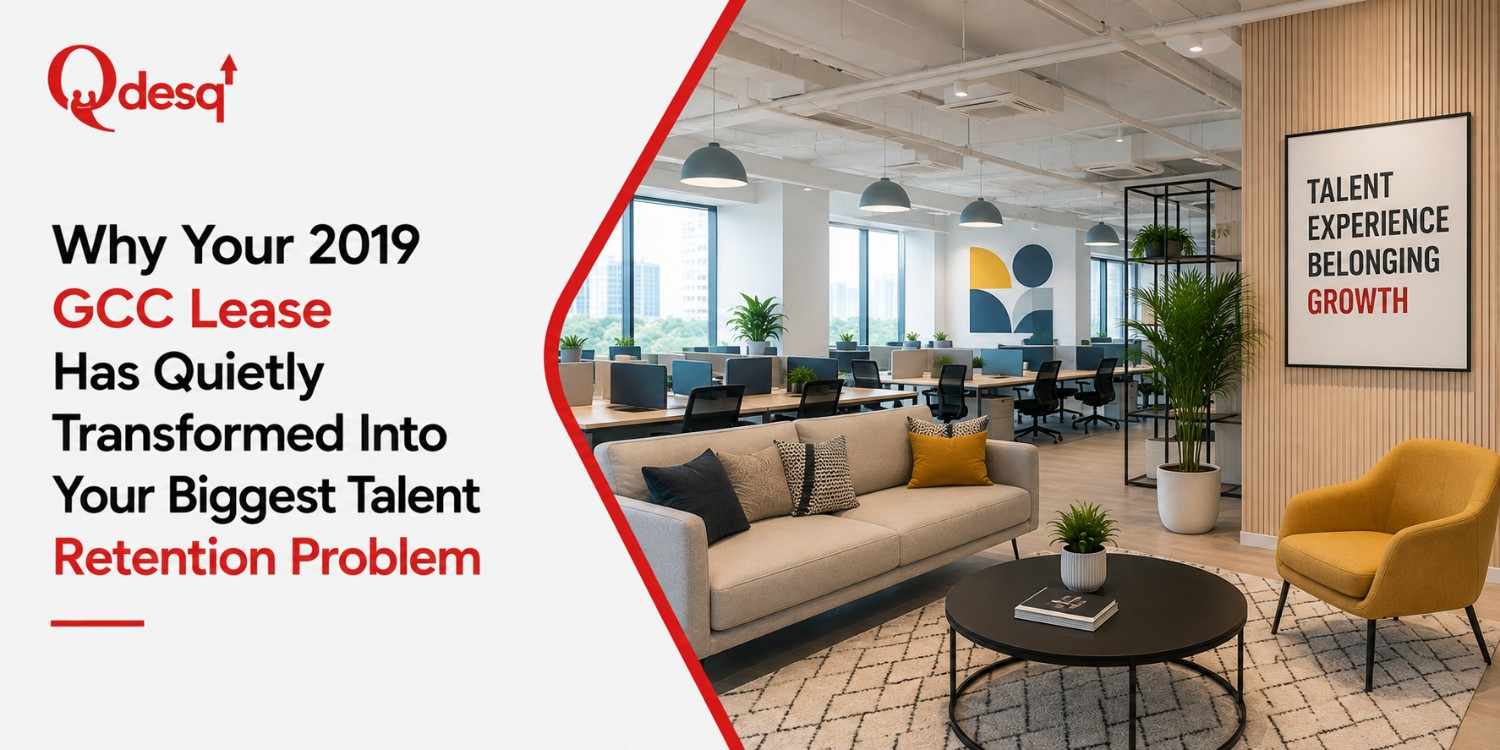
Your 9-year lease signed in 2019 is expiring. But the real expiry date was on your senior talent’s patience, two years ago.
Here’s the uncomfortable reality for hundreds of Global Capability Centres across India: the office space that seemed like a smart, cost-effective decision in 2019 has silently become the single most visible symbol of how far behind you’ve fallen. And your senior talent is noticeable.
The Structural Mismatch of Office Leases Signed in a Wholly Different Era
Between 2018 and 2020, GCCs signed long-term leases averaging 9 years. The rationale was straightforward: secure Grade A office space at favourable rates in established micro-markets. At the time, India’s GCC ecosystem was valued at approximately $64.6 billion, with over 1,700 centres employing nearly 1.9 million professionals . Growth was predictable, and office requirements were stable.
Today, the landscape has fundamentally reset. India now hosts over 2,000 GCC units, with more than 60% of Fortune 500 companies operating centres in the country . The mandate has shifted from back-office efficiency to strategic innovation, with R&D roles projected to rise from 15% in 2015 to 35% by 2030 . And the workforce? It’s becoming more senior, more specialised, and far more demanding.
The Workspace Data That Changes Everything for Global Enterprise Leaders
The numbers paint a stark picture:
- Workspace quality now matters to 89% of enterprises more than it did just two years ago .
- 82% of companies cite workspace quality as a meaningful factor in their AI talent-hiring pitch.
- Average space allocation per employee is expanding from 80–90 sq ft to 95–100 sq ft by 2028 .
- Corporate spending on office interiors has doubled, from approximately ₹2,500 per square foot to nearly ₹6,000 per square foot.
What does this mean for your 2019 office? It means you’re likely operating at 80–90 sq ft per employee, while top talent expects nearly 100 sq ft per employee. Your interiors, designed for a pre-pandemic, pre-AI world, are now competing against spaces that cost twice as much per square foot to fit out.
The Growing Micro Market Problem and Why Your Current Location Matters More Than Ever
The 2019 lease strategy often prioritised established commercial districts. But the talent map of India’s GCC ecosystem has shifted dramatically.
Senior talent—the 8–15 years’ experienced professionals that GCCs are desperately competing for-is making location decisions differently. According to NASSCOM data, mid-senior hiring has jumped by more than 30% year-on-year, with replacement cycles longer than ever. These professionals have options. Three competing offers, on average .
When an experienced engineer or data scientist evaluates opportunities, commute friction matters. Access to premium amenities matters. The quality of the micro-environment, not just the building, but the neighbourhood, matters. See: Your Attrition Number Is Lying to You: What India’s GCC Talent Crisis Is Actually About — and It Is Not Salary for more.
If your 2019 office is in a location that requires a 90-minute commute for talent living in emerging residential clusters, you’re losing candidates before they even see your collaboration spaces.
Embracing the New Hybrid 2.0 Reality to Meet Modern Employee Expectations
The office market has moved decisively toward what JLL calls “Hybrid 2.0″—intentional, data-driven environments designed for 50–60% daily occupancy . This isn’t the reactive hybrid of 2021. It’s a strategic reimagining of what an office should be.
Today’s GCC offices are evolving into experiential destinations with:
- Wellness zones and mother care facilities
- Nature-inspired designs with integrated greenery
- Sensory-controlled rooms for neurodiverse teams
- Acoustic solutions and quiet pods for deep focus Your 2019 office? It likely has fixed desks, limited collaboration zones, and none of these features. And your senior talent, the ones who could work anywhere, are noticing.
The Massive Flex Space Explosion and How It Redefines Portfolio Agility
India’s flexible workspace market has expanded from approximately 33 million sq ft in 2020 to 103 million sq ft in 2025 . The flex space industry is projected to surge to $9–10 billion by 2028, up from $3–4 billion today.
Why? Because GCCs are increasingly adopting flexible formats, flex leasing is growing 1.7x faster than other segments. Companies are compressing planning horizons, with 75% now planning for 3 years or less, compared to the pre-2020 dominance of 5–10-year leases.
Your 2019 lease locks you into a fixed footprint. Your competitors are scaling up and down with operational agility.
The AI Talent Factor
AI-specific workforce in India crossed 700,000 professionals in 2025, up 6x since 2019. AI job postings reached 290,000 in 2025 alone . The GCC AI workforce is projected to grow from approximately 181,000 to 730,000 by 2030 .
These aren’t entry-level workers. These are senior, specialised professionals who expect premium work environments. 82% of enterprises say workspace quality is a meaningful factor in their AI talent-hiring pitch. For more, see: Coworking & Managed Offices: The Big Corp Shift Explained.
What are you offering them? A 2019 office with dated interiors and insufficient collaboration space? Or a modern, flexible environment that signals investment in their success?
The Ownership Paradox
Here’s where the office problem intersects with a deeper retention crisis. GCCs are struggling with what experts call the “Ownership Paradox”: Indian engineers are entrusted with high-stakes execution, but strategic decision-making remains sequestered in headquarters .
Voluntary attrition overall sits at 9–12%, but in high-value AI and cloud roles it spikes to nearly 25%. Over 70% of GCCs now offer ESOPs or RSUs, yet retention remains challenging because compensation is merely a baseline, not a differentiator .
Your 2019 office compounds this problem. It signals that while you want senior talent to take ownership of complex global mandates, you haven’t invested in the environment that supports that ambition.
Solving the Costly Doers vs Builders Crisis Across Your Engineering Ranks
The most successful GCCs are shifting from hiring competent “Doers” who execute assigned tasks to “Builders” who create platforms, products, and intellectual property . Builders are motivated by mission, autonomy, and impact.
What Does A Builder See When They Walk Into Your 2019 Office?
- Rows of identical desks that prioritise efficiency over creativity
- Insufficient collaboration zones that signal individual execution over team innovation
- Dated technology infrastructure that makes global coordination harder, not easier
- A physical environment that says “we haven’t invested in this space for years”
Builders notice these signals. And they make decisions accordingly.
Understanding the Severe Financial Realities of Delaying Your Portfolio Transition
The cost of inertia is mounting:
- 93% of enterprises report higher collaboration intensity than a year ago, with meeting-room demand projected to increase 30–50% .
- Meeting these collaboration needs in a 2019 office requires expensive retrofitting.
- Rushing to relocate after your lease expires means accepting suboptimal terms.
The alternative? Strategic early exit negotiation, renegotiation with your current landlord, or a phased move to a managed office or flex space. These options require planning, not panic. Related reading: Top Amenities That Define Managed Office Success.
Navigating the Strategic Path Forward for Your Real Estate Portfolio
GCCs facing this 2019 lease trap should consider:
- Audit your current space against Hybrid 2.0 requirements. What’s missing? What would it cost to retrofit?
What’s the timeline?
- Map your senior talent locations against your current office micro-market. How many key employees face unreasonable commutes?
- Model the financials of early lease exit vs. waiting for expiry. Including attrition costs, losing one senior AI engineer can cost 2-3x their annual salary in replacement and productivity loss.
- Explore flex space allocation. 82% of enterprises plan to increase flex allocation over the next two years . Could you use flex space for specific teams or functions?
- Consider managed office solutions. Commit periods on the flex side have shifted to approximately 28 months of additional flexibility while maintaining quality.
The Bottom Line
Your 2019 GCC office isn’t just dated. It’s actively undermining your ability to retain the senior talent your innovation mandate requires. The data is clear: workspace quality matters more than ever, collaboration intensity is rising, and the workforce is becoming more senior and more demanding.
The companies that win the AI-era GCC talent war will be those that understand the office as a strategic asset, not a sunk cost. They’ll recognise that the space you provide signals your commitment to the work your people do.
Your 9-year lease may expire in 2027, 2028, or 2029. But the talent retention clock is ticking right now.
The question isn’t whether you’ll move. It’s about moving deliberately and strategically before your best people decide to move on.


