


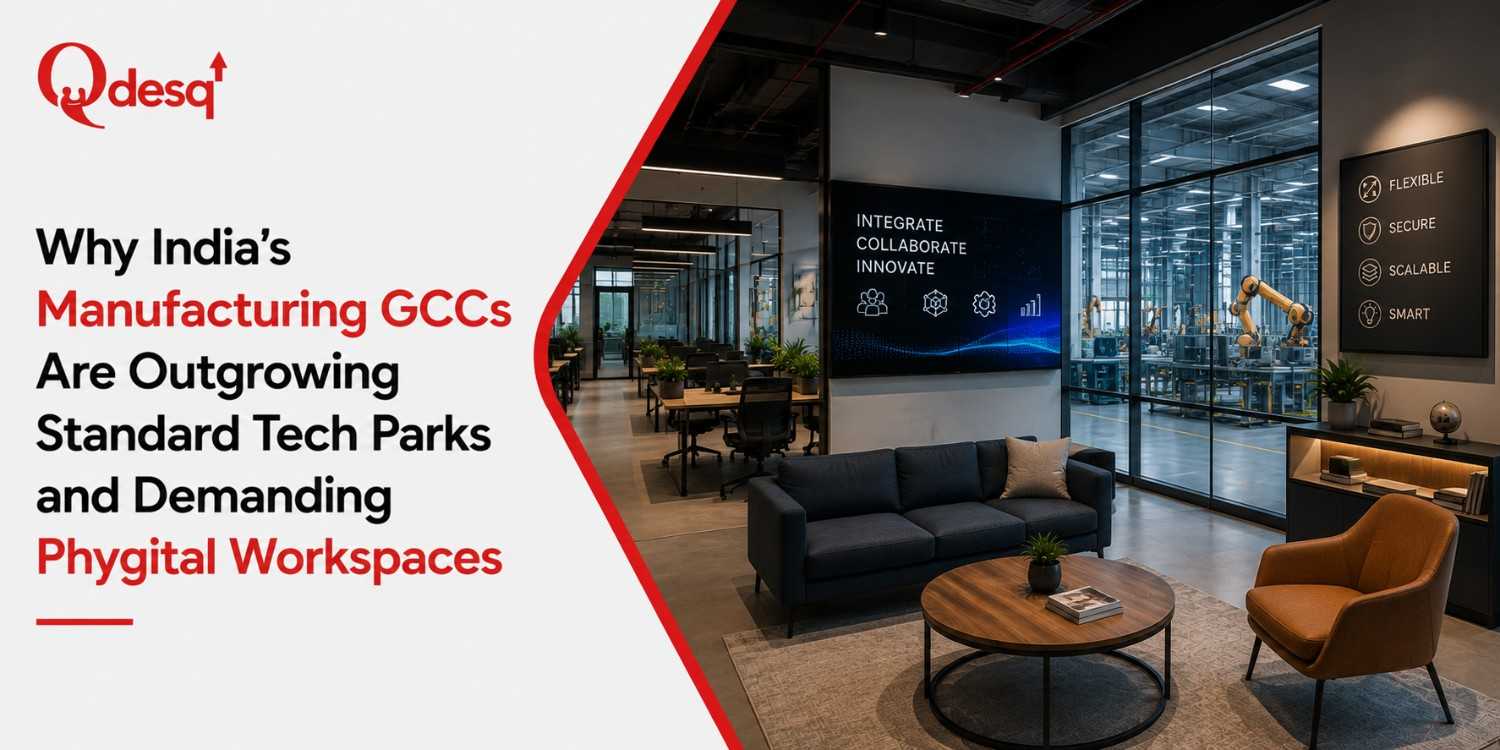
GCCs have transformed India’s office market, leasing a record ~31 million sq ft in 2025 and driving nearly 38% of total activity. While tech and BFSI GCCs thrive in standard Grade A campuses with flexible hybrid setups, manufacturing, engineering R&D (ER&D), auto-tech, and industrial design GCCs face a distinct challenge: their workspaces must support physical prototyping, testing labs, heavy equipment integration, and proximity to manufacturing corridors. Standard tech parks often fall short.
This underserved segment represents a high-potential opportunity for developers and real estate strategists. ER&D and manufacturing GCCs are growing rapidly, with the broader ER&D sector expanding 1.3x faster than the overall GCC ecosystem over the past few years. The manufacturing and industrial segments accounted for 15.4% of India’s total office leasing in 2025, while Chennai saw strong net absorption growth.
Why Manufacturing GCCs Need More Than a Desk and Wi-Fi
Tech GCCs prioritise collaboration spaces, high-speed connectivity, and amenities for software engineers. Manufacturing GCCs require hybrid environments blending office functions with industrial capabilities:
- Proximity to Prototyping and Test Facilities: Teams need on-site or nearby access to 3D printing, CNC machining, vibration testing rigs, environmental chambers, and cleanrooms for hardware validation.
- Integration with Manufacturing Corridors: Close access to supplier ecosystems, assembly lines, and logistics hubs accelerates design iterations and reduces time-to-market.
- Specialised Infrastructure: Higher floor loading capacities, reinforced flooring, dedicated power backups for heavy equipment, and zoning for lab-office hybrids.
- Talent and Ecosystem Fit: Locations near engineering colleges and industrial clusters for domain-specific hires in mechanical, automotive, and embedded systems engineering. Standard managed offices or IT parks in prime CBDs often lack these features, forcing compromises in efficiency or higher build-out costs. Many manufacturing GCCs opt for build-to-suit (BTS) developments or integrated industrial-office parks.
Key Insight: While tech GCCs can scale in generic high-rises, manufacturing GCCs need “phygital” workspaces where digital R&D meets physical validation—driving demand for purpose-built assets. See: Hub and Spoke Office Model India 2026: Strategy & Benefits for more.
Trend Signals Tracking the Growth of Engineering R&D Centres
India hosts over 2,000 GCCs, with manufacturing and engineering gaining share. GCC leasing hit record highs, with Engineering & Manufacturing absorbing significant volumes (e.g., ~5.6 msf in one reported period).
- Office Leasing Impact: Manufacturing/Industrial accounted for 15.4% of total 2025 office leasing activity. GCCs overall drove ~31-37% of demand.
- ER&D Momentum: This segment is growing faster, driven by automotive, aerospace, electronics, and semiconductors. Global firms leverage India’s engineering talent for product innovation, not just support.
- Chennai’s Surge: Net absorption grew notably (e.g., strong YoY figures), bolstered by its “Detroit of Asia” status for automotive and manufacturing.
Projections show GCCs continuing to drive 40-50% of office demand in the coming years, with ER&D and manufacturing playing larger roles amid supply chain diversification and PLI schemes.
Cities and Micro-Markets Where Manufacturing GCCs Are Solving (or Facing) the Workspace Puzzle
Pune:
- Strong in automotive and engineering. Micro-markets like Hinjewadi, Kharadi, and Chakan-Talegaon blend office and industrial access.
- Proximity to OEMs and auto clusters is a major draw, but talent saturation and traffic push demand toward peripheral corridors with better industrial integration.
- GCCs here favour BTS facilities near manufacturing belts.
Chennai:
- Manufacturing powerhouse with OMR (Old Mahabalipuram Road) and Oragadam clusters.
- Strong for auto-tech, embedded systems, and Japanese/Korean firms. Radial Road and Guindy areas offer residential proximity, reducing commutes.
- Chennai’s port and industrial ecosystem make it ideal, yet high-quality lab-integrated spaces remain limited. Net absorption has been robust.
Delhi NCR:
- Diversified, with Gurugram and Noida Expressway seeing corporate and engineering mixes.
- Proximity to policy hubs aids compliance-heavy manufacturing. Golf Course Extension Road and peripheral areas attract hybrid setups, but infrastructure strain (traffic, power) challenges heavy equipment needs.
- Engineering & Manufacturing holds notable shares.
Other Notes:
- Bengaluru and Hyderabad dominate overall GCCs but face higher costs and competition. Special Tier-2 cities (e.g., Coimbatore, Ahmedabad) emerge as cost-sensitive manufacturing hubs, offering lower attrition rates (10-14%) and available land for industrial hybrids.
Micro-Market Shift: GCCs increasingly target residential-heavy corridors (e.g., Pune‘s Kharadi, Chennai’s OMR) to shorten commutes and retain talent—critical for engineers who may need to visit nearby plants.
The Workspace Problem in Practice and Its Structural Pain Points
- Mismatch with Standard Supply: Most Grade A stock targets tech (light footprint, high density).
Manufacturing needs higher ceilings, load-bearing floors, and lab zoning—often requiring costly retrofits.
- Proximity vs. Amenity Trade-offs: Ideal locations near industrial corridors may lack premium amenities or housing for talent, leading to higher attrition.
- Regulatory and Build-Out Hurdles: Zoning laws, environmental clearances, and power/water reliability complicate hybrid facilities. State policies (e.g., incentives in Haryana, Tamil Nadu) help but vary.
- Talent and Infrastructure Strain: Competition for ER&D skills drives up costs in Tier-1 cities. Commutes of 45–60 minutes hurt productivity for lab-based roles.
- Scalability for Prototyping: Virtual simulations help, but physical validation demands dedicated zones— rare in pure office towers.
Real-World Example: Auto and industrial GCCs often co-locate R&D offices with nearby test tracks or supplier parks, unlike pure software teams. For more, see: Managed Office Space Guide 2026: Enterprise & GCC Strategy.
Solutions and Structural Opportunities for Developers and Occupiers
- Hybrid Industrial-Office Parks: Integrated campuses with office towers, prototyping labs, and light manufacturing zones.
- Build-to-Suit and Flex Models: Customised for specific equipment needs; flex operators expanding into specialised spaces.
- Tier-2 Expansion: Lower costs, available land, and policy support (e.g., incentives for R&D centres).
- Sustainability and Tech Integration: Green-certified facilities with high-power infrastructure for AI-driven simulations alongside physical labs.
- Ecosystem Partnerships: Collaborate with academic institutions for talent pipelines and shared prototyping facilities.
For Heads of Real Estate at German, US, or Japanese firms: Prioritise micro-market due diligence focusing on industrial adjacency, infrastructure resilience, and total cost of ownership (including talent commute and retention). Early engagement with developers for BTS can mitigate risks.
Final Words
Manufacturing GCCs are evolving from cost centres to innovation engines driving global product development. Their unique workspace needs—proximity to real-world testing and manufacturing—create both challenges and differentiation from tech peers. As ER&D accelerates and India deepens its manufacturing push, purpose-built real estate will become a key competitive advantage.
Developers who innovate with hybrid, ecosystem-aligned spaces stand to capture significant demand. For global firms, strategic site selection beyond generic tech parks will determine success in leveraging India’s engineering depth. Related reading: Top Amenities That Define Managed Office Success.
This segment’s growth trajectory points to sustained demand for specialised real estate through 2030 and beyond. The workspace problem is real—but so is the opportunity for those who engineer solutions around it.


