


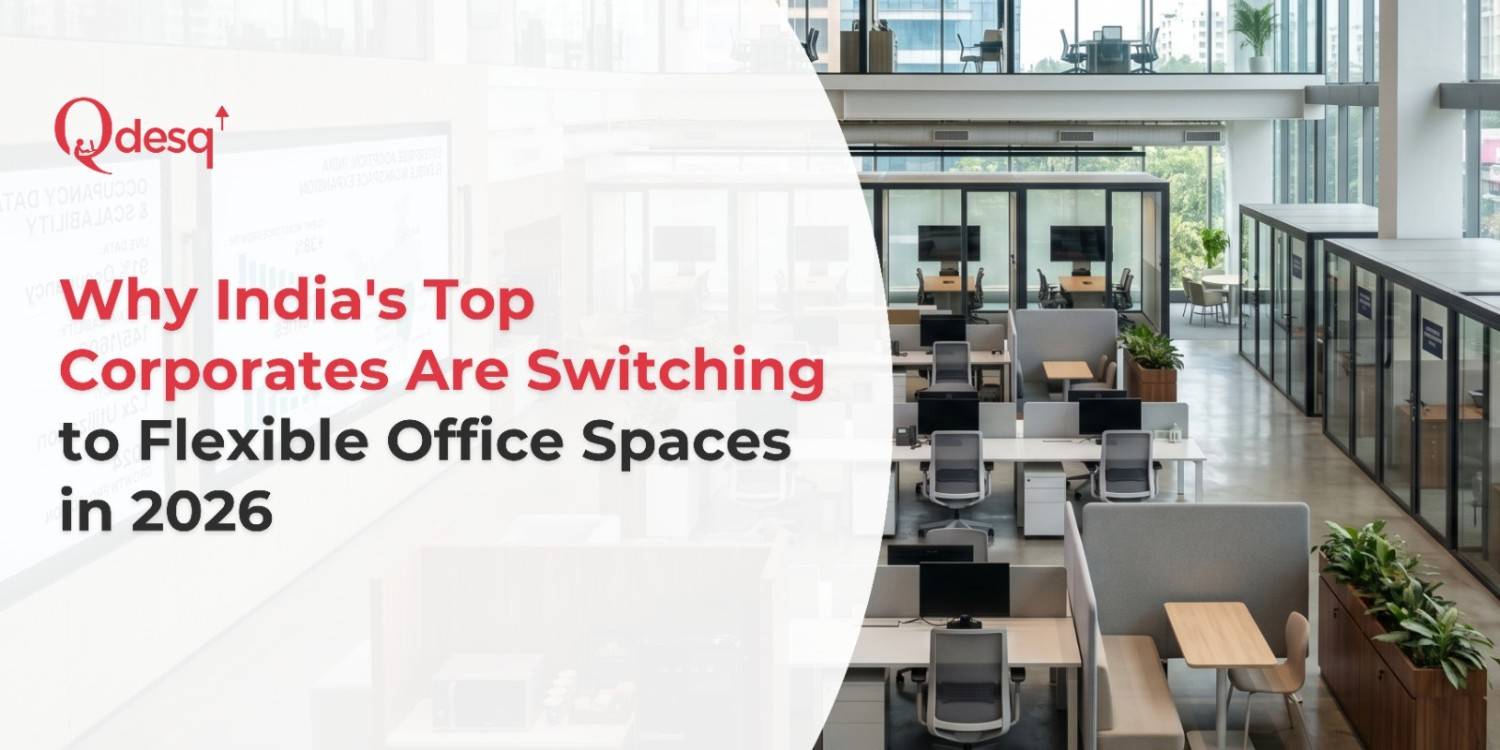
It is 2026, and the Indian corporate world is undergoing a transformation that few saw coming just five years ago. If you walk into a premium office building in Bengaluru’s Outer Ring Road or Gurgaon’s Cyber City today, you’ll notice something different.
The massive, multi-floor “owned” headquarters are shrinking, replaced by agile, high-design managed spaces. From Tata and Reliance to Global Capability Centres (GCCs), India’s top employers are moving away from traditional 9-year leases. But why is this happening with such intensity right now?
It is a fundamental rethink of what an “office” is supposed to do in a post-AI, talent-first economy. Let’s dive into the real reasons why India Inc. is going “flex.”
The Death of the 10-Year Prediction
In the past, a corporate real estate head had to guess how many employees the company would have in 2031. If they guessed wrong, the company was stuck with empty space or a cramped office that stifled growth.
In 2026, volatility is the only constant. Whether it’s a sudden pivot toward a new AI division or a shift in market demand, top corporates have realised that agility is a competitive advantage. Flexible spaces allow a firm to scale from 100 to 500 desks in weeks, not months. You are no longer paying for “just-in-case” space; you are paying for “just-in-time” space.
The “Reverse Brain Drain” and Tier-2 Expansion
One of the most fascinating trends of 2026 is the migration of talent back to their hometowns. Professionals who once flocked to Mumbai or Bengaluru are now preferring to stay in cities like Jaipur, Indore, Kochi, and Chandigarh.
To keep this top-tier talent, corporations are setting up “Satellite Offices.” Instead of building a massive branch in Lucknow, a company can simply take 50 desks in a premium managed office.
- For the Company: It’s a low-risk way to test a new talent hub.
- For the Employee: They get a Grade-A office environment without the 2-hour metro commute in a Tier-1 city.
Key Stat: Flexible workspace stock in India is projected to cross 100 million square feet by the end of 2026, with a significant chunk of that growth coming from non-metro cities.
ESG is No Longer “Optional”
By 2026, ESG (Environmental, Social, and Governance) reporting will be a hard requirement for Indian boards and global investors. Building a “Green Office” from scratch, complete with LEED certification, smart HVAC, and waste management, is an expensive, multi-year project.
Flexible office operators have spotted this gap. Most “Grade A” flex spaces are already housed in certified green buildings. By moving into these spaces, a corporate giant can instantly tick their “Sustainability” boxes. They benefit from solar power, rainwater harvesting, and energy-efficient lighting without having to manage the infrastructure themselves.
The Rise of “Managed” over “Shared” Office Spaces
There is a common myth that flexible space means sitting at a hot desk next to a stranger. In 2026, the trend has shifted heavily toward Managed Offices.
Think of this as “Office-as-a-Service.” A corporate client gets a private, secure floor that is fully branded with their logo and culture. However, the operator handles everything behind the scenes:
- High-end security and data privacy.
- Customised IT infrastructure.
- Housekeeping, cafeteria management, and front-desk services.
This allows leadership to focus entirely on their core business rather than arguing with a vendor about why the office AC isn’t working on a Monday morning.
CapEx vs. OpEx
Let’s talk about the money. Traditionally, setting up an office required a massive upfront CapEx. You had to pay for interior designers, wiring, furniture, and technology before a single employee even sat down.
In 2026, CFOs opt for asset-light models. Flexible spaces turn high upfront costs into predictable, monthly OpEx, helping companies stay lean and market-agile.
- Predictable monthly bills.
- Tax efficiencies on lease payments.
By shifting these funds away from real estate and toward R&D or talent acquisition, companies are staying leaner and more aggressive in the market.
The “Resimercial” Vibe: Solving the Return-to-Office Puzzle
The struggle to get people back to the office is real. If an office feels like a grey, sterile box, people will choose their living room every time.
Top corporates are using flexible spaces to offer a “Resimercial” (Residential + Commercial) experience. These spaces aren’t just offices; they are hubs for well-being.
- Biophilic Design: Lush greenery and natural light are now standard.
- Collaborative Zones: Spaces designed for brainstorming, not just typing.
- Wellness Centres: Gyms, meditation rooms, and even nap pods are common in 2026 flex hubs.
When the office offers a better experience than the home, including high-speed fibre and premium coffee, the “Return to Office” mandate becomes unnecessary. People want to be there.
Data Sovereignty and GCCs
While everyone talks about “flexibility,” few mention the Global Capability Centres (GCCs). In 2026, India is the global “Office for the World.” These GCCs handle sensitive data for parent companies in the US and Europe.
In the past, these firms avoided flexible spaces due to security concerns. However, modern flex operators have evolved. They now offer “Sovereign Zones” within their buildings: dedicated server rooms, private elevators, and air-gapped networks. This high-level technical integration is the “secret sauce” that is finally allowing the most conservative global banks and tech firms to move into flex spaces.
Final Thoughts
The shift toward flexible office spaces is a proactive strategy for the most successful players in India. In 2026, the traditional lease feels like an anchor, while flexible workspaces feel like a sail. By prioritising agility, employee well-being, and capital efficiency, India’s top corporates are ensuring they remain resilient in an unpredictable global economy.
At Qdesq, we understand that finding the right space is about more than just square footage; it’s about finding a strategic partner for your growth. We help you navigate India’s premier flexible office spaces, ensuring your workspace aligns with your financial goals and cultural vision. Whether you are scaling a GCC or expanding into Tier-2 markets, Qdesq provides the transparency and expertise to move your business forward today.
Connect with Qdesq to find workspaces that support innovation and agility, so your business can thrive—today and in the future.



