


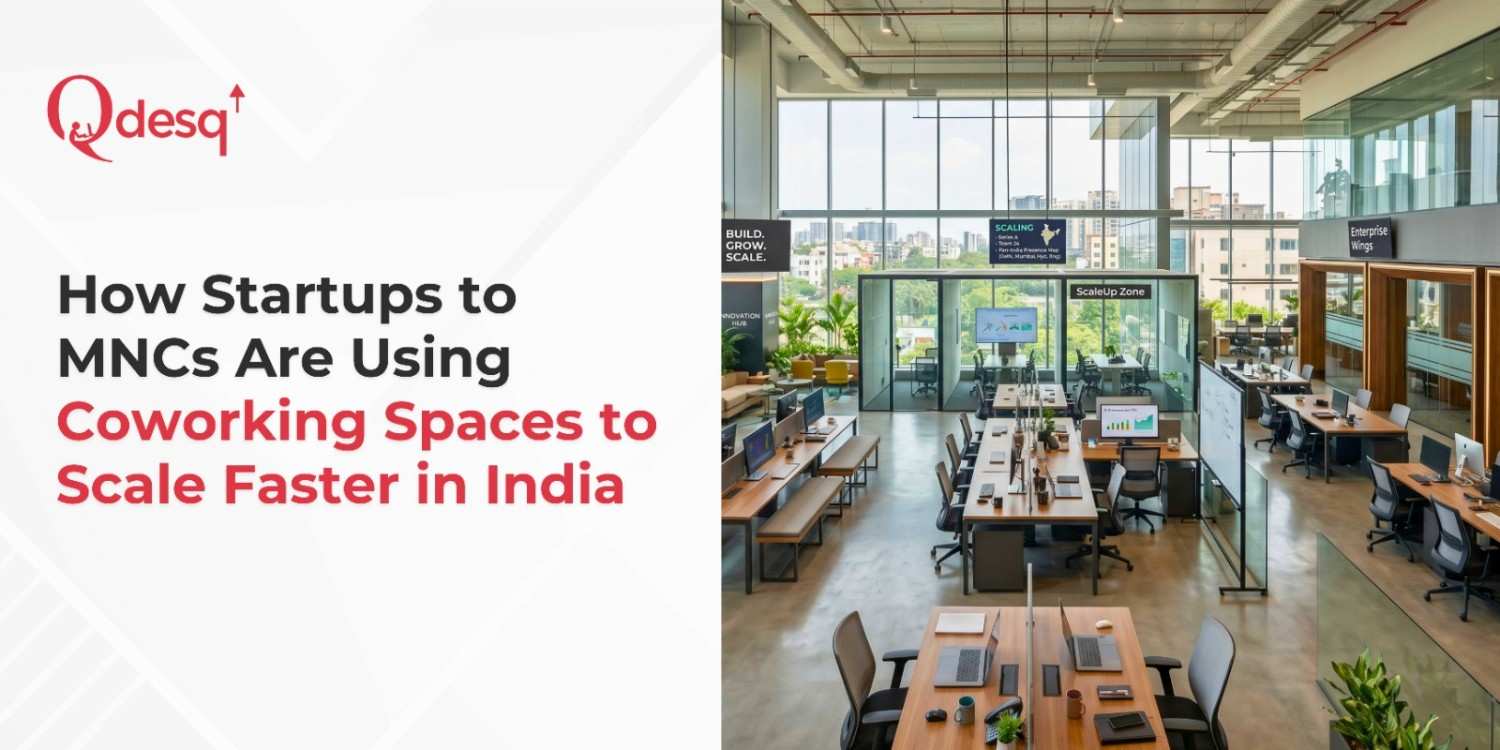
If you visit any coworking space today, you will see something that would have seemed impossible a decade ago: a 3-person fintech startup sharing a floor with a GCC of a Fortune 500 company. One is figuring out its MVP, the other is running a 200-person AI team for its US headquarters. Both chose the same coworking space, and both are scaling faster as a result.
This is a structural shift in how Indian businesses, from day-one startups to multinational giants, think about workspace strategy. From startups trying to survive to MNCs trying to optimise billions in real estate, coworking has become a serious scaling lever. Let’s break down exactly how and why.
Why Startups are Abandoning Traditional Leases
If you’ve ever run a startup, you know that capital is oxygen. Every rupee spent on a heavy security deposit for a traditional office is a rupee taken away from product R&D or hiring that star developer.
- Zero Capex, Maximum Agility: Startups in India are pivoting to coworking because it transforms a massive upfront capital expenditure (Capex) into a manageable monthly operational expense (Opex).
- The “Unicorn” Launchpad: Did you know that Indian giants like Zomato and Ola initially operated out of shared spaces? These environments allow a team of 5 to grow into a team of 50 in a single weekend, without the nightmare of relocation.
- Built-in Mentorship: You aren’t just renting a desk; you are buying into an ecosystem. Rubbing shoulders with investors, legal experts, and fellow founders over a cup of artisanal coffee is the kind of “organic networking” that traditional offices simply cannot replicate.
How SMEs and Growing Companies Unlock Efficiency
For Small and Medium Enterprises (SMEs), the challenge is often professionalising their image without the “corporate” price tag.
| Factor | Traditional Office | Coworking Space |
| Lease Term | 3 to 5 years | Monthly to annual |
| Setup Time | 3 to 6 months | Immediate |
| Upfront Cost | High deposit + buildout | Low or zero |
| Scalability | Fixed headcount | Expand or shrink as needed |
The MNC Pivot: Why Global Giants are Going “Flex”
The most surprising shift in the 2025–2026 market is the massive adoption by MNCs. We are talking about companies that could easily afford their own buildings. So, why the shift?
- Talent is Everywhere: High-quality talent no longer wants to migrate to Bengaluru or Mumbai. MNCs are using coworking spaces to set up “Satellite Offices” or Global Capability Centres (GCCs) in Tier-2 cities like Kochi, Indore, and Lucknow.
- The “Hub-and-Spoke” Model: Large firms maintain a central “Hub” in a metro city and multiple “Spokes” (coworking desks) near where their employees actually live. This reduces commute stress and skyrockets retention.
- Risk Mitigation: In an unpredictable global economy, MNCs prefer 12-month flexible agreements over 9-year lock-ins. If a project ends or a team reshuffles, they can instantly scale down their seat count.
Technology and Amenities Driving Growth
Today’s coworking spaces in India are not the bare-bones shared desks of 2015. They are genuinely sophisticated work environments, and that is a significant part of why enterprises are willing to move critical operations into them.
What a premium coworking space in India typically offers today:
- Smart infrastructure: IoT-enabled access control, AI-driven desk and room booking systems, real-time occupancy monitoring
- Connectivity: Redundant high-speed internet with enterprise-grade security
- Wellness: Yoga zones, air quality sensors, ergonomic furniture, quiet pods, and meditation spaces
- Sustainability: LEED-certified green buildings, energy-efficient HVAC, and reducing carbon footprint by up to 15%
- Community: Networking events, mentor access, investor connections, and cross-industry collaboration
The Role of Coworking Spaces in Rapid Scaling
One thing no one talks about enough is how coworking changes the speed of decision-making inside a company.
When your workspace can be set up in days rather than months, your go-to-market timelines compress. When you are not tied to a single location, you can hire from anywhere and still give employees a professional workspace close to home. When your lease commitment is measured in months rather than years, your board does not require a separate real estate sub-committee to approve an office expansion.This operational agility compounds over time. This is why companies adopting the flex model consistently report faster hiring cycles, lower attrition among employees who value location flexibility, and better utilisation of their real estate spend.
Future of Coworking Spaces in India: The 2026-2028 Outlook
The trajectory of the Indian coworking industry is moving from “explosive growth” to “institutional maturity.” Here is what the data tells us about the next three years:
- Massive Inventory Expansion: India’s flexible office stock is projected to surpass 125 million square feet by 2027, a significant jump from the 80 million square feet recorded in late 2024.
- Dominance of Global Capability Centres (GCCs): GCCs are expected to drive nearly half of India’s enterprise flexible‑workspace demand by 2027, with many centres integrating flex into their core portfolios to enable rapid, asset‑light scaling.
- Shift to Tier-2 Growth: Demand in non‑metro cities like Jaipur and Indore is rising fast, with hiring and business activity growing strongly year‑on‑year and operational costs 20-40% lower than in metros.
- Corporate Integration: By 2027, approximately 65% of all Indian firms, from tech giants to traditional BFSI, plan to make flexible offices a permanent, structural pillar of their real estate strategy.
Conclusion
Choosing a coworking space means you are finally prioritising your business strategy over a physical address. In a market as fast-moving as India, you need a workspace that expands and contracts as quickly as your goals do. Whether you are a startup founder stretching every rupee or an MNC leader building a satellite hub in a Tier-2 city, the real win is flexibility. You are swapping a rigid 10-year lease for a biophilic, tech-ready environment that fuels productivity rather than draining your time on office management.
When your office aligns with your business plan’s ambition, growth becomes frictionless. Qdesq bridges the gap between your current needs and your future expansion by offering a curated selection of verified workspaces with 100% pricing transparency. You focus on the vision; let us handle the operational logistics. Connect with Qdesq to align your office footprint with your actual growth trajectory.



