


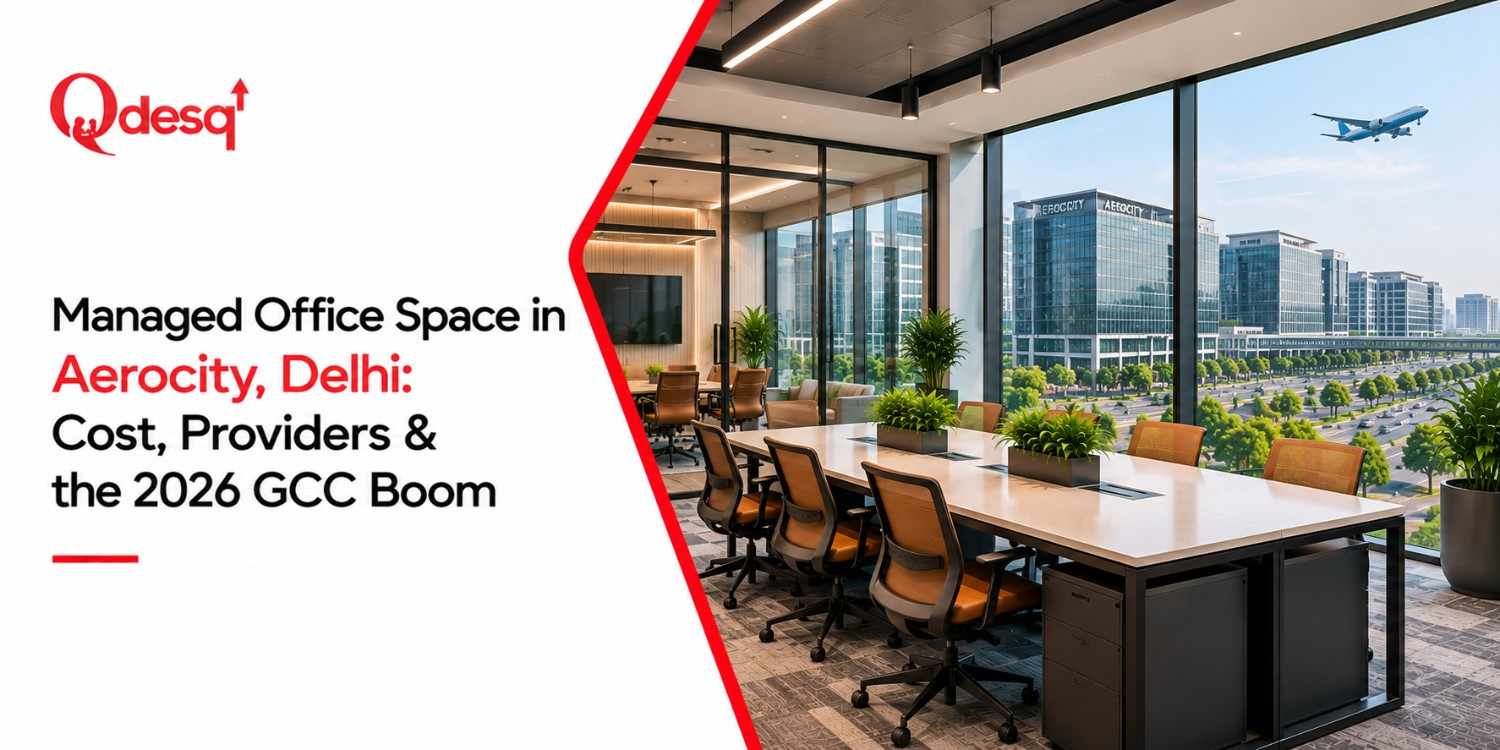
Managed office space in Aerocity is almost entirely quote-based, typically landing between ₹15,000 and ₹30,000-plus per seat monthly depending on building and finish — and 2026 has been the corridor’s breakout year for large-scale GCC commitments. The Executive Centre alone signed roughly 5,000 seats across three Worldmark buildings by April, and Smartworks added 1.41 lakh sq ft at Worldmark 4 in August, both signs of just how fast enterprise demand here is accelerating.
Consider this the full briefing rather than a single data point. Ahead: what a managed office costs in Aerocity, the checklist worth running before you commit, six providers driving 2026’s leasing activity, how the corridor compares to Cyber City for a GCC decision, why this has become Aerocity’s breakout year, who genuinely benefits from this address, and the mistakes worth avoiding given how fast this specific market is moving.
What a Managed Office Costs in Aerocity
Aerocity’s managed-office pricing is almost uniformly quote-based rather than published as a fixed rate card, reflecting how much of the market here is built around large, custom-negotiated enterprise deals rather than walk-in small-team bookings.
| Tier | Typical monthly cost per seat | What’s included |
|---|---|---|
| Standard managed floor | ₹15,000 – ₹22,000 | Furniture, internet, housekeeping, meeting rooms |
| Premium Grade-A / IGBC floor | ₹22,000 – ₹30,000+ | Branded fit-out, staffed reception, dedicated IT, 24/7 access |
| Large-format enterprise deal (1,000+ seats) | Custom quote | The Executive Centre’s 5,000-seat, 3-building commitment |
Add 18% GST to every rate above. Regus’s Caddie Commercial Tower managed suites are quoted from roughly ₹37,090 a month up to ₹6.89 lakh a month for larger configurations, per commercial-listing data — a useful indicator of just how wide Aerocity’s managed-office range runs once you move beyond a standard per-seat quote. Unlike Gurgaon’s more price-transparent corridors, almost every serious Aerocity enquiry above 20 seats ends up as a custom-negotiated quote rather than a rate-card booking.
What to Check Before You Commit in Aerocity
With most pricing here negotiated rather than published, a few extra checks matter more in Aerocity than in a more standardised corridor:
- Treat every quote as a negotiation starting point: with almost no fixed rate cards above 20 seats, get at least two provider quotes before benchmarking your budget against either.
- Confirm building-specific availability early: Worldmark 4 in particular has absorbed major footprints from both Smartworks and The Executive Centre in 2026 — don’t assume floor space is open by default.
- The escalation clause at renewal: get this in writing before signing, especially on a multi-year, large-seat-count commitment where the absolute rupee impact compounds quickly.
- GST and what’s genuinely bundled: 18% GST applies on top of every rate here, and inclusions like dedicated IT support and 24/7 access vary meaningfully between a Regus suite and a custom Smartworks or TEC floor.
- Timeline expectations for large-format deals: a 500-plus seat requirement should expect a competitive, multi-provider process rather than a single quick quote — build that into your planning timeline.
Managed & Private Office Providers in Aerocity
Six providers are actively driving Aerocity’s managed-office market, several through major 2026 expansions rather than steady-state operations.
- Smartworks – Worldmark 4
- The Executive Centre – Worldmark 4, 6 & 8
- Table Space – Worldmark 4
- WeWork – Worldmark 6
- COWRKS – Worldmark 1, Tower A
- Regus (IWG) – Caddie Commercial Tower
Smartworks – Worldmark 4
An IGBC Platinum pre-certified floor that added 1.41 lakh sq ft in a single expansion reported 5 August 2026 by Business Standard, with conference rooms, a game zone and a medical room among its facilities. Quote-based, and currently one of the most active managed-office expansions anywhere in this series.
The Executive Centre – Worldmark 4, 6 & 8
Signed roughly 480,000 sq ft and 5,000-plus seats across three Worldmark buildings by 9 April 2026, per The Flex Insights — the single largest managed-office commitment tracked anywhere in this Delhi-NCR series, and a clear signal of GCC leadership functions specifically choosing Aerocity.
Table Space – Worldmark 4
Custom-built, move-in-ready managed floors quoted around ₹49,999 a seat, positioned for tenants wanting a fully finished space without Smartworks or TEC’s larger-scale, multi-building footprint.
WeWork – Worldmark 6
Managed floors and private offices from ₹41,000 a desk, targeting consulting, banking, infrastructure and energy-sector tenants specifically alongside its open coworking desks in the same building.
COWRKS – Worldmark 1, Tower A
Private studios and managed floors scaling to 1,000-plus seats, quote-based, inside the same large-format building that anchors COWRKS’s more affordable open-desk coworking offering.
Regus (IWG) – Caddie Commercial Tower
Managed furnished suites quoted from roughly ₹37,090 a month to ₹6.89 lakh a month depending on configuration, per commercial-listing data — the corridor’s most transparently tiered managed-office pricing.
Aerocity vs Cyber City for a Managed Office
Both corridors are explicitly GCC and enterprise-driven, but Aerocity’s advantage is airport proximity and newer IGBC-rated stock, while Cyber City offers a longer-established Fortune 500 ecosystem and generally lower per-seat pricing.
| Locality | Per-seat range (monthly) | Positioning |
|---|---|---|
| Aerocity | ₹15,000 – ₹30,000+ | Airport-adjacent GCC and enterprise HQ, newest Grade-A stock |
| Cyber City, Gurgaon | ₹12,000 – ₹28,000+ | Established Fortune 500 density, GCC concentration |
Our managed office in Cyber City guide covers Gurgaon’s equivalent GCC hub in full, and Delhi-NCR: India’s Fastest Growing GCC Hub in 2026 gives the region-wide context behind both corridors’ 2026 leasing surge.
Why 2026 Is Aerocity’s Breakout Year for GCCs
The scale of 2026’s confirmed deals speaks for itself: The Executive Centre’s 5,000-seat, three-building commitment and Smartworks’ 1.41 lakh sq ft Worldmark 4 expansion happened within four months of each other, both reported by credible business press. The Flex Insights specifically frames this as enterprises favouring “design-led, enterprise-grade” flex space over older Grade-A stock — exactly the positioning Aerocity’s newer, IGBC-rated Worldmark towers were built around from the outset, unlike Cyber City’s more varied building-age mix.
Delhi-NCR’s broader Q1 2026 numbers back this up at the market level: gross office leasing hit 21.5 million sq ft in the quarter, up 10.2% year-on-year, with GCCs alone accounting for 45.5% of that leasing and flex operators another 25.9%, against a five-year-low vacancy rate of 14.7% (JLL data reported via CNBC-TV18, Q1 2026). Aerocity’s 2026 deals are a visible, concentrated expression of that region-wide trend rather than an isolated local story.
Who Should Actually Choose Aerocity for a Managed Office
A GCC or regional headquarters function that specifically values airport access for frequent international travel, alongside Aerocity’s hotel-and-hospitality cluster for visiting leadership and client delegations, gets real strategic value here that Cyber City’s more purely commercial character doesn’t replicate. A back-office or delivery-focused GCC function without that specific travel-intensity need is often better served by Cyber City’s generally lower per-seat pricing and more established, if less newly built, ecosystem.
A GCC evaluating Aerocity against Cyber City for a large-scale 2026 commitment should treat both corridors as genuinely comparable in overall quality, with the real decision resting on how much airport proximity and hotel-cluster access matter for that specific business’s travel patterns and client-hosting needs, rather than on any meaningful gap in building standard or operator sophistication between the two. You can explore current managed-office options for GCCs and enterprises to see how both corridors’ live inventory compares before deciding.
Mistakes to Avoid When Choosing a Managed Office in Aerocity
The most common mistake is accepting a single quote as representative — with almost no published rate cards above 20 seats, one number tells you very little about whether you’re getting a competitive deal. The second is assuming Worldmark 4 has open capacity by default; Smartworks and The Executive Centre have both absorbed substantial footprints there in 2026, and confirming availability early avoids a wasted planning cycle.
The third is choosing Aerocity purely on prestige without weighing whether your team’s travel patterns actually justify the premium over Cyber City’s generally lower pricing — the comparison in this guide exists precisely so that decision is made on real trade-offs rather than assumption. And the fourth is underestimating how long a large-format negotiation takes here; budgeting for a single quick quote on a 500-plus seat requirement is unrealistic given how competitive and multi-round this specific process has become in 2026.
How Setup Works in Aerocity
- Requirement brief: seat count and building preference get documented — given 2026’s leasing pace, larger seat counts (500-plus) should expect a competitive, multi-provider bidding process rather than a single quick quote.
- Shortlist and site visits: compare Smartworks and The Executive Centre’s Worldmark 4 addresses directly against COWRKS and WeWork’s Worldmark 1 and 6 alternatives.
- Commercial terms: given how much of 2026’s activity is large-format enterprise deals, expect a longer, more formal negotiation process than at a smaller corridor, often involving multiple rounds of building tours and reference checks.
- Build and move-in: eight to twelve weeks is typical for a custom-fitted floor at this scale; Table Space’s move-in-ready format can compress this materially for tenants prioritising speed over full customisation.
Given the size of the commitments closing at Worldmark 4 specifically — both Smartworks and The Executive Centre now operate substantial footprints in that one building — confirming your preferred floor and configuration early in the process matters more here than in a less contested corridor, since prime space is being absorbed quickly by competing enterprise tenants.
For a team weighing Aerocity against Cyber City on setup timeline specifically, expect the two corridors to move at a broadly similar pace for a comparable seat count — the meaningful difference is availability pressure at Aerocity’s most in-demand buildings right now, not any structural gap in how quickly either corridor can typically turn a signed mandate into a fully working office.
Frequently Asked Questions
How much does a managed office cost in Aerocity?
Standard managed floors run ₹15,000-22,000 per seat monthly, and premium IGBC-rated floors ₹22,000-30,000 or more, plus 18% GST. Large enterprise commitments negotiate a custom quote.
Which managed office providers operate in Aerocity?
Smartworks, The Executive Centre, Table Space, WeWork, COWRKS and Regus are the confirmed providers, with Smartworks and The Executive Centre both completing major expansions in 2026.
Why are GCCs choosing Aerocity in 2026?
Newer IGBC-rated Grade-A stock, direct airport access for international leadership travel, and a hotel-and-hospitality cluster for client delegations have driven The Executive Centre’s 5,000-seat and Smartworks’ 1.41 lakh sq ft expansions this year alone.
How does Aerocity compare to Cyber City for a managed office?
Aerocity runs ₹15,000-30,000-plus per seat versus Cyber City’s ₹12,000-28,000-plus — Cyber City is generally more affordable with a more established ecosystem, while Aerocity offers newer buildings and airport proximity.
Is Aerocity good for a large GCC commitment?
Yes, very strongly — The Executive Centre’s 5,000-seat, three-building deal is the largest tracked in this Delhi-NCR series, confirming Aerocity’s capacity for major enterprise-scale managed-office commitments.
Is Aerocity managed-office space getting harder to find?
At Worldmark 4 specifically, yes — Smartworks and The Executive Centre have both absorbed substantial footprints there in 2026, so confirming floor availability early in your search is more important here than in less contested corridors.
Should I choose Aerocity or Cyber City for a managed office?
Both offer genuinely comparable building standard and operator sophistication — the decision should rest mainly on how much your specific business values airport proximity and hotel-cluster access over Cyber City’s generally lower, more accessible per-seat pricing structure.
What’s the difference between a managed floor and a private office in Aerocity?
A managed floor is a full custom-built space for a larger team, typically 50-plus seats, with dedicated branding and facilities like Smartworks or The Executive Centre offer; a private office is a smaller, self-contained suite for a compact team, closer to what Regus’s Caddie Commercial Tower suites provide.
What’s the typical lock-in period for a managed office in Aerocity?
Multi-year commitments are standard for large-format deals, though exact terms are negotiated per contract given how quote-based this market is — get the escalation clause and exit terms in writing before signing, regardless of seat count.
What team size does Aerocity’s managed-office market suit best?
The market here skews toward large-format GCC and enterprise commitments — 50 seats and up gets meaningfully better negotiating leverage and provider attention than a small team, which may find Cyber City or a coworking format more cost-efficient instead.
Aerocity is where Delhi-NCR’s biggest 2026 GCC commitments are landing. Explore managed office solutions for GCCs and enterprises, or share your requirement and Qdesq will match you to the right building and scale.


